
14 min read
Korean skincare for anti aging comes down to 4 habits: daily sunscreen, layered hydration, gentle exfoliation and actives added slowly. Koreans usually start in their 20s and treat it as prevention, so the routine is designed for years of steady use. Below you’ll find the ingredients worth knowing, a simple morning and night routine for your 30s, 40s and 50s, and the signs that a dermatologist will help more than another serum.
Key takeaways
- Sunscreen every morning, all year, is the foundation. On Korean shelves, SPF 50+ with PA++++ is the everyday standard, not a premium extra.
- Start retinol or retinal on 2 nights a week and build up over several weeks. Never introduce two new actives at the same time.
- Niacinamide, ceramides, centella and snail mucin make up the gentle daily layer. Retinoids and exfoliating acids are the steps that need patience.
- PDRN made its name in Korea as an injectable clinic treatment. Evidence for PDRN creams is much thinner, so treat them as a hydrating extra.
How Korean skincare for anti aging works: prevention first
Koreans rarely wait for the first wrinkle. The phrase you’ll hear in Seoul is 저속노화 (jeosok nohwa, “slow aging”), and it covers food, sleep and skin. For skin, it means protecting early, keeping skin hydrated and avoiding anything that leaves it red and stripped. Years of UV exposure drive much of the visible aging on the face, from fine lines to uneven tone, so the routine is built to stop that damage before it adds up.
As a result, a 25-year-old and a 55-year-old in Seoul often use surprisingly similar basics. With age, the cream gets richer and a few more actives are layered on top.
The 4 pillars Koreans actually follow
- Sunscreen every morning, including winter and days spent indoors near windows.
- Hydration in thin layers: a watery toner, then a serum, then a cream. Skin stays plump without one heavy, greasy product.
- Gentle exfoliation with mild acids or toner pads once or twice a week. Gritty face scrubs have largely fallen out of use.
- One new active at a time, especially retinoids, and only after the skin barrier is in good shape.
What do toner, essence and ampoule mean?
Korean labels have their own vocabulary. Toner (often called 스킨, “skin”, in Korea) is the watery first layer after cleansing. Essence is a bit thicker and focuses on hydration. An ampoule (앰플) is a concentrated serum, usually sold in a small dropper bottle.
You don’t need all three. On a weekday, most Seoul office workers use three to five steps. The famous “10-step routine” always worked better as marketing than as an everyday habit.
Why daily sunscreen is the first anti-aging step in Korea
If you change only one thing, change this. UVA rays pass through clouds and window glass and are closely linked to photoaging (sun-driven wrinkles, sagging and dark spots). That’s why Koreans treat 선크림 (seon keurim, “sun cream”) as part of getting dressed, not as a beach product.
What does PA++++ mean on Korean sunscreen?
SPF measures protection from UVB, the rays that cause sunburn. The PA rating measures UVA protection, the rays most tied to aging, on a scale from PA+ to PA++++. Korean sunscreens print both. On a typical drugstore shelf, SPF 50+ with PA++++ is the normal version.
Mineral, chemical or hybrid sunscreen?
Korean reviews sort sunscreens by filter type with a shorthand you’ll see everywhere. 무기자차 (mugijacha) means mineral filters such as zinc oxide, 유기자차 (yugijacha) means chemical filters, and 혼합자차 (honhapjacha) is a mix. Mineral formulas often suit sensitive skin but can leave a white cast. Chemical ones usually feel lighter under makeup.
Two names foreigners search for a lot are Beauty of Joseon Relief Sun and Round Lab’s birch sunscreen. Still, the best sunscreen for anti-aging is the one whose texture you’ll wear every single day, so choose by feel and finish over hype.
How Koreans reapply over makeup
Koreans are good at reapplying. Sun sticks and sun cushions (sunscreen in a compact with a puff) exist mostly so people can top up over makeup at lunch. For the morning layer, a common guide is about two finger lengths of sunscreen for the face and neck. Use less and you won’t get the SPF printed on the tube.

The anti-aging ingredients Koreans use, explained
Korean formulas usually pair one working ingredient with a soothing one, so a retinol serum might also contain cica or ceramides. Below is what each main ingredient does in a routine, in cosmetic terms, and who should skip it. None of these treat a skin condition. If you have one, see a dermatologist first.
Retinol and retinal: what’s the difference?
Retinol and retinal (retinaldehyde) are both forms of vitamin A, a group called retinoids. Skin converts them toward retinoic acid, the form that does the work. Retinal is one step closer, so it usually acts faster than retinol and can irritate more at a similar strength. Among cosmetic ingredients, retinoids are the most studied for the look of fine lines and rough texture. They’re also the most likely to cause dryness and flaking in the first weeks.
- Good for
- The look of fine lines, rough texture and uneven tone on skin that isn’t easily irritated
- Skip it if
- You are pregnant, breastfeeding or trying to conceive (ask your doctor), or have eczema or rosacea without a dermatologist’s advice
- How to use
- At night only, a pea-sized amount on dry skin, starting on 2 nights a week, with sunscreen every next morning. Patch test first.
- Key ingredients
- Retinol, retinal (retinaldehyde), often buffered with ceramides or centella in Korean formulas
Peptides
Peptides are short chains of amino acids. Some cosmetic peptides are designed to act as signals that support the skin’s own firmness. They show up in Korean firming creams and eye creams because they rarely sting. The trade-off for that comfort is subtler results than you’d get from a retinoid.
- Good for
- Anyone who wants a firmness-focused step with low irritation, including retinoid-shy skin
- Skip it if
- You expect fast, visible change; peptides work best as a support act
- How to use
- Serum or cream, morning or night, after toner and before moisturizer
- Key ingredients
- Signal peptides (labels such as palmitoyl tripeptide), copper peptides
Niacinamide
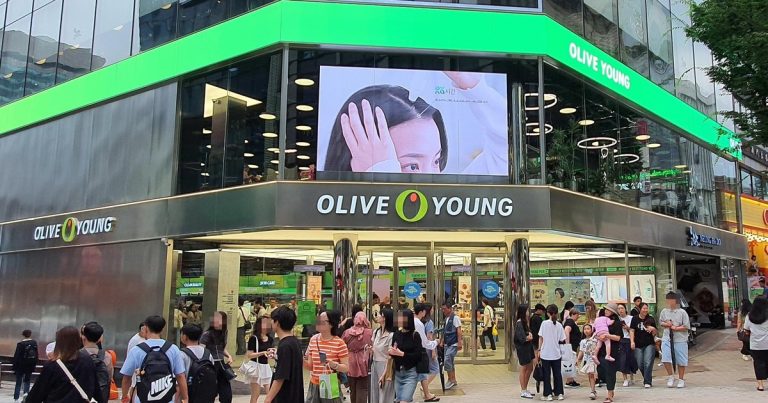
Niacinamide (vitamin B3) may be the most common active on an Olive Young shelf. Olive Young is Korea’s biggest health-and-beauty chain. Niacinamide turns up in brightening serums, toner pads and even sunscreens, and it’s used for dullness, uneven tone, oiliness and barrier support. It pairs well with almost everything, retinoids included.
- Good for
- Uneven tone, dullness, shine and a stressed barrier
- Skip it if
- High-strength formulas have made you flush or sting before; try a lower concentration
- How to use
- Morning or night, as a serum after toner
- Key ingredients
- Niacinamide, often paired with panthenol or tranexamic acid in brightening products
Ceramides
Ceramides are lipids that sit naturally between skin cells and hold the barrier together. Dry skin, and skin that has become drier with age, often feels more comfortable with a ceramide cream at night. Koreans reach for these in the dry winter months and whenever a retinoid leaves skin feeling tight.
- Good for
- Dry, tight or mature skin, and anyone using retinoids or acids
- Skip it if
- You are very oily and acne-prone and the formula is heavy; look for a gel-cream instead
- How to use
- As the last moisturizing step, especially at night
- Key ingredients
- Ceramide NP and related ceramides, cholesterol, fatty acids
Ginseng
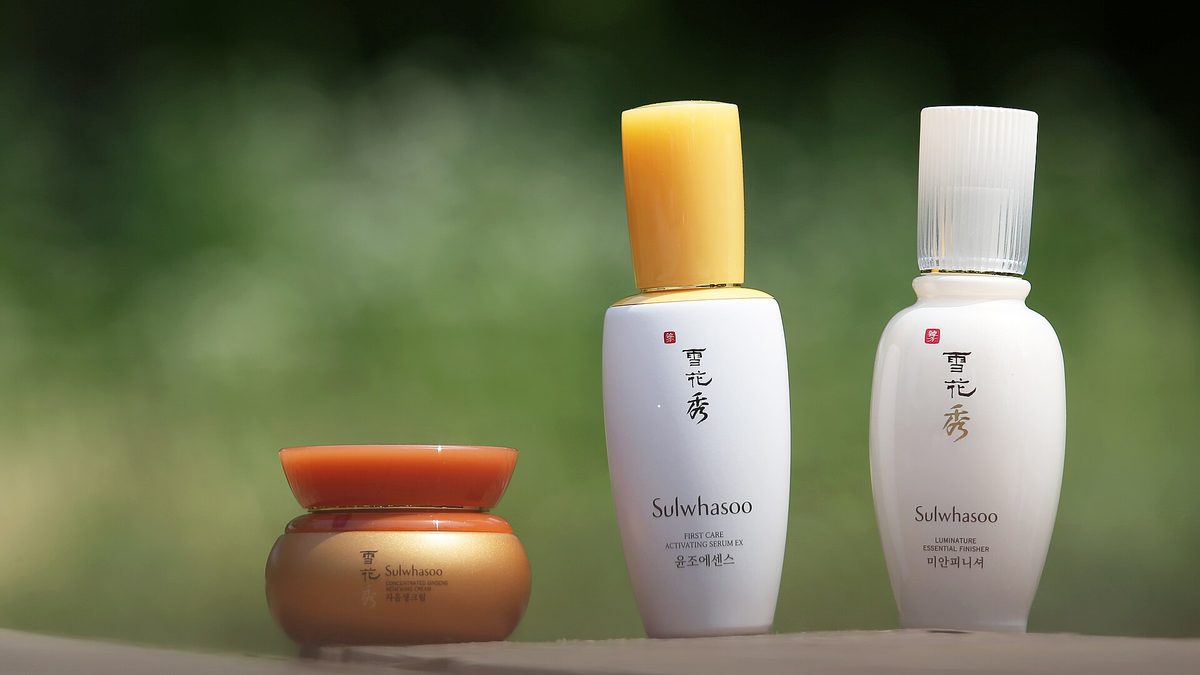
Ginseng (인삼, insam) is the heritage ingredient. Sulwhasoo, Amorepacific’s luxury line, built its name on it. Koreans more often swallow red ginseng (홍삼, hongsam) than put it on their faces: red ginseng extract sticks and drinks are a standard holiday gift. In creams, ginseng is used as an antioxidant-type botanical. It’s a rich, pleasant addition, but the evidence behind it is thinner than for sunscreen or retinoids.
- Good for
- Dry or mature skin that likes rich textures
- Skip it if
- You react to fragrance; many luxury ginseng creams are perfumed, so read the ingredient list
- How to use
- Serum or cream, usually at night
- Key ingredients
- Panax ginseng root extract, red ginseng extract
Snail mucin
Snail secretion filtrate is a humectant (it draws water into the skin) with a slippery gel texture. COSRX’s Advanced Snail 96 Mucin Power Essence made it famous outside Korea. It works best as the hydrating layer on retinoid nights. On its own, don’t expect it to erase lines.
- Good for
- Dehydrated skin and calming dryness from retinoids
- Skip it if
- You avoid animal-derived ingredients or have reacted to it before
- How to use
- After toner, morning or night
- Key ingredients
- Snail secretion filtrate, often with hyaluronic acid or panthenol
Centella asiatica (cica)
Centella asiatica, called 병풀 (byeongpul) in Korean and “cica” on labels, is the go-to calming ingredient. Compounds such as madecassoside appear in ampoules, toners and creams made for stressed, red-feeling skin. Skin1004’s Madagascar Centella line and Dr. Jart+ Cicapair are names you’ll see both abroad and on Seoul shelves.
- Good for
- Sensitive-feeling skin and the off nights between retinoid nights
- Skip it if
- You’ve had a reaction to plant extracts; patch test as with anything new
- How to use
- Toner, ampoule or cream, morning or night
- Key ingredients
- Centella asiatica extract, madecassoside, asiaticoside
Is PDRN skincare worth it?
PDRN (polydeoxyribonucleotide) is made from DNA fragments, usually taken from salmon. That’s why Koreans nicknamed the clinic injection 연어주사 (yeoneo jusa, “salmon injection”). It got famous as a clinic skin booster, then brands rushed out PDRN serums, creams and pads.
Most of the evidence and buzz concerns the injected form. Published support for creams and serums is limited, so treat topical PDRN as a hydrating, soothing extra. It won’t stand in for sunscreen or a retinoid.
- Good for
- Curious users who want a hydrating serum with a popular Korean ingredient
- Skip it if
- You have a fish allergy; ask a doctor before any clinic treatment and check product sourcing
- How to use
- As a serum layer, morning or night
- Key ingredients
- Sodium DNA or PDRN, usually alongside hyaluronic acid or peptides
| Ingredient | Main job in a routine | Morning or night | Irritation risk | Pairs well with |
|---|---|---|---|---|
| Retinol / retinal | Lines and texture | Night | Higher | Ceramides, centella |
| Peptides | Firmness support | Either | Low | Almost anything |
| Niacinamide | Tone, oil, barrier | Either | Low to moderate | Retinoids, sunscreen |
| Ceramides | Barrier repair | Night mostly | Very low | Retinoids, acids |
| Ginseng | Antioxidant-type botanical | Either | Low (watch fragrance) | Rich creams |
| Snail mucin | Hydration | Either | Low | Retinoid nights |
| Centella (cica) | Calming | Either | Low | Retinoids, acids |
| PDRN (topical) | Hydration, soothing | Either | Low | Peptides, hyaluronic acid |
Korean anti-aging routine for your 30s, 40s and 50s
Age is only a rough guide. Skin type matters more: an oily 50-year-old may need a lighter cream than a dry 35-year-old. In all three decades, the routine below rests on the same idea. Sunscreen stays every morning, and only one active works on any given night.
One Korean habit belongs in every decade: 이중세안 (ijung sean, double cleansing). Use an oil or balm cleanser first to melt sunscreen and makeup, then a mild foam or gel cleanser. On nights without makeup, a single gentle cleanse is enough.
Your 30s: build the habit
Morning: a water rinse or gentle cleanser, toner, a niacinamide or antioxidant serum, a light moisturizer, sunscreen. Night: double cleanse, toner, a low-strength retinol on 2 to 3 nights a week, and hydrating serums (snail mucin, centella) on the other nights, then moisturizer.
Your 40s: step up the actives
If your skin has tolerated retinol for months, this is when many people move to retinal or use their retinoid more often. Add a peptide serum or cream in the morning. Switch to a richer night cream, and keep exfoliation to about once a week so it doesn’t clash with the retinoid.
Your 50s: barrier first
Skin often turns drier and more reactive, so comfort leads. Use a cream or milk cleanser, a ceramide-rich moisturizer and, if you like it, a few drops of facial oil mixed into your night cream (a common Korean trick). Keep retinoids if your skin likes them, but at whatever frequency feels calm, and lean on peptides and centella on the nights in between.
| Step | 30s | 40s | 50s |
|---|---|---|---|
| Cleanser | Gel or mild foam | Mild foam or gel | Cream or milk cleanser |
| Morning serum | Niacinamide | Niacinamide or peptides | Peptides |
| Moisturizer | Light lotion or gel-cream | Cream | Ceramide-rich cream |
| Sunscreen | SPF 50+ PA++++ daily | SPF 50+ PA++++ daily | SPF 50+ PA++++ daily |
| Night active | Retinol, 2-3 nights a week | Retinol or retinal, as tolerated | Retinoid at a comfortable frequency |
| Exfoliation | PHA or BHA pad, 1-2 times a week | About once a week | Mild PHA, once a week or less |
How to add retinol and other actives slowly
Most anti-aging routines fail because the actives go on too fast, not because they’re the wrong ones. Irritated skin looks older. Korean beauty counters push “barrier first” for that reason, and it’s the right order for beginners abroad too.
How to patch test new skincare
Put a small amount on the side of your jaw or behind your ear once a day for several days. Stop if you get itching, swelling, a rash or burning beyond a brief tingle. Patch test every new active, and anything you plan to use near your eyes.
A slow start for retinoids
- Weeks 1 to 2: apply a pea-sized amount on 2 nights a week, on dry skin, after toner.
- Weeks 3 to 4: if your skin is calm, go to 3 nights a week.
- After about a month: try every other night. Some people never need more than that.
- If you flake or sting: try the “sandwich method”: moisturizer, then retinoid, then moisturizer again. Or drop back a step.
- Keep acid nights and retinoid nights separate, and never skip sunscreen the next day.
- Wait several weeks with a stable routine before you add the next active.
Gentle exfoliation the Korean way
Koreans like smooth skin, but exfoliating the face is a light-touch job. Gritty scrubs have been mostly replaced by chemical exfoliants.
AHAs such as glycolic and lactic acid work on surface texture. BHA (salicylic acid) gets into oily pores. PHAs are the gentlest of the three. They’re most often sold as 토너패드 (toner pads): pre-soaked cotton rounds in a jar, a huge category in Korea that every drugstore stocks.
Once or twice a week is plenty for most people, and less once you’re on a retinoid. Fun contrast: at a 찜질방 (jjimjilbang, Korean bathhouse), Koreans scrub their bodies hard with a rough “Italy towel” (이태리타올). The face never gets that treatment.
What Korean dermatology clinics commonly offer
In Korea, a 피부과 (pibugwa, dermatology clinic) is part of normal life. Many Koreans visit for lasers or skin boosters the way people elsewhere book a facial, and clinics cluster in Seoul’s Gangnam and Sinsa areas. If you’re visiting, our Gangnam guide covers the neighborhood.
Common anti-aging treatments, in general terms
- Laser toning and IPL for uneven tone and spots
- Fractional lasers for texture, usually with some downtime
- Radiofrequency and HIFU devices (energy-based lifting treatments)
- Skin boosters: injections of PDRN or polynucleotides, or hyaluronic acid, for hydration and skin quality
- Botulinum toxin and fillers for expression lines and volume
How to choose a clinic in Korea as a foreigner
Look for 피부과 전문의 (a board-certified dermatologist) on the sign or website. Some cosmetic clinics are run by doctors trained in other specialties. Have an in-person consultation, and ask who will actually do the procedure, what the downtime is and what aftercare you’ll need. Prices and packages change often, so check the clinic’s official site and get a written quote. Book treatments early in your trip, so you have time to recover and keep the treated skin out of strong sun.
When to see a dermatologist instead of buying another serum
Skincare helps healthy skin look its best. It can’t diagnose anything. See a dermatologist, at home or in Korea, if any of these apply:
- A mole or spot that is new, growing, bleeding or changing shape or color. Get it checked promptly.
- Patches of darkening (often melasma) that keep coming back. Some brightening routines and lasers can make them worse without the right plan.
- Persistent redness, flushing or stinging, which can be signs of rosacea or a barrier problem.
- Eczema, or acne that starts or worsens in your 30s or 40s.
- A reaction that doesn’t settle within a few days of stopping a product.
- You want prescription-strength retinoids such as tretinoin, which need a doctor.
Where to buy Korean anti-aging skincare outside Korea
Buying Korean skincare abroad has never been easier. Olive Young sells internationally through its global online store, and in the US it has been adding stores in Southern California, according to Drug Store News. Our comparison of Olive Young Global and the stores in Korea explains what’s easier to find where.
Check the formula and the seller
Sunscreen formulas can differ by country, because each market regulates sunscreen filters in its own way. Some Korean sunscreens aren’t officially sold in every country, so read the ingredient list on the version you’re actually buying. Buy from brand stores, official marketplace shops or major retailers to avoid fakes, and check the expiry date or the open-jar symbol on the pack.
If you’re in Seoul, the shopping streets in our Myeongdong guide have flagship beauty stores side by side, which makes it easy to test textures before you buy.
FAQ
What age should you start Korean anti-aging skincare?
Daily sunscreen and moisturizer can start at any age, and many Koreans begin in their teens or 20s. Retinoids usually come in during the late 20s or 30s, once a simple routine is stable. It’s never too late to start sunscreen.
Is retinol or retinal better for beginners?
Retinol is usually the gentler place to start. Retinal works faster but tends to irritate more at a similar strength. If your skin tolerates retinol well for a few months, retinal is a reasonable next step. Patch test either one first.
Can you use niacinamide and retinol together?
Yes, for most skin. Niacinamide is often used to make retinoid routines more comfortable, and many Korean serums combine them. If your skin stings, use niacinamide in the morning and the retinoid at night.
Does snail mucin reduce wrinkles?
Snail mucin is mainly a hydrator, and well-hydrated skin makes fine lines look softer. It doesn’t do what retinoids or sunscreen do. Use it as a comforting layer, especially on the nights you use a retinoid.
What is the salmon injection Koreans get?
It’s the nickname for PDRN or polynucleotide skin booster injections, made from salmon DNA fragments and given at dermatology clinics. It’s a medical procedure. Ask a qualified doctor about suitability and risks, and tell them about any fish allergy.
Do Koreans wear sunscreen in winter?
Yes. Sunscreen is a year-round habit in Korea because UVA reaches the skin on cloudy and cold days too. In winter, many people simply switch to a creamier formula to fight dry indoor heating.
What to try next: a 12-week starter plan
Weeks 1 to 4: pick a sunscreen you like the feel of and wear it every morning, alongside a gentle cleanser and a moisturizer. Weeks 5 to 8: add one serum, niacinamide or a hydrating centella or snail essence, and see how your skin responds. Weeks 9 to 12: patch test a low-strength retinol and start it on 2 nights a week, with a ceramide cream on top.
After that, adjust one thing at a time. Book a dermatologist if anything on the list above applies to you. If you’re planning a trip to Seoul, keep a clinic consultation as an option, but get the daily basics right at home first.
Related reading

Sources k-korea.blog · news.google.com
Prices, opening hours and availability change. Check the official page before you buy or travel.