13 min read
What is a chaebol family in Korea: a founding clan, often in its 3rd generation now, that controls a sprawling business group such as Samsung, Hyundai or LG. The word chaebol (재벌) means roughly ‘wealth clan’, and the model explains why one family name can sit behind your phone, your car battery and the hotel you book in Seoul.
It matters outside Korea because chaebol companies make much of what Korea sells to the world, from memory chips to ships, and because their family stories, real and fictional, shape how the country is seen abroad.
Key takeaways
- Chaebol (재벌) means ‘wealth clan’ and uses the same Chinese characters (財閥) as Japan’s prewar zaibatsu.
- Samsung started in 1938 as a Daegu trading shop selling dried fish and noodles. LG started with a face cream.
- Founding families usually own a minority of the shares and control the rest through holding companies or chains of cross-holdings.
- Hyundai, LG and Samsung have each split into several separate groups as heirs divided the empire.
What is a chaebol family in Korea? The short definition
A chaebol is a cluster of legally separate companies, often dozens of them in unrelated industries, tied together by cross-ownership and run as one empire by a single family. The family rarely owns most of the shares. It controls the group through a holding company or through affiliates that own each other.
The person at the top carries the title hoejang (회장, chairman), and Korean staff and media talk about the owner family (오너 일가) rather than just the shareholders. The Revised Romanization spelling is jaebeol, but English-language media almost always write chaebol. Say it roughly like ‘jeh-bull’.
How is a chaebol different from a Western conglomerate?
General Electric and Berkshire Hathaway also own many businesses. A chaebol differs in who holds the wheel. Control passes down the family line by inheritance, affiliates buy from, lend to and prop up one another, and the spread of industries can be extreme. The Samsung name alone covers electronics, life insurance, shipbuilding, construction, a theme park (Everland) and a hospital.
The closest relatives are Japan’s old zaibatsu, such as Mitsubishi and Mitsui before 1945, and family groups like India’s Tata. Korea’s version stands out because a handful of groups carry so much of a rich, export-driven economy.
What does the word chaebol mean to Koreans?
The neutral Korean word for a big firm is daegieop (대기업, large company). Chaebol carries more of an edge: a mix of awe at the wealth and suspicion of the power. Korean headlines use ‘jaebeol 3-se’ (재벌 3세, third-generation chaebol heir) as a shorthand for a privileged son or daughter of a founding family.
How did chaebols get so big? The state-backed boom
Most of today’s groups began small between the 1930s and the 1950s, as rice mills, trading houses and textile workshops. After the Korean War (1950 to 1953) left the South among the poorest countries in Asia, a few entrepreneurs grew rich processing basic goods, sugar, flour and cotton among them. Samsung’s sugar refiner Cheil Jedang, founded in 1953, was one of them.
Their real growth came after Park Chung-hee took power in a 1961 military coup. His government controlled the banks and steered cheap loans to companies that met export targets. In 1973 it launched the Heavy and Chemical Industry drive, pushing chosen firms into steel, shipbuilding, cars, chemicals and electronics, with protected home markets and state licenses.
The deal was simple: export more and the credit kept flowing. That rewarded expansion into almost anything, and Koreans still call the result ‘octopus-leg management’ (문어발 경영), one family reaching into dozens of unrelated markets.
What happened to chaebols in the 1997 Asian financial crisis?
Expansion paid for with debt broke down in 1997. Hanbo Steel and Kia Motors went bankrupt that year, Hyundai took over Kia in 1998, and Daewoo, one of the biggest groups in the country, collapsed in 1999. Korea accepted an IMF rescue package, and the reforms that came with it forced groups to cut debt, publish consolidated accounts and appoint outside directors. Being too big to fail turned out not to be a guarantee.

How Samsung, Hyundai, SK, LG and Lotte grew
These five are the names foreigners know best. The table shows where each began and what it is known for today. Leadership titles change, so check each group’s official site for the current line-up.
| Group | Founder and start | First business | Known for today |
|---|---|---|---|
| Samsung (삼성) | Lee Byung-chul, Daegu, 1938 | Trading dried fish, produce and noodles | Samsung Electronics (chips, Galaxy phones), insurance, construction |
| Hyundai (현대) | Chung Ju-yung, Seoul, 1940s | Car repair, then construction | Hyundai and Kia cars; shipbuilding and retail now run by separate groups |
| SK (에스케이) | Chey Jong-kun, Suwon, 1953 | Sunkyong Textiles | SK Hynix (memory chips), SK Telecom, energy |
| LG (엘지) | Koo In-hwoi, 1947 | Lak Hui Chemical, a face cream | LG Electronics, LG Chem, LG Energy Solution (EV batteries) |
| Lotte (롯데) | Shin Kyuk-ho, Tokyo, 1948 | Chewing gum | Snacks, department stores, hotels, chemicals, Lotte World |
Samsung: from dried fish to memory chips
Lee Byung-chul opened Samsung Sanghoe in Daegu in 1938. The name means ‘three stars’. After the war the company grew through sugar, wool and insurance, and Samsung Electronics was set up in 1969 to make black-and-white TVs. The group’s 1983 move into memory chips turned it into a global tech giant, a story told in our guide to the South Korean semiconductor industry.
His son Lee Kun-hee became chairman in 1987 and pushed the group into global brand building. His grandson Lee Jae-yong (known abroad as Jay Y. Lee) became chairman in 2022. Samsung Electronics is the largest company on the Korean stock market by value.
Hyundai: the construction man who built cars and ships
Chung Ju-yung, a farmer’s son from what is now North Korea, started with car repair and a construction firm in the 1940s. Hyundai means ‘modern’. The group built roads and dams, founded Hyundai Motor in 1967, launched the Pony in 1975 as Korea’s first mass-produced home-grown car, and opened a huge shipyard in Ulsan in the 1970s.
After a family succession dispute in 2000, the empire broke apart. Hyundai Motor Group (Hyundai, Kia, Genesis and the parts maker Hyundai Mobis) went to one son, Chung Mong-koo, and is now led by his son Chung Eui-sun. Shipbuilding, the department stores and the development arm became separate groups run by other relatives.
SK: textiles, then oil, phones and chips
SK stands for Sunkyong, the textile company Chey Jong-kun founded in 1953. His younger brother Chey Jong-hyun took over in 1973 and pulled off two big deals: Korea Oil Corporation in 1980 and Korea Mobile Telecommunications in 1994, which became SK Telecom. Chey Tae-won, chairman since 1998, bought the chipmaker Hynix in 2012. As SK Hynix it is now a major supplier of HBM (high-bandwidth memory, stacked chips that feed AI processors).
LG: a face cream and a radio
Koo In-hwoi founded Lak Hui Chemical in 1947 to make Lucky cream, a cosmetic, then toothpaste and plastics. His GoldStar company built Korea’s first domestic radio in 1959. Lucky plus GoldStar became Lucky-GoldStar, renamed LG in 1995. For decades the Koo family ran the group alongside the Huh family, and in the mid-2000s the empire divided peacefully into LG, LS (Koo relatives) and GS (the Huh family). Koo Kwang-mo, the fourth generation, has led LG since 2018.
Lotte: gum from Tokyo
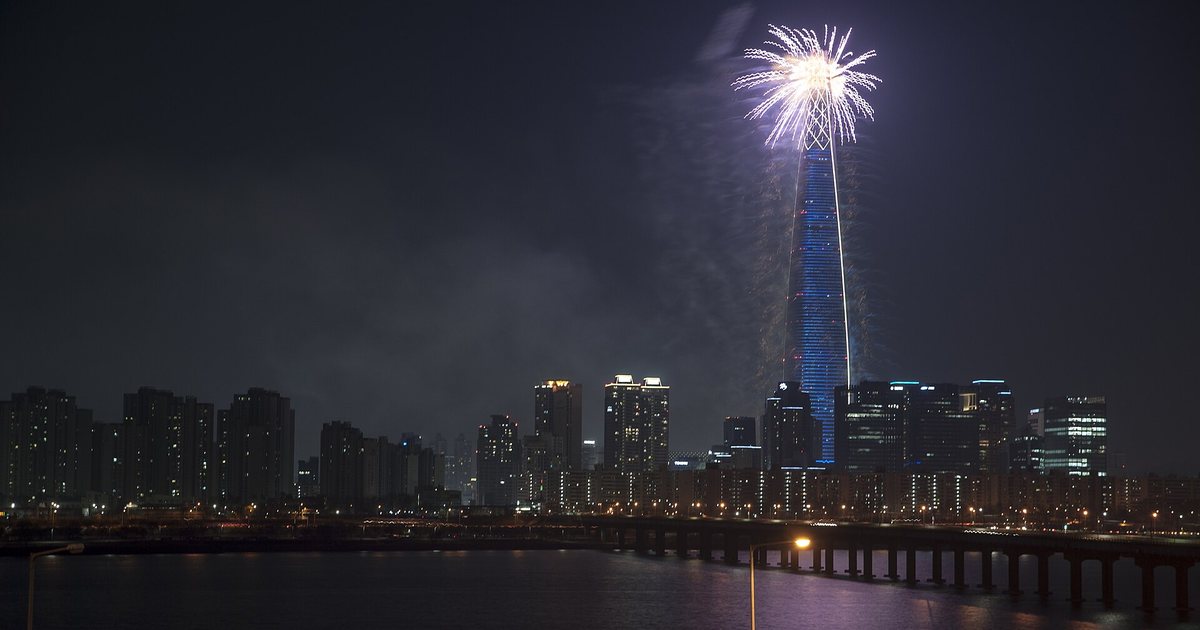
Shin Kyuk-ho started making chewing gum in Japan in 1948 and named his firm after Charlotte, the heroine of Goethe’s novel The Sorrows of Young Werther. He brought Lotte to Korea in 1967 with a confectionery company, then added hotels, department stores, duty-free shops, chemicals, the Lotte World theme park and Lotte World Tower, the tallest building in Korea. His son Shin Dong-bin chairs the group, which still has both Korean and Japanese arms.
How a chaebol family controls dozens of companies with a small stake
The family’s direct share of most affiliates is small. Control comes from structure. These are the main tools:
- Holding companies (지주회사): allowed in Korea since 1999. The family owns a big stake in one parent, which owns stakes in the operating companies. LG was the first major group to adopt this structure, in 2003.
- Circular shareholding (순환출자): company A owns B, B owns C and C owns A, so a small stake at one point of the loop moves the whole chain. Creating new loops has been banned since 2014, and most big groups have unwound theirs.
- De facto holding companies: a firm that is not legally a holding company but sits at the top of the ownership tree.
- Affiliated foundations and insurers: group-linked entities that hold shares and vote alongside the family.
Worked example: how the Lee family’s control of Samsung is structured
Here it is simplified. Family members hold large stakes in Samsung C&T, the construction and trading company that works as the group’s de facto parent. Samsung C&T owns a major block of Samsung Life Insurance and a stake in Samsung Electronics. Samsung Life in turn owns a significant slice of Samsung Electronics, and Samsung Electronics owns stakes in affiliates such as Samsung SDI.
So a family with a modest direct holding in Samsung Electronics can still steer it. The 2015 merger of Samsung C&T and Cheil Industries tightened this chain and led to years of lawsuits. Exact percentages change, so check the filings on Korea’s official disclosure system, DART.
How chaebol succession works, and why empires split
Founders mostly followed the Confucian habit of passing the business to the eldest son, though the choice was not always the eldest and the rule has loosened. Most big groups are now run by the third or fourth generation, and daughters lead some affiliates.
Why inheritance tax shapes chaebol succession
Korea’s top inheritance tax rate is 50 percent, one of the highest in the developed world, and a surcharge can apply to controlling stakes. Heirs often pay in installments over several years, funding the bill with dividends, loans or share sales. When Lee Kun-hee died in 2020, his family announced one of the largest inheritance tax payments on record and gave thousands of artworks to national museums, now shown as the Lee Kun-hee Collection.
The practical effect for outsiders is that succession can move share prices and set off restructuring, because heirs need cash and a clean line of control at the same time.
Why chaebol groups break apart
Several siblings with a claim usually means a split. In the 1990s Samsung spun off CJ (food, entertainment and the Olive Young beauty chain), Shinsegae (department stores and E-mart) and Hansol (paper), each run by relatives of the founder. Hyundai split into several groups after 2000, and LG gave rise to LS and GS. That is why Korea’s list of top business groups reads like a family tree full of cousins.
How big are chaebols in the Korean economy?
Very big. Chips, cars, ships, batteries, steel and petrochemicals, the industries that make up most of Korea’s exports, are dominated by chaebol affiliates. Samsung Electronics alone carries so much weight on the KOSPI (Korea’s main stock index) that the whole index often moves with it, and critics and admirers alike sometimes call the country the ‘Republic of Samsung’.
The other side is the labor market. Most Koreans work for small and mid-sized firms, and pay and job security at the big groups are widely seen as far better. That gap feeds the fierce competition for top universities and chaebol jobs.
What is the ‘Korea discount’?
Investors use the ‘Korea discount’ to describe Korean listed companies trading at lower valuations than similar firms elsewhere. Analysts usually point to two causes: governance in which minority shareholders can come second to the controlling family, and the risk posed by North Korea. Successive governments have pushed reforms aimed at shareholder rights and higher payouts.

Why Koreans both admire and resent chaebol families
The admiration is real. These groups helped turn a war-ruined country into one of the world’s major economies, and Samsung, Hyundai and LG are sources of national pride abroad. Parents want their children to land jobs there.
The resentment is real too. Koreans have a word, gapjil (갑질), for the arrogant abuse of power by those on top, and owner families have supplied famous examples. In the 2014 ‘nut rage’ incident at Korean Air, part of the Hanjin group, an executive from the founding family ordered a taxiing plane back to the gate over how macadamia nuts were served. She was later prosecuted, and the case made gapjil a word foreign media picked up.
Courts are another sore point. Several group chairmen convicted of bribery, embezzlement or tax offenses received suspended sentences or later presidential pardons, often justified by the economy’s need for them. Critics call this a double standard, and supporters say the groups need their leaders. Both views are common in Korean debate.
Why chaebol heirs fill K-dramas
The rich heir is one of K-drama’s most reliable leads, and for good reasons. He gives you a Cinderella story with a real class gap. His family gives you villains, most famously the mother who offers the heroine an envelope of cash to leave her son. Succession fights and boardroom coups keep the plot moving for 16 episodes. Our guide to K-drama tropes shows how the formula works across genres.
| Title | Year | The chaebol angle |
|---|---|---|
| Boys Over Flowers | 2009 | A working-class student versus the heir of the fictional Shinhwa Group |
| Secret Garden | 2010 | A department store CEO falls for a stuntwoman |
| The Heirs | 2013 | Rich teenagers at an elite Seoul school and a hidden family secret |
| Veteran (film) | 2015 | A detective against a violent third-generation heir |
| Crash Landing on You | 2019 | A chaebol heiress paraglides by accident into North Korea |
| Business Proposal | 2022 | A CEO grandson and a blind date gone wrong |
| Reborn Rich | 2022 | A murdered employee is reborn as the youngest grandson of the family he served |
| Queen of Tears | 2024 | Marriage into the heiress family of the Queens Group |
Streaming rights differ by country, so check your local platform or JustWatch for where each title is available.
How realistic are chaebol dramas?
Real succession battles mostly involve share swaps, tax bills and court filings, which make poor television. Reborn Rich comes closest to the real thing: its fictional Soonyang Group lives through real turning points such as the 1997 crisis. Some details also ring true to anyone who follows the Korean business press, like secretaries managing an heir’s whole life, family meals at the chairman’s house and a chairman who can overrule any board. The violence and the slaps are pure fiction.
What chaebols mean for you outside Korea
You probably meet several groups a day without noticing. Here is a worked example of one ordinary evening abroad. You stream a drama made by Studio Dragon, part of CJ, on an LG TV. You message a friend on a Samsung Galaxy, snack on Lotte’s Pepero sticks and drive home in a Kia. That’s four separate family-run groups, and all four go back to founders who started between 1938 and the 1950s.
For investors, the big affiliates trade on the Korea Exchange, and some, including Samsung Electronics, also have overseas listings. Our guide to buying Samsung stock as a foreigner compares the routes. Read the group structure before you buy: a listed affiliate can be pulled into decisions that serve the family’s control as much as its own shareholders. This is not investment advice.
Should you worry about buying chaebol products?
Not for warranty or quality reasons. Each affiliate is its own legal company with its own service network. Governance controversies mostly affect shareholders and Korean politics, not the TV on your wall.
FAQ
Is Samsung a chaebol?
Yes. Samsung is the best-known chaebol: dozens of affiliates, from Samsung Electronics to Samsung Life Insurance, controlled by the founding Lee family. Its chairman is the founder’s grandson. Samsung Electronics is one listed company inside that wider group.
How many chaebols are there in Korea?
There is no fixed number, because chaebol is an informal word. The Korea Fair Trade Commission designates large business groups every year by asset size, and the list changes as groups grow, shrink or split. Check the commission’s official site for the current list.
Is a chaebol the same as a Japanese zaibatsu?
The word is written with the same Chinese characters and the idea is similar: a family-controlled, diversified group. Japan’s zaibatsu were broken up after 1945 and their successors, the keiretsu, are looser networks without one controlling family. Korean chaebols kept family control.
Are chaebols good or bad for Korea?
Both, depending on who you ask and which side of the record you look at. They drove decades of export growth and built global brands. They are also criticized for squeezing smaller suppliers, concentrating wealth and getting lenient treatment in court. Most Korean policy debate is about reforming them, not abolishing them.
How do you pronounce chaebol?
Close to ‘jeh-bull’, with a soft first consonant. The official Revised Romanization is jaebeol, which you will see in some Korean newspapers. In English, chaebol is the standard spelling.
Which chaebol family is the richest?
The Lee family of Samsung is widely reported as the wealthiest family in Korea, mostly because of its holdings in Samsung affiliates. Fortunes move with share prices, so for current figures check a published rich list such as Forbes, which updates its estimates regularly.
What to watch next with Korea’s chaebols
Watch for the next handovers. Several groups are preparing to pass control to a new generation, and every transfer means a tax bill, possible spin-offs and a fresh look at ownership structures. Watch company-law and shareholder-rights reforms too, since they decide how much weight minority investors have against controlling families.
On the business side, the race to supply AI memory chips puts Samsung and SK Hynix at the center of the global tech supply chain, and battery makers from LG and SK are tied to the EV market. For reliable facts, use primary sources: filings on DART, the Fair Trade Commission’s business group data and each company’s investor relations page.
Related reading
Sources k-korea.blog · dart.fss.or.kr
Prices, opening hours and availability change. Check the official page before you buy or travel.