15 min read
Jeju Island travel guide in brief: plan 4 days, split them east and west, and rent a car. Jeju (제주도), South Korea’s largest island, is about an hour’s flight south of Seoul. Its big sights are spread around a volcanic island roughly 73 km wide, so where you sleep decides more of your trip here than it does almost anywhere else in Korea.
This guide covers how to get there, which side of the island suits you, how to hike Hallasan, when to see Seongsan Ilchulbong and the haenyeo divers, whether buses can replace a car, and a 4-day route you can copy.
Key takeaways
- Gimpo to Jeju is roughly a one-hour flight on one of the busiest domestic air routes anywhere, so flights from Seoul leave all day.
- Use two bases: the east for Seongsan Ilchulbong, Udo and the haenyeo, then the west or south for Hyeopjae Beach, the tea fields and the waterfalls.
- The two Hallasan trails that reach the summit, Seongpanak and Gwaneumsa, need an online reservation, and each takes a full day.
- Buses are fine if you stay in one base and travel slowly. On a trip of 4 days or less, a rental car (you’ll need an International Driving Permit) saves you hours.
How to get to Jeju Island from Seoul and abroad
Most visitors fly. Jeju International Airport sits on the north coast, right next to Jeju City, and gets domestic flights from almost every Korean airport. Airfares move with the season and how early you book, so compare on the airlines’ own sites or a flight search tool. Don’t plan around a fare you saw once.
Flying from Seoul: Gimpo or Incheon?
Fly from Gimpo, Seoul’s domestic airport in the west of the city, which is on the subway. Korean Air, Asiana and several budget carriers run the Gimpo to Jeju route, with flights spread through the day. Incheon, the big international hub, has far fewer Jeju flights, so it mainly makes sense if you’re connecting straight off a long-haul arrival. Domestic flights still need photo ID, so bring your passport.
Flying direct from abroad
Jeju has a smaller set of direct international routes, mostly from other parts of Asia. Routes come and go, so check the airport’s official site or your airline. If nothing flies direct from your city, fly into Incheon, move to Gimpo, and add an hour in the air.
Taking the ferry to Jeju
Car ferries cross from southern mainland ports such as Mokpo, Wando and Busan. The sea route is slow and sometimes rough, and winter wind can cancel sailings. It makes sense if you’re bringing your own car or you want the crossing for its own sake. For most foreign visitors, flying is quicker and less hassle. You’ll find schedules on the ferry operators’ official pages.
Do you need a visa for Jeju?
Jeju has its own visa-free entry scheme for many nationalities who arrive on a direct international flight, separate from the rules for the mainland. The list of eligible countries and the conditions (including how this interacts with K-ETA, Korea’s online travel authorization) can change. Check the Korean immigration or K-ETA official site and your nearest Korean embassy before you book, especially if you plan to continue to Seoul afterwards.
Jeju Island travel guide: east vs west, and where to stay
Jeju is basically a ring road around Hallasan, the volcano in the middle. Getting from one end of the island to the other takes a good part of a morning, so people who stay in one hotel for the whole trip spend a lot of it driving. Book two bases instead. Each half of the island has a different character.
| Area | Best for | Main sights | Stay here if |
|---|---|---|---|
| East (Seongsan, Gujwa) | Volcanic scenery, sunrise, islands | Seongsan Ilchulbong, Udo, Seopjikoji, Manjanggul lava tube, Haenyeo Museum | You want early starts and a quieter, rural feel |
| Northeast (Hamdeok, Woljeong-ri) | Beaches near the airport | Hamdeok Beach, Woljeong-ri café strip, Gimnyeong coast | You arrive late or want beach time without a long drive |
| West (Aewol, Hallim, Hyeopjae) | Sunsets, turquoise water, cafés | Hyeopjae and Geumneung beaches, Hallim Park, O’sulloc tea fields, Suwolbong | You want beaches and slow afternoons |
| South (Seogwipo, Jungmun) | Waterfalls, cliffs, resorts | Jeongbang and Cheonjiyeon falls, Jusangjeolli cliffs, Sanbangsan, Songaksan | You want resort hotels and the warmest side of the island |
| North (Jeju City) | Transport hub, markets, food | Dongmun Market, Yongduam Rock, Black Pork Street | You’re getting around by bus or only have one night |
For a first trip, the simplest split is two nights in the east and two in the south or west. If you’re getting around without a car, Jeju City is the most practical bus base, because the express and trunk buses all fan out from there. As a resort, though, it’s the dullest choice.
Is the east or west side of Jeju better?
The east has the dramatic scenery: Seongsan’s crater rising out of the sea, lava tubes, black basalt coastline and the haenyeo villages. The west is softer, with pale sand, green tea fields, more cafés and sunsets over the water. If you only have time for one, pick the east for volcanic scenery and the west for beach time.
How to climb Hallasan (한라산): trails, reservations and timing
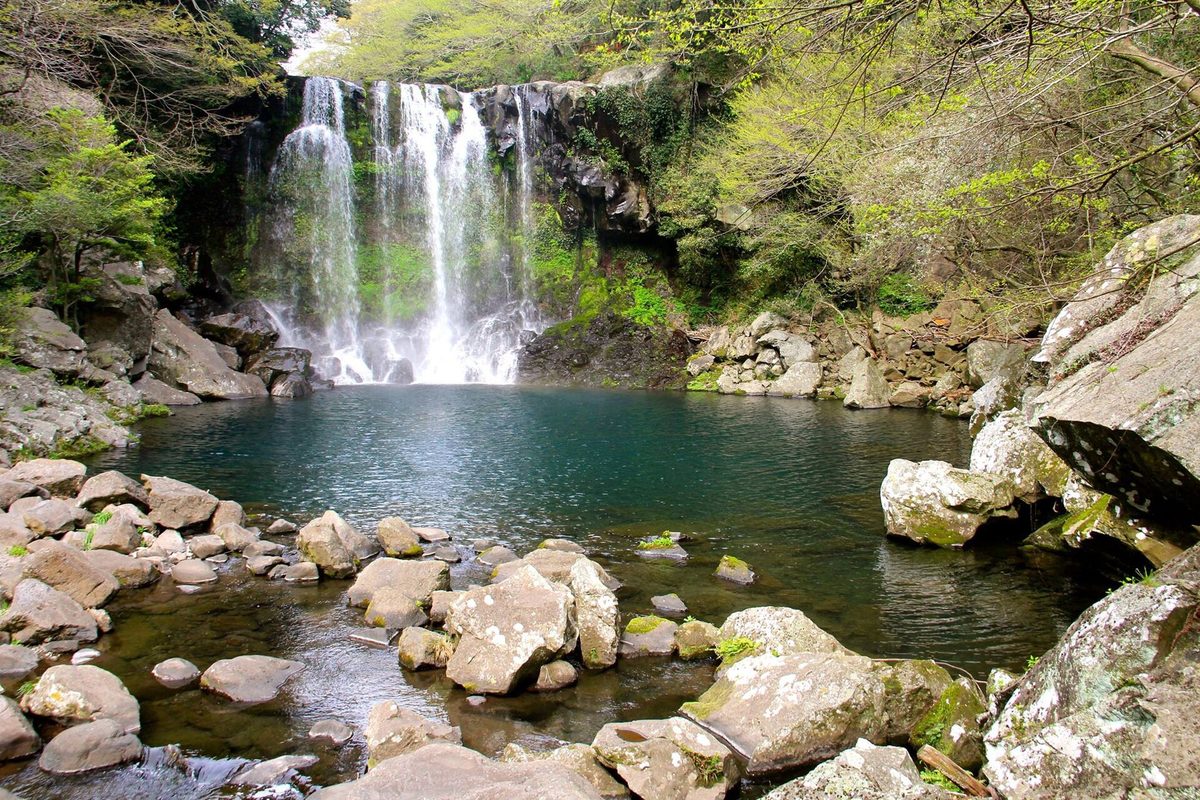
At close to 2,000 m, Hallasan is the highest mountain in South Korea. It’s a shield volcano with a crater lake, Baengnokdam (백록담), at the top, and it’s at the center of Jeju’s UNESCO World Natural Heritage listing (Jeju Volcanic Island and Lava Tubes, inscribed in 2007). You don’t need climbing skills. The catch is that a summit hike takes most of a day.
Which Hallasan trail should you take?
- Seongpanak (성판악): the long, gradual route from the east side of the mountain. It reaches the summit and is the usual first choice. Expect a full day.
- Gwaneumsa (관음사): the steeper northern route, with more dramatic valley views. It also reaches the summit. Many hikers go up one of these two and come down the other.
- Eorimok (어리목) and Yeongsil (영실): shorter western routes that stop below the summit at the Witse Oreum (윗세오름) shelter area. Yeongsil is the favorite half-day option for its cliffs and rock pinnacles.
- Donnaeko (돈내코): a quieter southern route that joins the upper plateau.
- Area
- Central Jeju, between Jeju City and Seogwipo
- Nearest station
- No train on Jeju. Trailheads are reached by bus along the cross-island roads such as the 1100 Road, by taxi or by car
- Time needed
- A full day for Seongpanak or Gwaneumsa; half a day for Yeongsil or Eorimok
- Before you go
- Check summit reservations, checkpoint cut-off times and trail closures on the official Hallasan National Park page
Do you need a reservation to hike Hallasan?
For the summit trails, yes. Seongpanak and Gwaneumsa use an online reservation system with a daily limit on hikers. Popular days fill up early, so book as soon as your dates are fixed.
The trails also have checkpoints with cut-off times: arrive at a checkpoint after the cut-off and you’ll be turned back, so start early. The shorter western trails generally don’t require a booking. Confirm the current rules on the official park site.
What to bring, and when to skip the summit
Bring proper shoes, water, food (there are no shops on the trail) and a warm layer, because the top can be much colder and windier than the coast. In winter Hallasan gets heavy snow and Koreans hike with crampons. Fog, rain and wind can close the trails at short notice. If the forecast is bad, do Yeongsil instead or swap days. A summit lost in cloud is a long walk for no view.
Seongsan Ilchulbong (성산일출봉) and Udo: how to do the east in a day
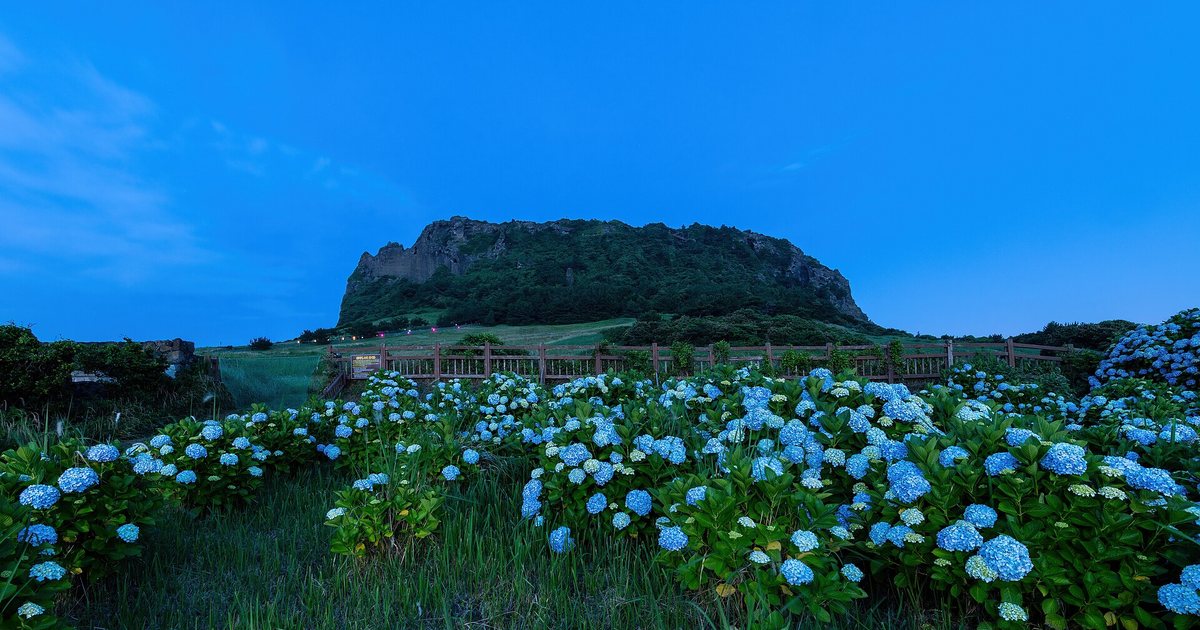
Seongsan Ilchulbong, often called Sunrise Peak, is a tuff cone: a crater built by an eruption in shallow sea water, now joined to the coast by a narrow strip of land. A steep stairway takes you to the crater rim, and most people get up in about half an hour. It’s part of the same UNESCO listing as Hallasan.
- Area
- Seongsan-eup, far east of Jeju
- Nearest station
- No train. Express buses from Jeju City stop in Seongsan; parking is beside the entrance
- Time needed
- 1 to 2 hours including the climb and the coast below
- Before you go
- Check opening hours, sunrise access and fees on the official page
Is the Seongsan sunrise worth getting up for?
If you’re staying in Seongsan, yes. The name literally means “sunrise peak”, and watching the sun come up over the sea from the rim is the classic Jeju moment. From Jeju City it means a pre-dawn drive, and cloud often hides the sun, so treat sunrise as a bonus rather than the plan. A late-afternoon climb is calmer and much less crowded.
How to get to Udo (우도)
Udo, the low, flat “cow island” just offshore, is reached by ferry from Seongsan Port, a short drive from the peak. It’s known for its pale beaches, peanut ice cream and coastal views back to Seongsan. Car access to the island is restricted, so most visitors rent an electric scooter, bicycle or small buggy on the island or use the circular tour bus. Wind regularly cancels sailings, so check the ferry operator’s notice on the day.
Other east-side stops
- Seopjikoji (섭지코지): a headland walk with a lighthouse and a view straight at Seongsan Ilchulbong.
- Manjanggul (만장굴): one of the world’s long lava tubes. Part of it is open to walk through, and it stays cool even in summer. Check the official site, because it has had long closures.
- Bijarim Forest (비자림): an old nutmeg-yew forest with an easy, shaded walking loop.
Best beaches in Jeju, by what you want from them
Jeju’s beaches look nothing like each other, because the sand ranges from white shell sand to black volcanic grit. Choose by what you want to do there.
- Hyeopjae (협재) and Geumneung (금능), west: shallow, bright turquoise water and white sand, with Biyangdo islet on the horizon. They’re the best for families and photos, and sunsets here are excellent.
- Gwakji (곽지), west: a long beach in the Aewol café area, good for a walk and a coffee.
- Hamdeok (함덕), northeast: close to the airport, shallow and easy, with a small grassy hill at one end. A good first-afternoon beach.
- Woljeong-ri (월정리), northeast: a beach lined with cafés, popular with young Korean travelers. It gets windy, which is why you’ll see kitesurfers.
- Jungmun Saekdal (중문색달), south: bigger waves and the island’s best-known surf spot. Currents are stronger, so swim only where lifeguards are on duty.
- Pyoseon (표선), southeast: a very wide, flat bay where the tide goes far out.
Official swimming season, when lifeguards are on duty, runs through the summer. Exact dates vary by beach and year, so check the Visit Jeju official page. Outside the season the beaches are still lovely for walking, but the water is cold and nobody is watching.
Who are the haenyeo (해녀), Jeju’s women divers?
The haenyeo are Jeju’s women divers. They free-dive without air tanks to gather abalone, conch, sea urchin and seaweed, and many of them keep working well into old age. UNESCO added the culture of Jeju haenyeo to its Intangible Cultural Heritage list in 2016. They’re the reason for Jeju’s old nickname, samdado (삼다도), the island of three abundances: wind, rocks and women.
When a haenyeo surfaces she lets out a sharp whistling breath called sumbisori (숨비소리). If you walk the eastern coast in calm weather, you may hear it before you spot the orange floats bobbing offshore.
Where to see haenyeo culture
- Haenyeo Museum (해녀박물관), Gujwa: the best place to understand the history, the gear and the village cooperatives. It’s on the northeast coast, so it fits easily into an east-side day.
- Below Seongsan Ilchulbong: haenyeo have long held diving demonstrations on the shore beside the peak, and you can sometimes eat their catch on the spot. Whether it’s running depends on the day and the weather.
- Haenyeo-run restaurants and kitchens in coastal villages, where the seafood on your plate came up that morning.
How to be a respectful visitor
This is working fishing, not a show staged for tourists. Don’t swim into their diving areas, don’t take shellfish from the rocks (village cooperatives manage the harvest), and ask before taking close-up photos of individual divers.
Renting a car in Jeju vs taking the bus
Most Korean travelers rent a car on Jeju, and with good reason. Buses do reach every major sight, but they run less often outside Jeju City and Seogwipo, and connecting two east-side stops by bus can eat a whole afternoon.
| Option | Best for | What it costs you | Watch out for |
|---|---|---|---|
| Rental car | Trips of 3 to 5 days, families, two-base plans | Rental, insurance and fuel or charging; no time lost waiting | Speed cameras everywhere, narrow village roads, parking at busy sights |
| Public bus | Solo travelers, one base, slow itineraries | Cheap fares, a lot of time | Long gaps between rural buses, transfers, no luggage space at peak times |
| Taxi or taxi-with-driver day hire | Non-drivers who want car flexibility | More money per day, little effort | Fewer taxis waiting at remote sights for the trip back |
| Group day tour | Seeing the highlights on a short trip without driving | A fixed price and a fixed schedule | Short stops and a set route |
What you need to rent a car in Jeju
Bring your home driving license and an International Driving Permit in the 1949 Geneva Convention format. Most rental firms won’t hand over keys without both. Korea drives on the right.
Most rental companies don’t have counters inside the terminal: they pick customers up by shuttle and drive them to lots near the airport. Many Jeju rentals are electric cars, so ask how charging works before you leave the lot. Take full insurance coverage.
How do Jeju buses work?
Jeju’s buses are color-coded: red express buses cross the island quickly between the main towns, blue trunk buses run the major roads, and green local buses serve the villages. Airport limousine buses link the airport with Jungmun and Seogwipo. You can pay with cash or tap a Korean transit card. The same card you use in Seoul works here (see our guide to using a T-money card). Plan each leg in Naver or Kakao Map, which show live arrival times.
Taxis and day tours
Taxis are easy to find in Jeju City and Seogwipo. Use the Kakao T app to call one anywhere else. Hiring a taxi with a driver for the whole day is a common Korean way to see the island without driving. Book it through your hotel or an established operator and agree the route and price in writing first.
How many days do you need in Jeju? A 4-day route
Three days covers the highlights in a hurry. With four you get them with some breathing room, and five lets you add a Hallasan summit day without wrecking the rest of the plan. Here’s a 4-day route with a car, sleeping two nights in the east and two in the south.
Day 1: Jeju City to the east coast
Land, pick up the car and eat lunch near Dongmun Market. Drive east along the coast via Hamdeok Beach, stop at the Haenyeo Museum in Gujwa, and check in near Seongsan. Climb Seongsan Ilchulbong in the late afternoon when the crowds thin out.
Day 2: Udo and the east
Take an early ferry to Udo if the sea is calm. Spend the afternoon at Seopjikoji and Bijarim Forest, or Manjanggul if it’s open. If you’re up in time, watch sunrise from Seongsan.
Day 3: Hallasan’s Yeongsil trail and the south
Drive the 1100 Road to the Yeongsil trailhead and hike up to Witse Oreum. Head down to Seogwipo for Jeongbang Falls, which drops straight onto the shore, and the Jusangjeolli basalt column cliffs near Jungmun. Stay in Seogwipo or Jungmun.
Day 4: The southwest and west, then fly out
Walk the Songaksan coastal trail, see Sanbangsan, then drive north past the O’sulloc tea fields to Hyeopjae Beach. Head back up the west coast through Aewol to the airport.
Only 3 days? Merge days 1 and 2 and skip Udo. 5 days? Add a Seongpanak summit day (book the reservation first) or slow down with a few sections of Jeju Olle (제주올레), the network of signposted walking routes that circles the island along the coast.
Common Jeju planning mistakes
- Staying in one hotel and trying to see the whole island in day trips.
- Arriving without an International Driving Permit and being refused a car.
- Leaving Hallasan’s summit reservation until the night before.
- Ignoring wind: it cancels Udo ferries and turns beach days cold, even in spring.
- Visiting in late summer without checking typhoon forecasts.
For seasons, Jeju’s canola flowers and cherry blossoms come in spring, tangerine picking in winter, and the beaches peak in summer. Our guide to the best time to visit Korea covers how the weather shifts month by month.
What to eat in Jeju: black pork, abalone and tangerines
Jeju food is different from mainland Korean food. It leans on pork, seafood and citrus, and dishes tend to be lightly seasoned.
- Heuk dwaeji (흑돼지): Jeju black pork, grilled at the table and often dipped in meljeot, a salty anchovy sauce. Jeju City even has a Black Pork Street.
- Gogi guksu (고기국수): noodles in a rich pork broth topped with sliced pork. It’s the island’s comfort food.
- Jeonbok-juk (전복죽): abalone rice porridge, a classic breakfast, often served at haenyeo-run restaurants.
- Galchi-jorim (갈치조림): silver hairtail fish braised in a spicy sauce, served for sharing.
- Okdom-gui (옥돔구이): grilled tilefish, a Jeju specialty.
- Hallabong (한라봉) and gyul (귤): Jeju’s citrus. Hallabong is the big, sweet one with a bump on top, and you’ll find it in juice, chocolate and ice cream all over the island.
Korean barbecue has its own table rules (who grills, who pours, how you share banchan, the free side dishes). Our Korean dining etiquette guide covers the mistakes to skip.
FAQ
Is Jeju Island worth visiting for foreigners?
Yes, if you want nature after Seoul. Jeju gives you volcanic peaks, lava tubes, beaches and coastal walks in a small area, plus food you won’t find on the mainland. If you mainly want shopping and nightlife, stay in Seoul or Busan.
How many days in Jeju is enough?
Four days is the sweet spot for a first visit. Three works if you skip Udo and the Hallasan summit. Five lets you add the summit hike or some Olle walking at an easy pace.
Can you get around Jeju without a car?
Yes. Express and trunk buses reach all the main sights, and Naver or Kakao Map shows routes and arrival times. Expect longer travel days, and base yourself in Jeju City or Seogwipo where the bus links are best.
Is Jeju visa-free?
Jeju has long had a visa-free entry scheme for many nationalities who arrive on a direct international flight, with separate rules from the mainland. Eligible countries and conditions change, so check the Korean immigration or K-ETA official site and your Korean embassy before you travel.
Can a beginner climb Hallasan?
A fit beginner can manage the Yeongsil or Eorimok trails, which are half-day hikes. The summit routes need no technical skill but take a full day, a reservation and an early start. In winter they need crampons.
What is the best way to get from Seoul to Jeju?
Fly from Gimpo Airport. The flight takes about an hour and there are departures throughout the day. Ferries from southern ports exist but take far longer. There’s no train to Jeju.
What to plan next for your Jeju trip
Lock in the things that sell out first: your Gimpo flight, a rental car with your International Driving Permit sorted, and a Hallasan summit slot if you want one. Then book your two bases, one in the east and one in the south or west. Leave the rest flexible, because Jeju’s weather decides each day for you. Keep a beach day and a museum or lava-tube day you can swap.
If you’re also spending time in Seoul, our 3-day Seoul itinerary pairs well with this route. Our basic Korean phrases for travelers will help at rural restaurants where menus are only in Korean.
Related reading

Sources k-korea.blog
Prices, opening hours and availability change. Check the official page before you buy or travel.