10 min read
How to eat Korean BBQ comes down to 5 steps: order a cut, grill it, snip it, wrap it and pour drinks. The meat cooks at your table, you eat it wrapped in lettuce with garlic and a smear of sauce, and you pour drinks for each other instead of for yourself. Get those basics right and you’ll look at home in any gogi-jip (meat restaurant) from Seoul to Los Angeles.
Key takeaways
- Samgyeopsal is unmarinated pork belly, galbi is marinated ribs (beef or pork), and bulgogi is thin-sliced marinated beef that is usually pan-cooked rather than grilled over flame.
- Many Korean BBQ restaurants ask for a minimum of 2 servings per order, and the side dishes (banchan) are included and refilled free.
- Use the tongs for raw meat and your chopsticks only for cooked food; the scissors on the table are for cutting meat into bite-size pieces.
- Never fill your own glass; pour for others, receive with two hands, and turn slightly away from an older person when you drink.
What is the difference between samgyeopsal, galbi and bulgogi?
These three get lumped together on menus abroad, but in Korea they often live in different restaurants. A pork belly place and a beef rib house are separate businesses with separate rhythms.
Samgyeopsal: plain pork belly
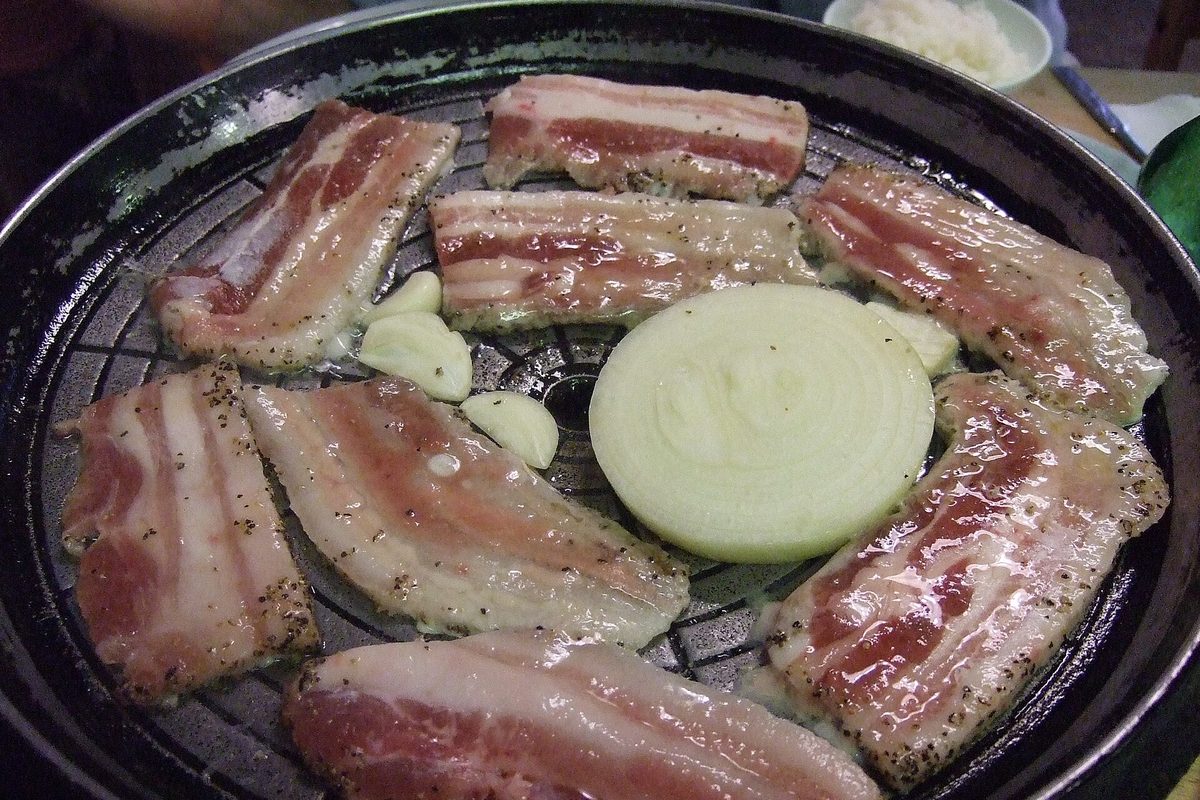
Samgyeopsal (literally “three-layer meat”) is thick strips of pork belly, served raw and unseasoned. The flavor comes from the grill, the fat and what you dip it in: sesame oil with salt and pepper, ssamjang (a thick paste of fermented soybean and chili), or salt alone. It’s the most common Korean BBQ meal, the one office workers order after work, and the cheapest way in.
Galbi: marinated ribs
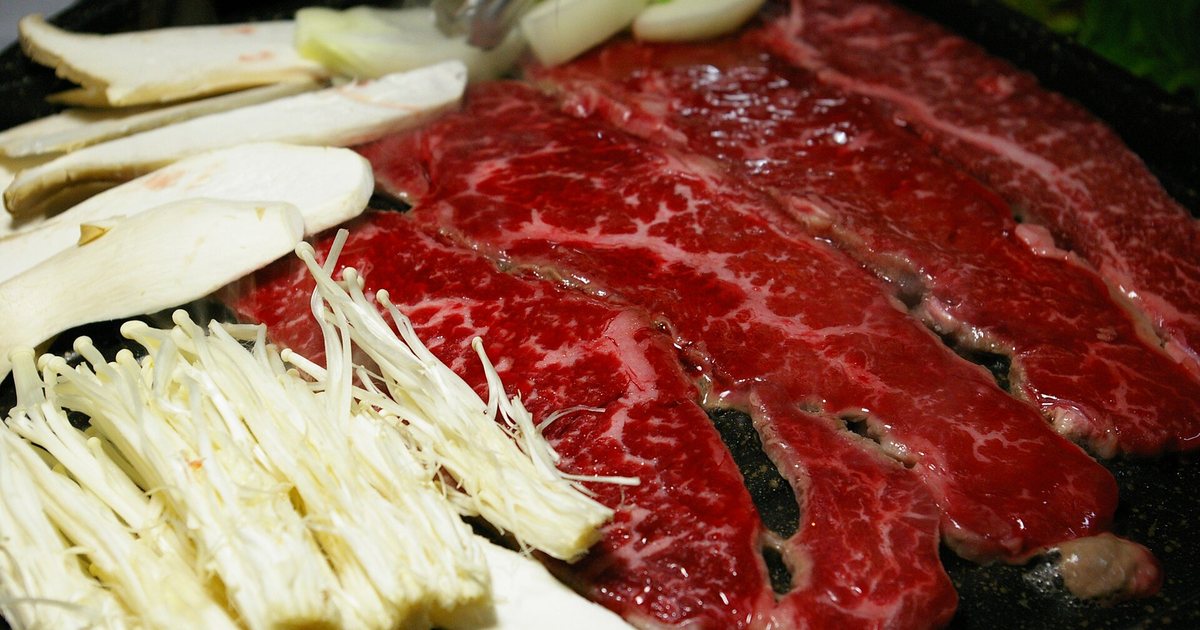
Galbi means ribs. So-galbi is beef short rib and dwaeji-galbi is pork rib or shoulder. Both are usually marinated in a sweet soy mixture with garlic, sesame oil and often grated Korean pear, which softens the meat. Because the sugar in the marinade burns fast, galbi needs more attention on the grill than pork belly. If a menu says saeng-galbi, it’s unmarinated (“raw”) rib, usually served for people who want to taste the beef itself.
Bulgogi: thin beef, cooked in its juices
Bulgogi is beef sliced paper-thin and marinated, similar in flavor to galbi but without the bone. In Korea it is commonly cooked on a domed pan with a moat around the edge, or in a shallow pan with broth, glass noodles and vegetables, so it’s closer to a stew-grill hybrid. If you want the char of a grill, order galbi. If you want something sweet, soft and easy for kids or spice-shy eaters, bulgogi is the safer pick.
| Dish | Meat | Marinated? | How it’s cooked | Best for |
|---|---|---|---|---|
| Samgyeopsal | Pork belly | No | Grilled on a flat plate or grill until crisp | First-timers, groups, drinking nights |
| Moksal | Pork neck/shoulder | No | Grilled, thicker and leaner than belly | People who find belly too fatty |
| Dwaeji-galbi | Pork rib or shoulder | Yes, sweet soy | Grilled over charcoal or gas, watch for burning | A sweeter pork option |
| So-galbi | Beef short rib | Usually | Grilled, often by staff | Special occasions, family dinners |
| Chadolbaegi | Beef brisket, shaved thin | No | Seconds on a hot plate | Fast eating, light dipping sauces |
| Bulgogi | Thin-sliced beef | Yes | Domed pan or shallow pan with broth | Kids, no-spice eaters, a full meal with rice |
Which other Korean BBQ cuts are worth ordering?
Once you know the big three, the rest of the menu opens up. These are the cuts you’ll see most often in Korea.
- Moksal: pork neck, meatier than belly with fat running through it. A good second order after samgyeopsal.
- Hangjeongsal: pork jowl, small portions with a chewy, bouncy texture that many Koreans rate highly.
- Ogyeopsal: belly with the skin left on, so the edges crisp up.
- Chadolbaegi: beef brisket shaved so thin it cooks in seconds. Eat it as soon as the color changes.
- Deungsim and kkotsal: beef sirloin and well-marbled cuts, usually ordered at hanwoo restaurants (hanwoo is native Korean cattle, prized and priced as a premium product).
- Gopchang and makchang: beef or pork intestines, grilled until chewy and crisp. An acquired taste, and a whole restaurant category of its own.
A simple rule for a group: start with an unmarinated cut, then move to marinated meat. Sugar from galbi marinade sticks to the grill, so most places swap the grill plate before or after the marinated order.
How does ordering work at a Korean BBQ restaurant?
Ordering is simpler than it looks, but a few habits surprise visitors.
- Sit first, order second. Staff will often seat you and light the grill before you’ve decided.
- Order by the serving (in-bun). Menus list meat per serving, and many restaurants require at least 2 servings to start. A common approach is one serving per person, then adding more as you go.
- Call staff with the button or a word. Many tables have a call bell. Otherwise a polite “Jeogiyo” (excuse me) works.
- Add drinks and sides separately. Rice (gonggi-bap), stew and cold noodles are usually ordered on their own, often toward the end.
- Pay at the counter on the way out. In most Korean restaurants you don’t get the bill at the table, and tipping is not part of Korean dining custom.
Prices vary a lot by neighborhood, cut and whether the beef is hanwoo or imported, so check the menu board or the restaurant’s page on a map app such as Naver Map or KakaoMap before you go.
What are banchan, and are they free?
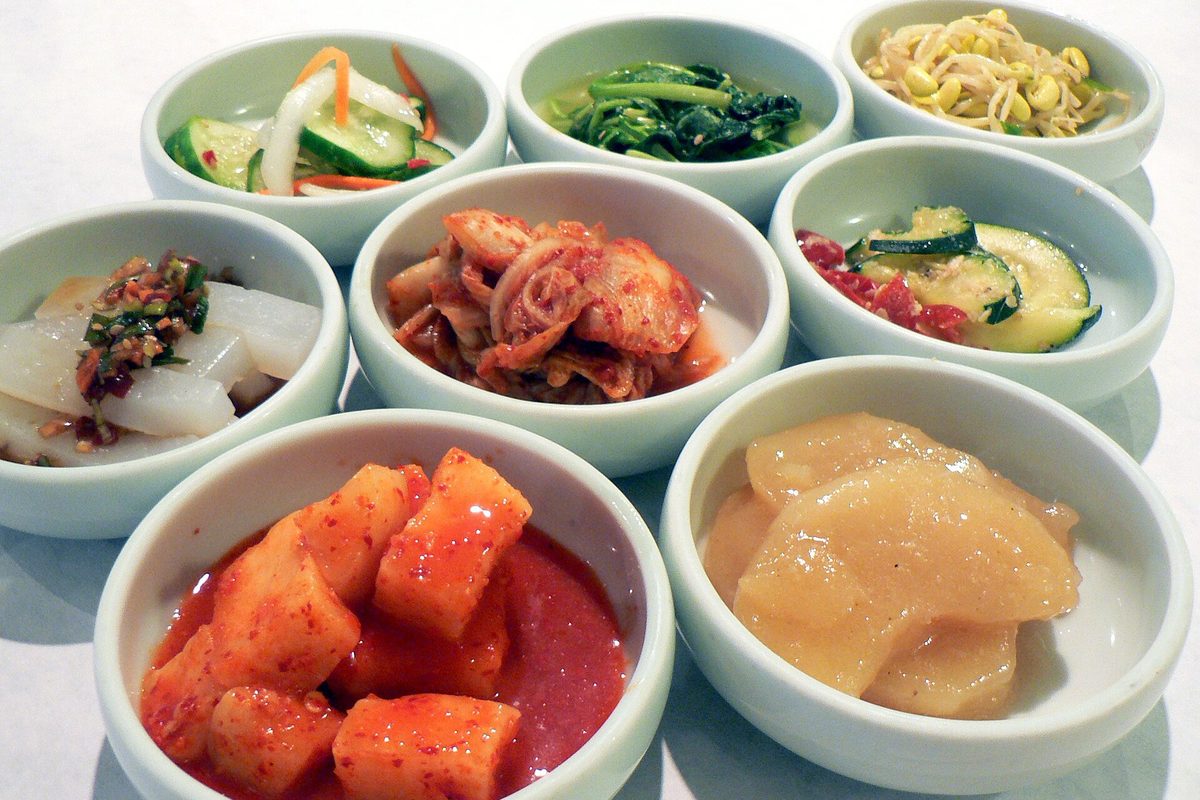
Banchan are the small side dishes that arrive before the meat. At a BBQ restaurant expect some mix of kimchi, seasoned bean sprouts, pickled radish, a green onion salad called pajeori, a small steamed egg dish (gyeran-jjim) and sometimes a bowl of soybean-paste soup.
They come with your order and are refilled at no extra charge. Ask politely, or look for a self-service bar near the kitchen where you can top up lettuce and sides yourself. Taking a reasonable amount is normal; piling up plates you won’t eat is frowned on.
Some banchan are meant for the grill. Kimchi, garlic cloves and sliced mushrooms often go on the edge of the plate to cook in the pork fat. If a little dish of raw garlic sits next to the grill, that’s your cue.
How to eat Korean BBQ: wrapping ssam step by step
Ssam means “wrap,” and it’s how most Koreans eat grilled meat. You don’t have to wrap every bite, but it’s the classic method and the reason the table is full of leaves.
- Hold a lettuce leaf (or a kkaennip, perilla leaf, which tastes faintly of mint and anise) flat in your open left hand.
- Add one piece of grilled meat, dipped in sesame oil and salt or not, as you like.
- Put a small dab of ssamjang on top.
- Add extras: a slice of raw or grilled garlic, a ring of green chili, a pinch of pajeori or kimchi.
- Fold the leaf closed and eat it in one bite.
The one-bite rule matters more than it sounds. A wrap that’s too big falls apart halfway, and biting a ssam in two is considered a bit messy. Make them small. If you’re new to raw garlic, grill it first; it turns soft and sweet.
Some restaurants also bring thin sheets of pickled radish (ssam-mu) or rice paper as wrappers. Same idea, different crunch.
Who grills the meat at Korean BBQ?
It depends on the restaurant and the cut. At many beef restaurants, especially premium hanwoo places, staff grill for you because the timing is part of what you’re paying for. At a typical samgyeopsal spot you may get a demonstration of the first round and then the tongs are yours.
In a group of Koreans, the youngest or most junior person often takes the tongs, or whoever is best at it simply does. Offering to grill is a friendly move, and if an older person takes over, let them.
How to grill without ruining it
- Wait for the grill to get properly hot before laying meat down, or it sticks.
- Pork belly: let one side go golden before flipping. Constant flipping keeps it pale.
- Cut with the scissors once the outside is browned, then finish the pieces.
- Pork should be cooked through. Beef can be pulled earlier, to your taste.
- Marinated meat burns fast; turn it often and ask for a new grill plate when it blackens.
Tongs, scissors and chopsticks
Use the tongs for raw meat and your own chopsticks only for cooked food. This is basic food hygiene as much as manners. The kitchen scissors are completely normal in Korea for cutting meat, noodles and kimchi at the table.
What is the drinking etiquette at Korean BBQ?
Korean BBQ and soju (a clear distilled spirit, usually served in small green bottles) go together, often alongside beer. Mixing the two into somaek (soju plus maekju, beer) is a common table habit. You never have to drink alcohol, and saying you’ll stick to soft drinks is fine, but the pouring rules still apply.
- Don’t pour your own drink. Fill other people’s glasses and they’ll fill yours.
- Watch for empty glasses. Refill a glass once it’s empty, not while it’s half full.
- Use two hands with elders. When pouring for or receiving from someone older or more senior, hold the bottle or glass with two hands, or support your pouring arm with the other hand.
- Turn your head. When drinking in front of someone older, turn slightly to the side as you sip.
- Toast with “geonbae” (cheers). Clink your glass a little lower than an older person’s.
Pacing is up to you. Korean drinking culture can be fast, and nobody at a good table minds you nursing one glass all night.
How do Koreans finish a BBQ meal?
The meat is rarely the end. Koreans tend to order a “finishing” dish once the grilling slows down, and this is where a BBQ dinner becomes a full meal.
- Doenjang-jjigae: soybean-paste stew with tofu and vegetables, eaten with a bowl of rice. The most common choice at pork restaurants.
- Naengmyeon: cold buckwheat noodles in icy broth (mul-naengmyeon) or with spicy sauce (bibim-naengmyeon). Popular after galbi, and you can wrap the noodles around leftover meat.
- Bokkeumbap: fried rice made on the grill plate itself, with kimchi, seaweed and the leftover fat. Ask staff if they offer it.
- Gyeran-jjim: fluffy steamed egg, sometimes served free, sometimes ordered.
If you only order one, make it the stew with rice. It cuts through the richness and it’s what most Koreans at the next table will be eating.
Is Korean BBQ abroad different from Korean BBQ in Korea?
Yes, in a few useful ways. In the US and many other countries, all-you-can-eat (AYCE) Korean BBQ is a common format: a fixed price per person, a long menu of cuts, and time limits. In Korea, most BBQ restaurants specialize in one type of meat and charge per serving, though buffet-style places exist too.
Restaurants abroad often serve pork belly, brisket, bulgogi and galbi at the same table, plus Americanized extras like cheese corn. In Korea you’re more likely to pick a pork restaurant or a beef restaurant and stay with it. Banchan spreads also vary. Korean restaurants at home often serve fewer, simpler banchan focused on what pairs with the meat.
Etiquette carries over everywhere. Tongs for raw meat, small wraps, pouring for each other: all of it works in Koreatown as well as Seoul. The main exception is tipping, which follows local custom outside Korea.
FAQ
Do you eat Korean BBQ with rice?
Often not at first. Many Koreans eat the meat wrapped in lettuce with banchan, then order rice with stew at the end of the meal. At bulgogi restaurants, rice usually comes with the meal from the start.
Can one person eat Korean BBQ alone?
It can be tricky, because many restaurants require at least 2 servings per order or per table. Solo dining (honbap) has become more common in Korea, and some restaurants are set up for single diners, so look for one that advertises one-person servings or ask before sitting down.
What is ssamjang made of?
Ssamjang is a thick dipping paste made mainly from doenjang (fermented soybean paste) and gochujang (fermented chili paste), usually mixed with garlic, sesame oil and sesame seeds. It’s salty and savory with mild heat, and you use a small dab per wrap.
Is it rude to grill your own meat at a restaurant where staff grill?
It isn’t rude, but it can be awkward if staff are already timing the cooking. At beef restaurants where an employee is grilling, let them finish. At casual pork places, nobody minds if you take over.
Should I tip at a Korean BBQ restaurant in Korea?
No. Tipping is not customary in Korea and service is part of the price. You pay at the counter as you leave; a simple “jal meogeosseumnida” (I ate well) is a warm way to thank the staff.
What should vegetarians order at Korean BBQ?
Options are limited at meat-focused restaurants. You can usually eat lettuce wraps with grilled mushrooms, garlic and some banchan, but kimchi and stews often contain fish sauce, shrimp or meat broth, so ask staff before ordering.
What to order on your first Korean BBQ night
Keep it simple. For two to four people, start with samgyeopsal and moksal, wrap them with perilla leaves and grilled garlic, and finish with doenjang-jjigae and rice. On a second visit, try a galbi house or a hanwoo restaurant where staff grill the beef and you can watch how they time it.
If you’re planning a Seoul trip around food, you’ll likely be shopping between meals too. Our guide to what to buy at Olive Young covers the tax refund, and if you’ll spend long days walking markets and food alleys, read how to choose a Korean sunscreen before you go. For current menus and prices, check each restaurant’s listing on Naver Map or KakaoMap; both work in English and are what Koreans use themselves.
Related reading
Sources k-korea.blog
Prices, opening hours and availability change. Check the official page before you buy or travel.