13 min read
This Busan travel guide fits Korea’s second city into 3 days, about 2.5 hours by KTX from Seoul. Stay near Haeundae or Gwangalli for the beaches. Give one day to the old port around Jagalchi Market and Gamcheon Culture Village, and save a morning for Haedong Yonggungsa, the temple built on the sea rocks.
Busan (부산) moves at a different pace from Seoul. It has fewer palaces and a lot more sea, and its food comes from fish markets, pork soup and noodles that refugees invented during the Korean War. Below you’ll find how the city fits together, which area suits you, and what to eat where.
Key takeaways
- The fastest KTX trains run from Seoul Station to Busan Station in about 2 hours 30 minutes. SRT trains leave from Suseo Station in southern Seoul.
- Three days covers the five big sights. Two days feels rushed. With four, you can add Taejongdae, Yeongdo or a side trip to Gyeongju.
- Busan has two halves. The east (Haeundae, Gwangalli, Gijang) is for beaches, and the west (Nampo, Jagalchi, Gamcheon) is for markets and history. Plan each day around one half.
- At Jagalchi you buy fish downstairs and eat it upstairs, where the restaurant charges a per-person table fee. Ask what the fee is before you sit down.
How to get from Seoul to Busan by KTX
The KTX (Korea Train eXpress, the high-speed rail network run by the state operator Korail) is how most visitors get here. Trains on the Gyeongbu Line run from Seoul Station to Busan Station. The fastest take about two and a half hours. Others make more stops and take longer, so check the journey time before you book.
If you’re staying in Gangnam or elsewhere south of the Han River, look at the SRT (Super Rapid Train, a separate high-speed operator). It leaves from Suseo Station and also ends at Busan Station.
How to book KTX tickets as a foreigner
Korail sells tickets in English on its official website and through its app. SRT has its own booking site. Weekend trains sell out early, and so do trains around Seollal (Lunar New Year) and Chuseok (the autumn harvest holiday), so book as soon as your dates are set. Korail also sells a Korea Rail Pass to foreign visitors. Rules and prices change, so check them on Korail’s site rather than relying on old blog posts.
Should you fly or take the bus instead?
Domestic flights go from Gimpo Airport in Seoul to Gimhae International Airport in Busan. The flight is short. Once you add security and the trip out to each airport, though, the train usually wins door to door. Express buses from Seoul cost less and take much longer. They only make sense if the trains are full.
Getting around Busan once you arrive
The Busan Metro has four numbered lines. The Donghae Line, a commuter rail line, runs up the coast to Gijang. A T-money card (the rechargeable transit card used across Korea) works on the metro and city buses, and the same card you used in Seoul works here. Busan is hilly and spread along the coast, so taxis help at the top of steep neighborhoods like Gamcheon. Most locals book them through the Kakao T app.
Busan travel guide by area: where to stay
Where you stay decides how much time you lose on the metro. Busan stretches for kilometres along the coast. Haeundae to Nampo-dong takes most of an hour by subway, so pick a base near what you’ll do most.
| Area | Best for | Nearest station | Skip it if |
|---|---|---|---|
| Haeundae (해운대) | First-timers, the main beach, the most hotels | Haeundae or Jung (Line 2) | You want old-port character |
| Gwangalli (광안리) | Bridge views at night, bars, cafes | Gwangan or Geumnyeonsan (Line 2) | You want quiet evenings |
| Seomyeon (서면) | Transit links, nightlife, shopping, late food | Seomyeon (Lines 1 and 2) | You want to see the sea from your window |
| Nampo-dong (남포동) | Markets, Jagalchi, Gamcheon, short ride from the train | Nampo or Jagalchi (Line 1) | The beach is your priority |
| Busan Station area | Late arrivals and early trains | Busan Station (Line 1) | You’re staying more than one night |
On a first trip, stay in Haeundae or Gwangalli and ride the metro west for one day. If you only have two days and arrive by train, Nampo-dong or Seomyeon cuts the most travel time. Seomyeon is the city’s downtown, where Lines 1 and 2 cross, so you can reach both halves of the city from there.
What to do at Haeundae Beach (해운대)
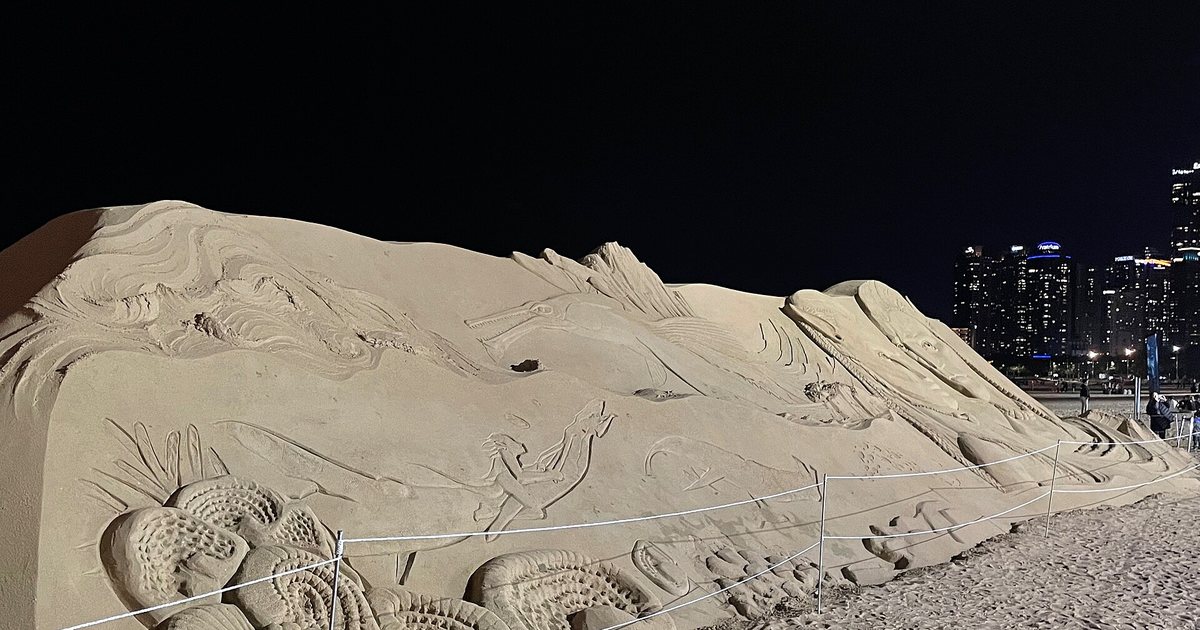
Haeundae is Korea’s best-known beach. It’s a wide curve of pale sand with a wall of hotels and apartment towers behind it. In summer it’s famously packed, with rows of parasols. In the off-season it’s a calm place for a walk, and the restaurants and cafes stay open all year.
Dongbaekseom and Nurimaru APEC House
At the beach’s southwest end, a coastal path loops around Dongbaekseom, a small wooded headland whose name refers to the camellia trees growing on it. On the path you’ll pass Nurimaru APEC House, built for the 2005 APEC summit that Busan hosted, and a lookout across the water to Gwangan Bridge. The loop is easy and takes under an hour at a slow pace.
Haeundae Blueline Park
An old coastal railway between Mipo, at Haeundae’s east end, and Songjeong Beach has become Blueline Park. It runs a slow beach train and small elevated Sky Capsule cars along the cliffs. The capsules book up on weekends, so reserve on the official site. A walking path runs beside the tracks if you’d rather go on foot.
- Area
- Haeundae-gu, east Busan
- Nearest station
- Haeundae (Line 2)
- Time needed
- Half a day with Dongbaekseom and Blueline Park
- Before you go
- Check opening days and fees on the official page
Why Gwangalli Beach (광안리) is best at night
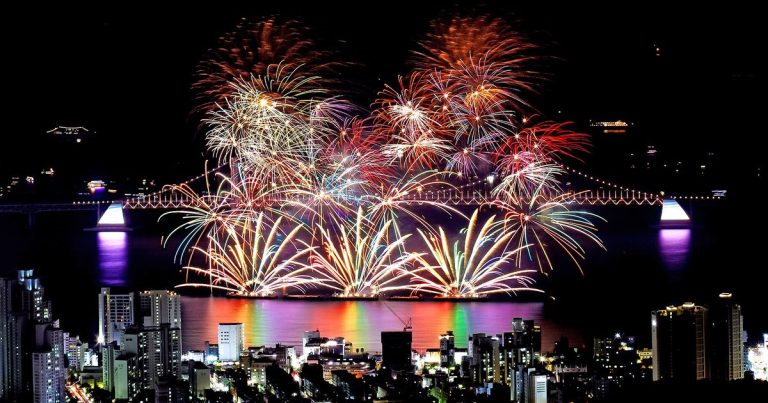
Gwangalli is smaller than Haeundae, and it has the view. Gwangan Bridge (광안대교), a double-deck suspension bridge across the bay, is lit up after dark. The beachfront road is lined with cafes, bars and raw-fish restaurants that face it. Come for dinner and stay for a walk on the sand.
The area draws Busan’s younger crowd, so expect noise and late nights on weekends. At the north end, Millak (민락) has a raw-fish center where locals buy hoe (thinly sliced raw fish) and eat it facing the water.
The bay is also home to the Busan Fireworks Festival each autumn. Our guide to where to watch the Busan Fireworks Festival covers the best spots. Drone light shows have also been staged over the beach on some evenings. Check the official Visit Busan site for current dates, because event schedules change.
- Area
- Suyeong-gu, between Haeundae and downtown
- Nearest station
- Gwangan or Geumnyeonsan (Line 2)
- Time needed
- An evening
- Before you go
- Check opening days and fees on the official page
Gamcheon Culture Village (감천문화마을): how to visit
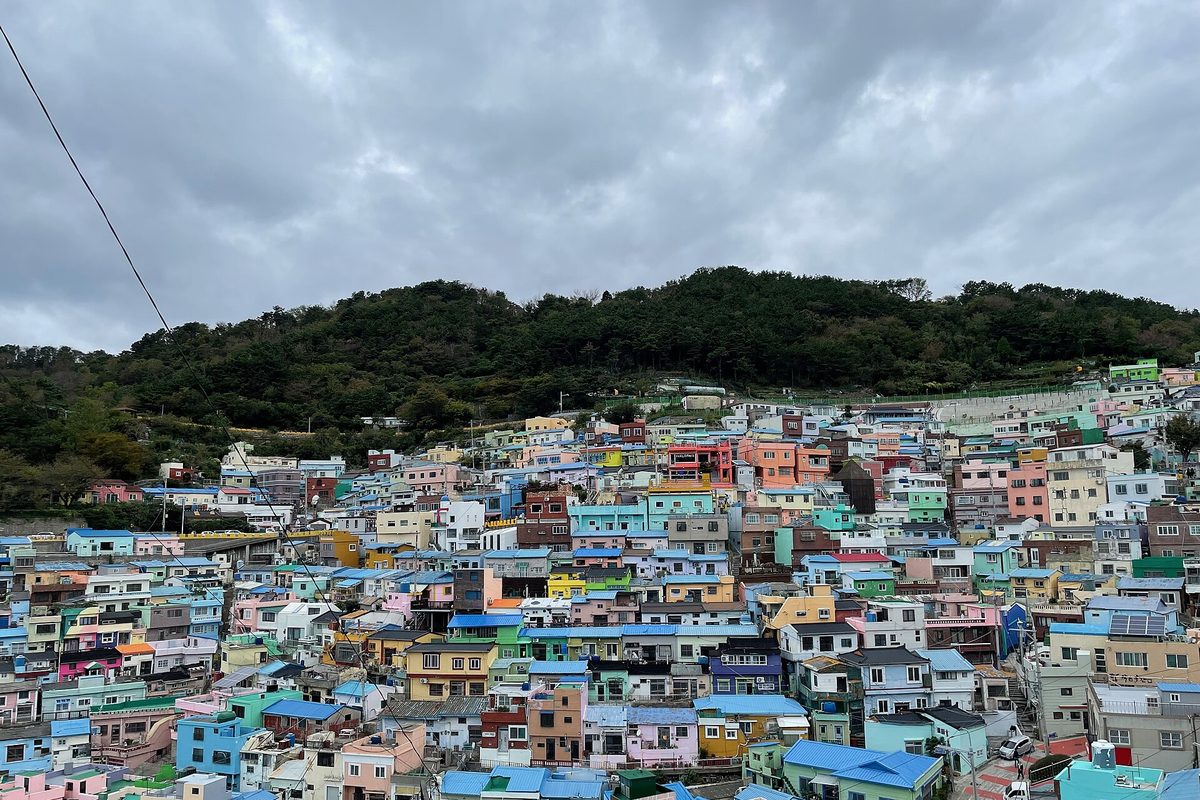
Gamcheon is the photo you’ve already seen: pastel houses stacked in terraces up a steep hill above the sea. Refugees built it during the Korean War, when Busan was one of the few parts of the South that was never captured and people poured in from the rest of the country. Many of the first settlers belonged to a religious community called Taegeukdo.
The village was poor for decades. A local art project starting in 2009 turned its alleys into an open-air gallery, with murals, sculptures and small exhibition spaces in old houses. The best-known stop is a statue of the Little Prince and the fox sitting on a wall above the rooftops. Expect a queue for that photo.
How to get to Gamcheon Culture Village
Take Line 1 to Toseong Station, then a small village bus (maeul bus, a short local route) up the hill, or a taxi. Ride up and walk down. The streets are steep, and walking downhill lets you see more of the village without wearing yourself out. At the information center you can pick up the stamp-trail map, which leads you to the main art spots.
How to behave in Gamcheon
About the people who live here: it’s still a residential neighborhood, and residents have complained about tourist noise. Keep your voice down, stay out of doorways and private stairs, and don’t photograph people without asking.
- Area
- Saha-gu, west Busan
- Nearest station
- Toseong (Line 1), then village bus
- Time needed
- 2 to 3 hours
- Before you go
- Check opening days and fees on the official page
Jagalchi Market (자갈치시장) and Nampo-dong: how the fish market works
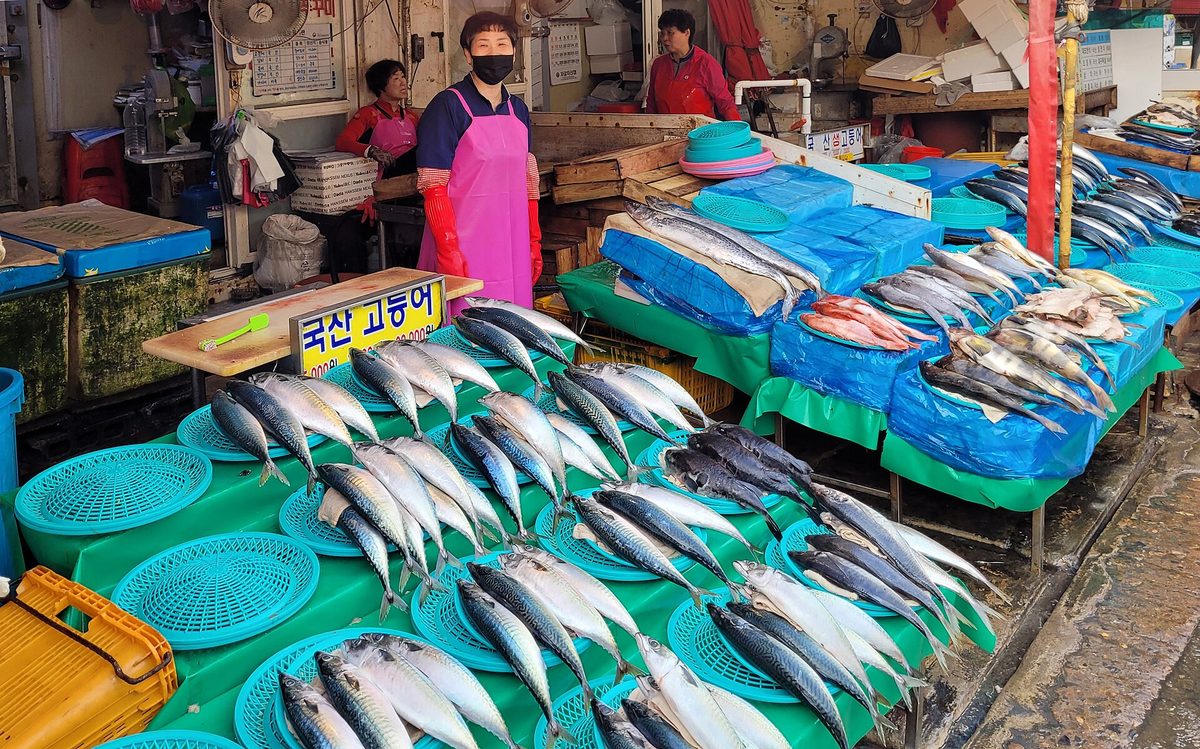
Jagalchi is Korea’s largest seafood market and the heart of the old port. The tanks are full of flatfish, octopus, abalone, sea squirts and crabs. The vendors are famously the Jagalchi ajumma (middle-aged women who run the stalls), and they’ve been selling here for generations.
How to eat at Jagalchi Market in 5 steps
- Walk the ground floor first. Look at several stalls before you buy anything. Prices and quality vary from one to the next.
- Agree on the price before the fish leaves the tank. Seafood is priced by weight and changes daily, so ask for the total, not a rate.
- Say how you want it cooked. The default is hoe, sliced raw. You can also ask for grilled or steamed.
- Follow the vendor upstairs. Restaurants on the upper floor serve your fish and charge a per-person table fee for the sides, lettuce, garlic and dipping sauces. Ask what it is first.
- Finish with maeuntang. This spicy fish stew is made from the leftover head and bones. It costs extra and is the traditional way to end the meal.
For two people new to raw fish, one gwangeo (광어, olive flounder) is a safe pick. It’s mild and firm, and most stalls carry it. Add a few live shellfish for grilling and you’ll have both raw and cooked dishes without over-ordering.
What else to see in Nampo-dong
You can walk to everything else from Jagalchi. BIFF Square is named for the Busan International Film Festival, which began in this neighborhood and now happens each autumn at the Busan Cinema Center in Centum City. It’s where to get ssiat hotteok.
Gukje Market, a sprawling market that grew out of the war years, gave its name to the 2014 film Ode to My Father (국제시장). Bupyeong Kkangtong Market runs a night market with food stalls. Up on the hill, Yongdusan Park and Busan Tower look out over the harbor.
- Area
- Jung-gu, old downtown by the harbor
- Nearest station
- Jagalchi or Nampo (Line 1)
- Time needed
- Half a day with lunch and the markets
- Before you go
- Check opening days and fees on the official page
Haedong Yonggungsa (해동용궁사): the temple by the sea
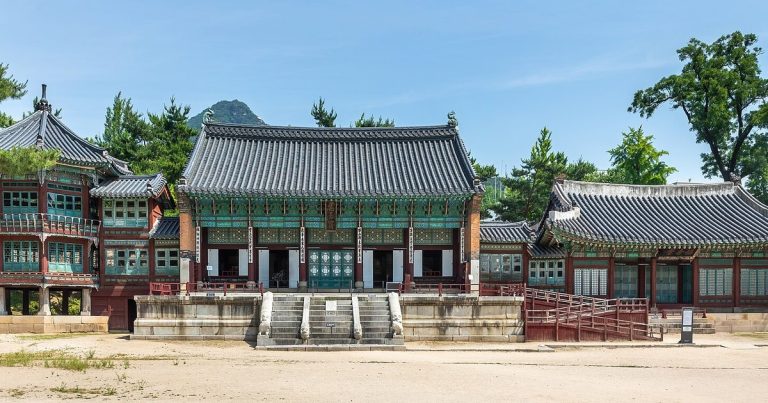
Most Korean Buddhist temples are in the mountains. Haedong Yonggungsa sits on rocks right above the waves in Gijang, on Busan’s northeast coast. The temple dates its founding to 1376 and was rebuilt in the 20th century. Visitors walk down a long stone stairway, traditionally counted as 108 steps (the number of earthly desires in Buddhist teaching), past stone lanterns to halls facing the sea.
Come early in the morning, because tour buses fill it by late morning. Sunrise here is popular, especially on New Year’s Day. Around Buddha’s Birthday, which follows the lunar calendar so its date moves each year, the temple is hung with lanterns and gets very crowded. It’s a working temple: dress modestly, speak quietly and don’t stand in front of people praying.
How to get to Haedong Yonggungsa
Ride the Donghae Line to Osiria Station, then take a short bus or taxi. Pair it with Songjeong Beach, a quieter surf beach nearby, and ride the Blueline Park train back to Haeundae. That covers a full day on the east side.
- Area
- Gijang-gun, northeast Busan
- Nearest station
- Osiria (Donghae Line), then bus or taxi
- Time needed
- 1.5 to 2 hours
- Before you go
- Check opening days and fees on the official page
What to eat in Busan: 7 dishes and where to find them
Busan food is saltier, spicier and more seafood-heavy than Seoul’s, and a lot of it dates from the war years, when the port fed people from all over the peninsula.
| Dish | What it is | Where to try it |
|---|---|---|
| Dwaeji gukbap (돼지국밥) | Milky pork-bone soup poured over rice, seasoned at the table | The gukbap alley in Seomyeon, or almost any neighborhood |
| Milmyeon (밀면) | Chewy wheat noodles in cold broth, or spicy without broth | Noodle shops across the city, best in warm weather |
| Hoe (회) | Thinly sliced raw fish with lettuce, garlic and chili paste | Jagalchi Market, Millak Raw Fish Center at Gwangalli |
| Eomuk (어묵) | Busan-style fish cake, on skewers in broth or fried | Market stalls, Busan Station area, bakery-style fish cake shops |
| Ssiat hotteok (씨앗호떡) | Fried sweet pancake split open and stuffed with seeds | BIFF Square stalls in Nampo-dong |
| Nakgopsae (낙곱새) | Spicy stew of small octopus, beef tripe and prawns, eaten with rice | Local restaurants downtown and in Seomyeon |
| Dongnae pajeon (동래파전) | Thick scallion pancake with seafood, from the old Dongnae district | Restaurants around Dongnae |
Why milmyeon and gukbap are Busan’s signature dishes
People from the North brought naengmyeon (cold buckwheat noodles) with them when they fled south. Buckwheat was scarce, so cooks made the noodles from the wheat flour that came in as relief aid, and that became milmyeon. Dwaeji gukbap followed a similar path: cheap pork bones simmered for hours into a filling soup. Order it plain, then add saeujeot (salted tiny shrimp), chives and chili paste to taste. That’s how locals season it.
What to eat in Busan if you don’t like raw fish
You’ll still eat well. Have gukbap for breakfast, eomuk and ssiat hotteok as snacks, and grilled shellfish or nakgopsae for dinner. At Jagalchi, ask for your fish grilled. If you eat no seafood at all, Seomyeon’s food streets have plenty of Korean barbecue and fried chicken.
How many days in Busan? A 3-day itinerary
Three days lets you see the city without rushing, with one day for the west side, one for the beaches and one for the far northeast coast. The route below assumes you arrive by KTX in the morning.
Day 1: Nampo-dong, Jagalchi and Gamcheon
Drop your bags and ride Line 1 to Jagalchi for a seafood lunch. Take a taxi or bus up to Gamcheon Culture Village in the afternoon. Come back down for ssiat hotteok at BIFF Square and a wander through Gukje Market. Finish at Bupyeong Kkangtong night market or watch the harbor lights from Yongdusan Park.
Day 2: Haeundae and Gwangalli
Walk the Dongbaekseom loop in the morning, then the length of Haeundae Beach. Have lunch near Haeundae Market. In the afternoon, take the Blueline Park train or capsule along the coast. Move to Gwangalli for dinner facing the bridge once it’s lit.
Day 3: Haedong Yonggungsa and Songjeong
Reach the temple early, before the crowds. Walk Songjeong Beach, then head back toward Seomyeon for a bowl of dwaeji gukbap before an afternoon or evening train to Seoul.
With only two days, merge Days 2 and 3: do the temple first thing, then Haeundae and Gwangalli in the afternoon and evening. A fourth day gives you Taejongdae, the cliff park at the tip of Yeongdo island, plus Huinnyeoul Culture Village, a cliffside lane of houses and cafes above the sea that feels quieter than Gamcheon.
FAQ
Is Busan worth visiting if I’ve already seen Seoul?
Yes. It’s the best contrast to Seoul you can reach in one train ride. You get city beaches, a working fishing port, hillside neighborhoods and a regional food culture you won’t find in the capital. Most travellers who skip it end up wishing they’d given it two or three days.
Is 2 days enough for Busan?
Two days covers the highlights if you group them by area: one day for the west (Jagalchi, Gamcheon, Nampo) and one for the east (Haedong Yonggungsa, Haeundae, Gwangalli). You’ll be moving all day, though. Three days is the comfortable minimum.
Is the KTX or a flight better from Seoul to Busan?
For most travellers it’s the KTX, which goes from central Seoul to central Busan in about two and a half hours on the fastest services, with no airport check-in. A flight from Gimpo to Gimhae only makes sense if you’re connecting from an international flight or the trains are sold out. Compare current fares on Korail and the airline sites.
What is the best time to visit Busan?
Spring and autumn have the mildest weather. Autumn also brings the Busan International Film Festival and the fireworks over Gwangalli. Summer is beach season, hot and crowded, especially at Haeundae. Winter is cold and windy by the sea, but it’s often clear and quieter at the sights.
Can you swim at Haeundae Beach?
Yes, during the official summer swimming season, when lifeguards are on duty and swimming zones are marked. Outside that season the beach is for walking. The Busan city and Haeundae district sites post each year’s opening period, so check them before you plan a beach day.
Do people speak English in Busan?
Less than in Seoul, but enough to get by. Metro signs and announcements are in English, and the main sights have English information. At markets and small restaurants, a translation app and pointing at the menu or the tank work fine. Learn the word for “how much” (얼마예요, eolmayeyo) for the fish market.
What to plan after your Busan trip
Busan works well as one stop on a longer route. Gyeongju, the former capital of the Silla kingdom with its royal tombs and temples, is a short train or bus ride north, so you can visit as a day trip or an overnight stop. Gimhae Airport has domestic flights to Jeju, so you can go on to the island without returning to Seoul. Our Jeju Island travel guide explains how to choose between the east and west sides.
Before you book, check the official Visit Busan site for festival dates, beach opening periods and Blueline Park reservations. Then book your KTX seats early, especially for weekends and holidays.
Related reading
Sources letskorail.com · k-korea.blog · visitbusan.net
Prices, opening hours and availability change. Check the official page before you buy or travel.