12 min read
Incheon Airport to Seoul takes roughly 45 to 90 minutes, and you have 4 main ways in: the AREX express train, the AREX all-stop train, a limousine bus or a taxi. Most Koreans pick by where they’re going. The train makes sense for Seoul Station and Hongdae, the bus is easier for Gangnam and the big hotel districts, and a taxi is for late nights, heavy bags or groups.
Incheon International Airport (인천국제공항) sits on Yeongjong Island, west of Seoul. That means every option crosses a long bridge, so the real choice is about how many transfers you can stand with a suitcase. You don’t need to worry about which mode is fastest on paper.
Key takeaways
- The AREX all-stop train stops at Hongik Univ. Station, so it’s the only rail route that drops you straight into Hongdae.
- Limousine buses (리무진 버스) go door to door to major hotels in Gangnam, Myeongdong and Jamsil, and staff load your luggage underneath.
- Buy a T-money card at a convenience store in arrivals. It works on the all-stop train, city buses, the subway and most taxis.
- If you land after about 11 pm, assume the trains are finished and plan for a late-night bus or a taxi.
Incheon Airport to Seoul: which option should you pick?
Start with your hotel’s nearest subway station, not the airport. If it’s on the AREX line or one easy transfer away, take the train. If the transfer would mean carrying bags up stairs at a busy interchange, take the bus. If you’re 3 or 4 people splitting the cost, or it’s late, a taxi often makes the most sense.
| Option | Rough time to central Seoul | Best for | Skip it if | How to pay |
|---|---|---|---|---|
| AREX express train (직통열차) | About 45 to 50 minutes to Seoul Station, nonstop | Hotels near Seoul Station, Namdaemun, City Hall; a guaranteed seat | Your hotel is in Gangnam or Jamsil (two more transfers) | Ticket from machines, counters or the AREX website |
| AREX all-stop train (일반열차) | About an hour to Seoul Station | Hongdae, Mapo, Gongdeok, Gimpo Airport transfers; tight budgets | You need a guaranteed seat at rush hour | T-money or a single-journey card |
| Limousine bus | About 60 to 90+ minutes depending on traffic | Gangnam, Jamsil, Myeongdong and Dongdaemun hotels; big luggage | You’re travelling on a Friday evening or holiday eve, when traffic is heavy | Ticket counter, kiosk, or T-money/card on many routes |
| Taxi | About an hour, traffic dependent | Late arrivals, families, groups, mobility needs | You’re travelling alone on a budget | Card, T-money or cash; tolls added |
Fares change, and different sites quote different numbers. Check current prices on the Incheon Airport official site and the AREX official site before you fly.
AREX express vs all-stop train: which one do Koreans take?
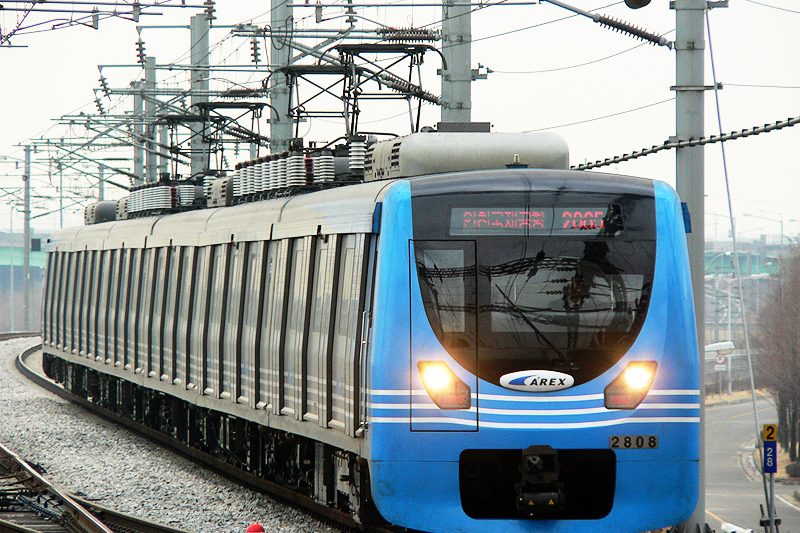
AREX (Airport Railroad Express, 공항철도) is the airport rail line, and it runs two kinds of train on the same track. Both start at Terminal 2, stop at Terminal 1 and end at Seoul Station. They differ on what happens in between.
The express train: nonstop to Seoul Station
The express runs straight from the airport to Seoul Station with no stops. Seats are assigned, there’s room for luggage, and you buy a separate ticket before you board. It’s comfortable and predictable, but it only gets you to Seoul Station. From there you’re on Line 1, Line 4 or the Gyeongui-Jungang Line, or in a taxi.
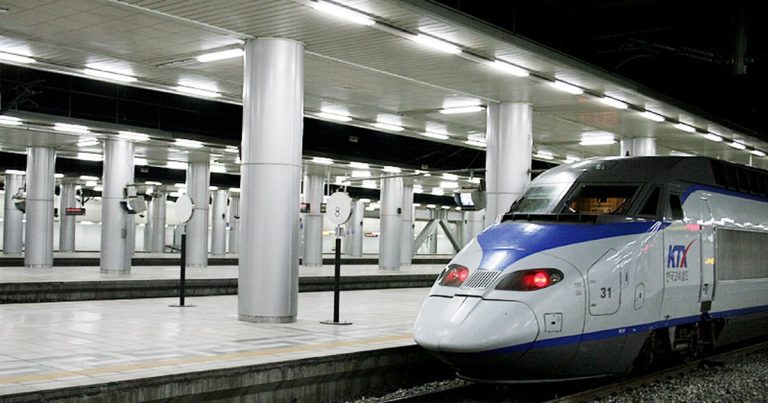
Seoul Station is also where you’d catch a KTX (Korea’s high-speed train) to Busan or Gyeongju, so if you’re heading straight out of the capital, the express is the cleanest link. Our guide to Busan, Gyeongju and Jeju covers where to go next.
The all-stop train: slower, cheaper and more useful
Most Koreans riding into the city take the all-stop train. It’s a commuter train with sideways bench seats, it costs noticeably less than the express, and you pay with a T-money card at the gate like any subway. On the way to Seoul Station it stops at stations including Cheongna International City, Gimpo Airport, Digital Media City, Hongik Univ. and Gongdeok. That’s why it suits so many travellers:
- Hongik Univ. (홍대입구): Line 2 and the Gyeongui-Jungang Line, and the heart of Hongdae.
- Gongdeok (공덕): Lines 5 and 6, handy for Mapo hotels and an easy hop toward Itaewon on Line 6.
- Gimpo Airport (김포공항): Line 9, whose express trains run fast to Yeouido and Gangnam.
- Digital Media City (디지털미디어시티): Line 6, for the Sangam area.
Here’s a worked example. Say your hotel is near Sinnonhyeon in Gangnam, on Line 9. Take the AREX all-stop train to Gimpo Airport, walk through the transfer corridor, and catch a Line 9 express (급행, marked in red) toward Gangnam. That’s one transfer and no stairs-heavy interchange. If that still sounds like too much with two big cases, take the limousine bus.
- Area
- Hongdae, Mapo-gu
- Nearest station
- Hongik Univ. Station (AREX, Line 2, Gyeongui-Jungang Line)
- Time needed
- About an hour from the airport by all-stop train
- Before you go
- check the current timetable and fares on the official AREX page
Airport limousine buses: the easiest ride with luggage
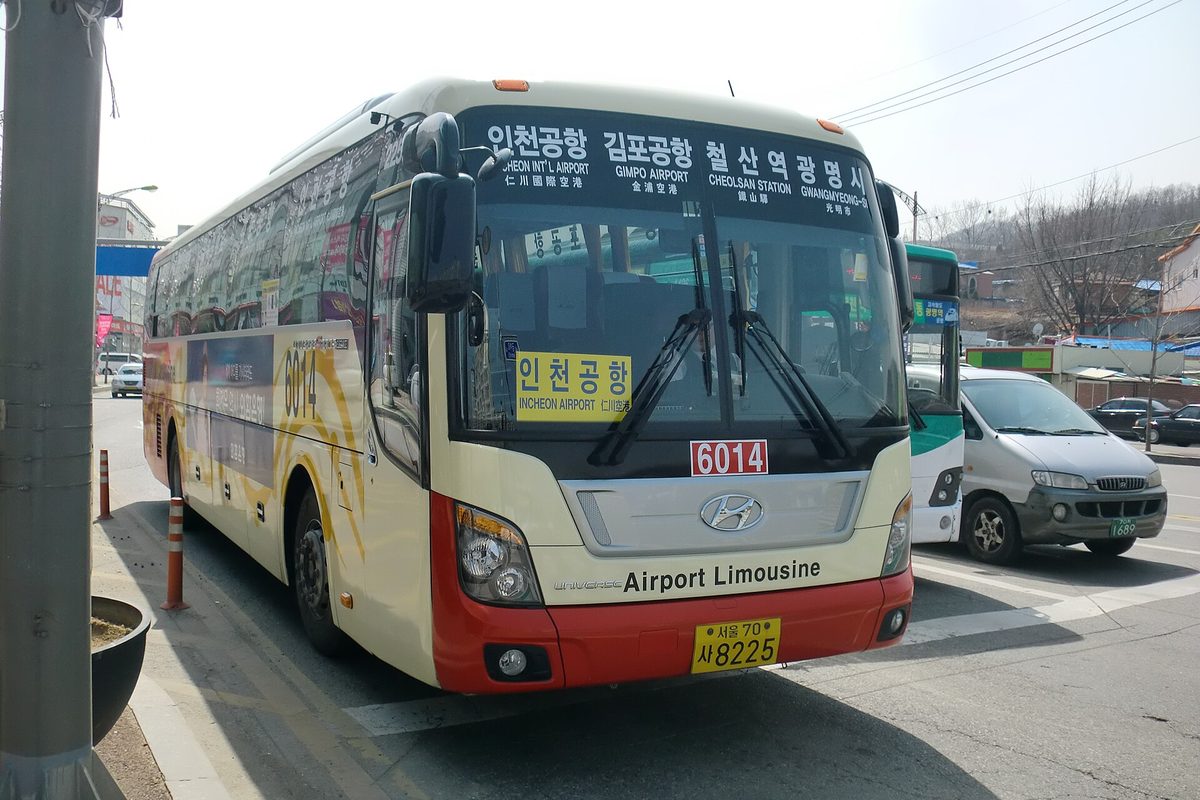
In Korea, a “limousine” (리무진) is a coach bus, not a stretch car. These buses leave from bays right outside arrivals at Terminal 1 and from the transportation center at Terminal 2. Staff load your suitcases underneath, and you don’t touch them again until your stop.
They come in two broad types. Standard airport buses make more stops and cost less. Deluxe limousines have wider seats with three across, and many of them stop right outside major hotels. Routes are numbered and grouped by destination, such as Gangnam, Jamsil, Myeongdong and City Hall, Dongdaemun, Yeouido and Mapo.
How to find the right limousine bus
- Look up your hotel’s district on the Incheon Airport website’s bus search before you fly, and write down the route number.
- In arrivals, buy a ticket at the bus counter or a kiosk, or check whether your route takes T-money or a contactless card on board.
- Find the bay number shown on the overhead screens and queue there.
- Tell the driver or the luggage handler your stop. Announcements are made in Korean and English.
Koreans heading to Gangnam, Jamsil or southern Seoul usually take the bus. Driving there means one trip on the expressway with no transfers, and if you’re staying near COEX or Sinsa the bus may stop within a short walk of your door. Our Gangnam guide maps those neighborhoods.
The bus has one weakness, which is traffic. Friday evenings and the eves of long holidays like Chuseok (추석, the autumn harvest holiday) and Seollal (설날, Lunar New Year) can add a lot of time. On those days the train is the safer bet.
Taxis from Incheon Airport: regular, deluxe, international and jumbo
Taxi ranks sit right outside arrivals, with separate lines for each type. Pick a type before you join the queue.
The 4 taxi types
- Regular taxi (일반 택시): usually white, silver or orange. It’s the cheapest metered option and the one Koreans use day to day.
- Deluxe taxi (모범 택시): black, with a higher base fare and per-km rate. You get more space and drivers with longer records.
- International taxi (인터내셔널 택시): drivers who speak English, Japanese or Chinese, with fixed fares by zone of Seoul. You can book it ahead, and it helps if you’re nervous about explaining an address.
- Jumbo taxi (대형 택시): vans for groups of up to about 8 or for lots of luggage, often priced like a deluxe taxi.
On a metered taxi, expressway tolls are added on top of the fare, so the meter isn’t the whole bill. Regular taxis also add a late-night surcharge. Most taxis take credit cards and T-money, but carry some won in cash in case a card reader fails.
Using Kakao T
Koreans hail almost every taxi through Kakao T (카카오 T), the ride-hailing app from Kakao, which also makes the messenger KakaoTalk. The app has added support for foreign phone numbers and overseas cards, but registration and payment rules shift, so set it up and test it before your flight rather than at the curb. At the airport you don’t need an app. The rank works fine.
T-money at the airport: what to buy before you leave arrivals
T-money (티머니) is Korea’s rechargeable transit card. You tap it on subway gates, city buses, the AREX all-stop train and most taxis, and convenience stores accept it too. Every Seoul resident carries one, either as a card or built into their phone.
- Go to a convenience store in arrivals, such as GS25, CU or 7-Eleven, and ask for a T-money card.
- Pay for the card, then ask the staff to charge it. Charging is usually cash only, so withdraw some won at an airport ATM first.
- Tap in at the AREX gate and tap out at your destination. Transfers to the subway within the time window are discounted automatically.
- Top up at any subway station machine or convenience store later.
You’ll also see prepaid cards made for foreign visitors that combine a T-money function with currency exchange, sold from machines at the airport and around Seoul. They’re useful if you’d rather top up from foreign currency. A plain T-money card is still the simplest buy, and you can keep it for your next trip.
Don’t use T-money for the AREX express train. It needs its own ticket. T-money works on the all-stop train only.
Late-night arrivals at Incheon: what still runs after midnight
This is the question that catches people out. AREX trains stop running a little before midnight, and the subway in Seoul closes around the same time. If your flight lands at 11 pm, by the time you clear immigration and collect bags, the last train may already be gone.
Your late-night options
- Late-night buses: Incheon Airport runs a small number of overnight bus routes into Seoul, numbered with an N. They cover key hubs like Seoul Station rather than every district, so check the routes on the airport website and plan a short taxi ride from the drop-off.
- Taxi: the dependable fallback. The ranks keep working through the night, and regular taxis add a late-night surcharge.
- Stay at the airport: both terminals have rest areas, and there’s capsule-style lodging airside and landside. Some travellers book a hotel on Yeongjong Island near the airport and head into Seoul in the morning.
If you land very early, say before 6 am, flip that logic. Buses and the first trains start in the early morning, so a coffee in arrivals and the first all-stop train is often smarter than a taxi.
Best route from Incheon Airport to Seoul by area
Every Korean friend will ask you the same question first: “Where’s your hotel?” Here’s what they’d tell you.
| Where you’re staying | Best pick | Why |
|---|---|---|
| Hongdae, Yeonnam-dong, Hapjeong | AREX all-stop to Hongik Univ. | Direct, no transfer, cheap with T-money |
| Myeongdong, Namdaemun, City Hall | Limousine bus, or AREX to Seoul Station then Line 4 | The bus stops at major hotels; the train is one short transfer |
| Gangnam, Sinsa, COEX | Limousine bus | No transfers; rail needs a change at Gimpo Airport or Seoul Station |
| Jamsil, Songpa | Limousine bus | Rail involves two transfers across the city |
| Jongno, Insadong, Gwanghwamun | Limousine bus, or AREX to Seoul Station then Line 1 | Both work; pick the bus if you have big bags |
| Itaewon, Yongsan | AREX all-stop to Gongdeok, then Line 6 | One transfer on a quieter line |
| Dongdaemun | Limousine bus | Several routes stop near the big hotels |
| Yeouido | AREX all-stop to Gimpo Airport, then Line 9 express | Line 9 express is fast and direct |
Staying in Myeongdong? Our Myeongdong guide covers what’s near the bus stops. For Hongdae, the Hongdae guide explains its 3 subway lines.
Gimpo vs Incheon: which airport are you flying into?
Seoul has two airports, and some travellers book the wrong one. Incheon (ICN) handles the large majority of international flights, including long-haul routes from Europe, North America and Australia. Gimpo (GMP), in western Seoul, is mainly domestic, with flights to Jeju and Busan, plus a handful of short international routes to nearby cities in Japan, China and Taiwan.
Gimpo is much closer to the city, and it’s on 4 rail lines at once: AREX, Line 5, Line 9 and the Gimpo Goldline. Getting into central Seoul from there feels like an ordinary subway ride. If you’re flying from Tokyo or Osaka, check whether your ticket lands at Gimpo, because it can save you real time.
Need to go between the two airports? The AREX all-stop train links them directly, and so do airport buses. Allow a generous buffer, since the international check-in at Incheon is where queues build.
Terminal 1 or Terminal 2?
Incheon has two passenger terminals several kilometres apart. Airlines are split between them, and the assignments have changed over the years, so check the terminal on your booking or the airport website. A free shuttle bus runs between them, and AREX stops at both. Departing from the wrong terminal is one of the most common ways people miss flights home.
Common mistakes on the first ride into Seoul
- Taking the express train to Gangnam. It ends at Seoul Station, which is north of the river. You’d then need a long subway trip back south. Take the bus.
- Trying to top up T-money with a card. Charging is usually cash only. Get won first.
- Boarding the express with a T-money tap. The express needs a separate ticket. If you tap through the all-stop gates, you’re on the all-stop train.
- Judging a taxi only by the meter. Tolls and any late-night surcharge come on top.
- Booking an “airport hotel” without checking where it is. Yeongjong Island hotels are near Incheon, not near Seoul. Hotels marketed as near Gimpo are a different airport entirely.
- Planning on a 11:30 pm train. Immigration and baggage can take an hour. Build in that time before you count on the last train.
If you’re mapping your whole trip, our 7-day Seoul itinerary shows how to plan around your arrival day.
FAQ
What is the fastest way from Incheon Airport to Seoul?
To Seoul Station, the AREX express train is the fastest fixed option, at about 45 to 50 minutes nonstop. For other parts of the city, the fastest choice depends on transfers. A limousine bus or taxi to Gangnam can beat the train once you count changing lines. Check live traffic and timetables on the day.
Is the AREX express worth it over the all-stop train?
Only if you’re going to Seoul Station and want a guaranteed seat. The all-stop train is cheaper, takes T-money and stops at useful transfer stations like Hongik Univ., Gongdeok and Gimpo Airport. Most locals take the all-stop train.
Can I use T-money on the airport bus and taxi?
Most taxis accept T-money, and many airport bus routes accept T-money or contactless cards on board. Some limousine routes still expect a ticket bought at the counter. Check your route on the Incheon Airport website before you go.
How do I get from Incheon Airport to Seoul after midnight?
Trains will have stopped, so your options are a late-night airport bus (routes numbered with an N) or a taxi. Night buses cover main hubs only, so expect a short taxi ride from the drop-off. Regular taxis add a late-night surcharge on top of the meter and tolls.
Should I take a taxi from Incheon Airport to Seoul?
A taxi makes sense if you’re 3 or more people, arriving late, travelling with kids or carrying a lot of luggage. For a solo traveller in daylight, the train or bus costs far less. Expressway tolls are added to the metered fare.
Is Gimpo or Incheon closer to Seoul?
Gimpo is much closer, since it’s inside Seoul’s western edge and on 4 rail lines. Incheon is on an island further west and handles most international flights. Check which one your ticket names before you plan your transfer.
What to plan before you land at Incheon
Do three things before your flight. First, look up your hotel’s nearest station and its address in Korean. Second, check the current AREX timetable and your limousine bus route on the official sites. Third, if you land late, decide in advance whether you’re taking the night bus, a taxi or a bed at the airport. With those sorted, the trip into the city is easy.
Once you’re in, use your first free afternoon well. Our list of 25 things to do in South Korea is a good place to start.
Related reading


Sources airport.kr · arex.or.kr · k-korea.blog
Prices, opening hours and availability change. Check the official page before you buy or travel.