
13 min read
How to pay in Korea as a foreigner comes down to 4 tools: a card, some cash, T-money and an app. A Visa or Mastercard covers most shops, restaurants and taxis, a T-money transit card handles subways and buses, and a small stack of won (Korea’s currency) covers markets, street food and card top-ups.
Get those four sorted before you land and you will rarely hit a payment wall. The main traps are kiosks and apps built for Korean cards, cash-only top-up machines, and your own bank’s foreign transaction fees.
Key takeaways
- Visa and Mastercard work at most shops, cafes, convenience stores and taxis; American Express is accepted less often, so carry a backup.
- T-money (티머니), the rechargeable transit card, is bought and topped up at convenience stores and subway stations, and top-ups are usually cash only.
- Traditional markets, street food carts and some small family restaurants still prefer cash in small notes.
- Korea has no tipping culture: the price on the menu is what you pay, and leaving extra can cause confusion.
How to pay in Korea as a foreigner: the 4 methods compared
Korea is one of the most card-friendly countries you can visit. Locals pay for a single bottle of water or a coffee with a card, and many younger Koreans barely carry cash. For visitors that is mostly good news, with a few gaps worth knowing about.
Here is how each method lines up against what you will actually do on a trip.
| Method | Best for | Where it struggles | Set it up |
|---|---|---|---|
| Foreign credit or debit card (Visa, Mastercard) | Shops, restaurants, cafes, convenience stores, hotels, most taxis | Some self-order kiosks, Korean shopping and delivery apps, small market stalls | Tell your bank you are travelling; check its foreign transaction fee |
| Cash (Korean won) | Traditional markets, street food, T-money top-ups, small rural shops | Large amounts are bulky; some cafes and kiosk shops are cashless | Withdraw at a global ATM or exchange at the airport or in the city |
| T-money card (티머니) | Subway, city buses, many taxis, convenience store snacks | Topping up usually needs cash; it is a transit card, not a bank card | Buy at a convenience store or station machine on arrival |
| Mobile pay (Apple Pay, Google Pay, Kakao Pay, Naver Pay) | Some contactless terminals and merchants that show the right logo | Many local wallets want a Korean phone number or Korean card | Check what your wallet supports in Korea before you fly |
If you remember one rule, make it this: card first, cash as backup, T-money for transit. Mobile pay is a bonus, not a plan.
Do foreign credit cards work in Korea?
Yes, in the large majority of places. Card readers are everywhere, from department stores in Myeongdong to the 24-hour convenience stores (GS25, CU and 7-Eleven are the big chains) on almost every block. You will often hand your card to the cashier, who inserts it and hands it back, or you will insert it yourself on a small terminal facing you.
Visa and Mastercard vs American Express
Visa and Mastercard are the safe choices. American Express and Discover work at hotels, department stores and many chains, but acceptance drops at smaller places. If Amex is your main card, bring a Visa or Mastercard as well. Two cards from two different networks also protect you if one gets blocked by your bank’s fraud system mid-trip.
Paying for taxis with a foreign card
Most Korean taxis have a card reader near the meter and take foreign cards as well as T-money. Say “kadeu-yo” (카드요, “card, please”) as you arrive, or simply show your card. If you book through a taxi app such as Kakao T, check inside the app whether a foreign card can be registered at the time you travel; many visitors book in the app and pay the driver directly instead.
Where foreign cards get rejected
The gaps are mostly digital. Self-order kiosks in fast-food chains and cafes sometimes decline overseas cards, and many Korean shopping, ticketing and food-delivery apps are built around Korean-issued cards and identity checks with a Korean phone number. When a kiosk refuses your card, go to the counter: staff can usually take the same card on their own terminal.
Always pay in won
Some terminals, especially at duty-free shops and hotels, offer to charge you in your home currency. This is called dynamic currency conversion (DCC), and the exchange rate it uses is usually worse than your card network’s. Choose won (KRW) every time.

Where you still need cash in Korea
Cash has shrunk in Korea, but it has not disappeared. It still matters in exactly the places many visitors want to go.
- Traditional markets (시장, sijang) such as Gwangjang Market and Namdaemun Market in Seoul. Many vendors now take cards or bank transfers, but small food stalls often prefer cash, and it speeds everything up.
- Street food carts selling tteokbokki (spicy rice cakes), hotteok (sweet filled pancakes) or fish cakes on skewers.
- T-money top-ups at station machines and convenience stores.
- Small family restaurants, rural shops and some temple or village stalls outside the big cities.
Which notes and coins to carry
Korean won comes in 1,000, 5,000, 10,000 and 50,000 won notes, plus 10, 50, 100 and 500 won coins. Carry a mix of 1,000 and 10,000 won notes. Street vendors handling small sums will not thank you for a 50,000 won note, and station top-up machines work best with smaller notes.
How much cash to bring
There is no single right number, because prices and your plans vary. A practical approach: keep enough for a day of market snacks and a T-money top-up, and refill from an ATM when it runs low. Exchange rates move, so check the live rate with your bank or a currency app before you work out a budget.
Which ATMs in Korea take foreign cards?
Not every Korean ATM accepts overseas cards, and that confuses first-timers. Look for machines labelled “Global ATM” or showing the logos of your card network (Visa, Plus, Mastercard, Cirrus, Maestro and so on). You will find them at Incheon and Gimpo airports, inside many convenience stores, in subway stations and at branches of major banks.
- Find a machine marked Global ATM or with your network’s logo.
- Press the language button and choose English.
- Select withdrawal from your overseas card, enter your PIN and choose the amount.
- When offered a conversion into your home currency, decline it and withdraw in won.
Two charges can apply: a fee from the ATM operator, which the screen should show before you confirm, and a fee from your own bank. Withdrawing a larger amount less often usually keeps fees down. Use a four-digit PIN if you can; some Korean machines handle longer PINs poorly, so ask your bank before you travel.
Currency exchange counters are the alternative. Airport counters are convenient for a first batch of cash, and licensed money changers in tourist districts such as Myeongdong are widely used by visitors. Compare the posted rates before you hand over your money.
T-money card: how to buy, top up and use it
T-money (티머니) is a rechargeable transit card used on subways and buses across Seoul and in most other Korean cities, as well as in many taxis and convenience stores. You tap it on a reader; the fare comes off the balance. It is the single thing that makes getting around Korea painless, and buying one should be your first errand after landing.
How to get a T-money card in 4 steps
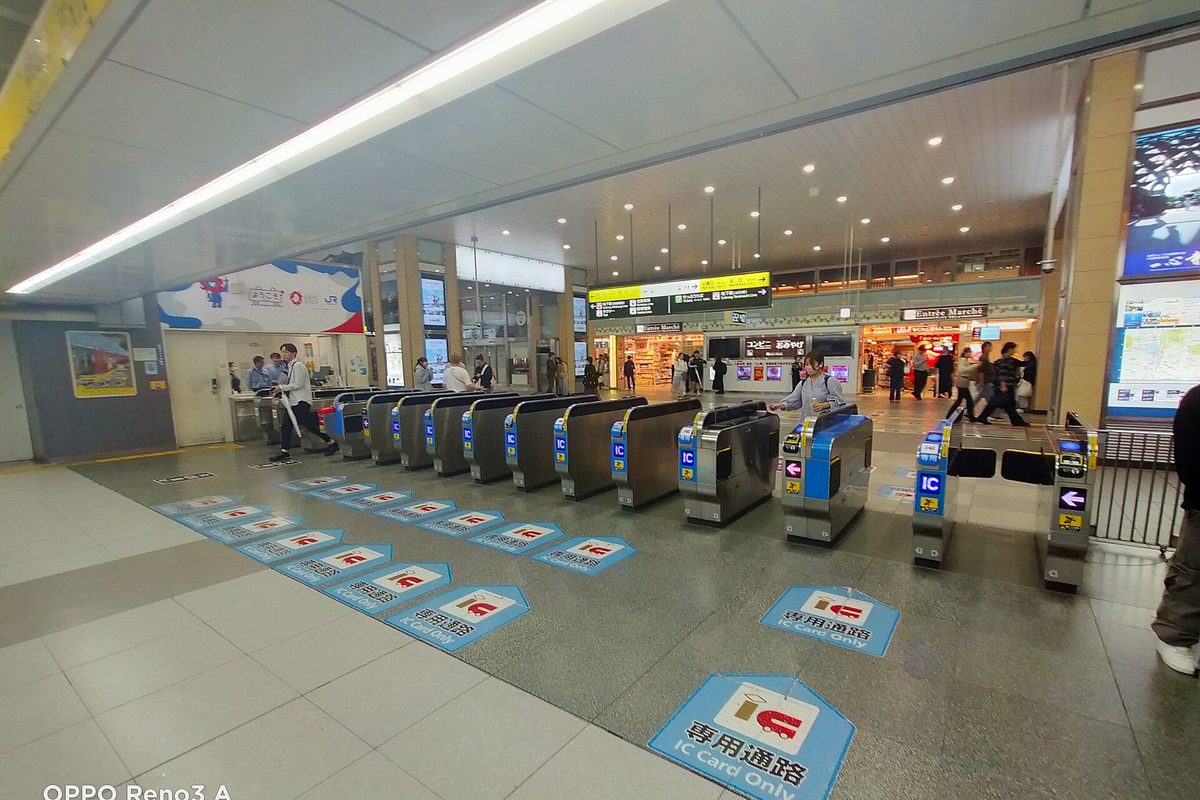
- Buy the card at a convenience store (GS25, CU, 7-Eleven and others) or a vending machine in a subway station. The card itself has a small purchase price separate from your balance; check the T-money official site for current details.
- Top it up (충전, chungjeon, meaning charge). At a convenience store, hand the card and cash to the cashier and say “T-money chungjeon.” At a station, use the charging machine, switch it to English, place the card on the reader and insert notes.
- Tap in and tap out. On the subway, tap at the gate going in and coming out. On buses, tap when you board and again when you get off, because tapping out lets the system apply the transfer discount if you switch to another bus or the subway.
- Check your balance on the station charging machine or the display at the gate, and top up before it runs low.
Using T-money in shops and taxis
Most convenience stores accept T-money for purchases, which is handy for using up a leftover balance before you fly home. Many taxis take it too. Just do not treat it as your main wallet: it is tied to cash top-ups, and if you lose an unregistered card, the balance goes with it.
Prepaid tourist cards with a transit function
Several prepaid cards aimed at foreign visitors, such as WOWPASS, combine a payment card you load with money and a T-money-style transit function. They can be useful if your home bank charges heavy foreign fees. Features, top-up methods and fees change, so compare them on each card’s official site before deciding. Some cities and transit operators also sell their own visitor passes; check the city’s tourism site for current options.
Mobile pay in Korea for tourists: Apple Pay, Kakao Pay and Naver Pay
Korea’s mobile payment scene is huge, but much of it is built for Koreans. Kakao Pay (from Kakao, the company behind the KakaoTalk messenger) and Naver Pay (from Naver, Korea’s biggest search portal) are everywhere, and Samsung Pay is common on Korean Galaxy phones. Signing up for most of these normally requires a Korean phone number, a Korean bank account or both.
Does Apple Pay work in Korea with a foreign card?
Apple Pay is available in Korea, but support has centred on Korean-issued cards and on terminals that accept contactless payment. A foreign card in your Apple Wallet may work at some contactless terminals, especially at larger chains, yet you should not rely on it. Carry the physical card. The same goes for Google Pay: treat a successful tap as a pleasant surprise.
Wallets from your home country
Some international wallets are accepted at Korean merchants that display a partner logo near the till. Visitors from China and other parts of Asia often use their own wallets this way. If you use a mobile wallet at home, open its app and check whether it lists Korea as a supported destination and which logo to look for.
For the apps that are worth downloading anyway (maps, translation, taxis), see our list of the best apps for Korea travel, and if you are deciding how to stay online, our comparison of Korea eSIM vs SIM card vs pocket Wi-Fi covers which options give you a Korean phone number.
Do you tip in Korea?
No. Tipping is not part of Korean culture in restaurants, cafes, taxis, hair salons or bars. The menu price is the final price, and service is built in. If you leave cash on the table, a server may run after you to return it.
The exceptions are narrow. Some upscale hotels and restaurants add a service charge to the bill, which will be printed on it, so there is nothing extra to add. Private tour guides and drivers on tours aimed at foreigners sometimes accept tips, but it is not expected. A warm “gamsahamnida” (감사합니다, thank you) does the job.
Prices also include VAT, Korea’s value-added tax, at most shops, so what you see on the shelf is what you pay at the till. If you are coming from the US, that combination of no tip and no added tax makes budgeting simpler than at home.
Getting tax back on shopping
Shops displaying a “Tax Free” or “Tax Refund” sign can process a refund on eligible purchases for foreign tourists. Bring your passport when you shop. Some stores deduct the refund at the till; otherwise you claim it at a refund kiosk or counter, often at the airport. Rules and minimum amounts change, so check the details at the store or on the official Korea tourism site. For where to put that to use, see our guide to where to shop in Seoul.
Check your bank’s foreign fees before you fly
The cost of paying in Korea depends less on Korea and more on your own bank. Many US cards charge a foreign transaction fee on every purchase abroad, while some travel-focused credit cards and accounts charge none. ATM withdrawals can carry both a flat fee and a percentage from your bank, on top of the Korean ATM operator’s fee.
Before your trip, spend ten minutes on these checks:
- Foreign transaction fee: look in your card’s terms or app. If it charges one, consider bringing a card that does not for daily spending.
- ATM fees abroad: ask whether your debit card charges per withdrawal, and whether it refunds third-party ATM fees.
- Travel notice: some banks still want to know where you are going; others rely on fraud monitoring. Either way, make sure you can approve transactions from your phone while abroad.
- PIN: confirm you know your card’s PIN. Korean terminals sometimes ask for it, and ATMs always do.
A worked example: one day of paying in Seoul
Picture a first full day. You land at Incheon, withdraw won from a Global ATM in arrivals, then buy a T-money card at the airport convenience store and top it up with cash. The airport train and the subway into the city go on T-money.
Breakfast at a cafe goes on your Visa. Lunch at Gwangjang Market is cash: a plate of bindaetteok (mung bean pancake) and some gimbap (rice rolls in seaweed) paid with 10,000 won notes. A late-afternoon shopping run in Myeongdong goes on your card, with your passport ready for tax refunds. That night a taxi back to the hotel takes either your card or your T-money.
By bedtime you have used all four methods except mobile pay, and you never needed to tip. That is a normal Korean day.
Korean words for paying
You can get through every transaction by pointing at a card reader, but a few words make it smoother.
| English | Korean | Romanization | When to use it |
|---|---|---|---|
| Card, please (polite) | 카드요 | kadeu-yo | Handing over your card at a till or in a taxi |
| Cash | 현금 | hyeongeum | Asking if cash is fine, or hearing a vendor ask |
| Charge / top up | 충전 | chungjeon | Topping up T-money at a convenience store |
| Currency exchange | 환전 | hwanjeon | Signs at exchange counters and banks |
| Receipt, please (polite) | 영수증 주세요 | yeongsujeung juseyo | Asking for a receipt after paying |
| Thank you (polite) | 감사합니다 | gamsahamnida | After any purchase; your substitute for a tip |
Common mistakes foreigners make when paying in Korea
- Arriving with zero won. You can survive the airport on a card, but your T-money top-up and first street snack will want cash.
- Relying on one card. A fraud block from your home bank at 10 p.m. Seoul time can leave you stuck. Carry two cards on two networks.
- Accepting home-currency conversion. Pay and withdraw in won.
- Forgetting to tap out on buses. You can lose the transfer discount.
- Expecting every app to work. Korean delivery and booking apps often need a Korean card or phone number; use the counter, the hotel front desk or a foreigner-friendly booking site instead.
- Breaking a 50,000 won note at a street cart. Keep small notes for small sellers.
Packing your cards and cash sensibly is part of the plan too; our Korea travel packing list covers what else to bring.
FAQ
Can I use my US credit card in Korea?
Yes. Visa and Mastercard are widely accepted at shops, restaurants, convenience stores, hotels and most taxis. American Express works at many larger businesses but less at small ones. Check your card’s foreign transaction fee before you go.
Is Korea a cashless country?
Close to it, but not completely. Cards dominate everyday spending, while traditional markets, street food stalls and T-money top-ups often still need cash. Carry a modest amount of won in small notes.
Can I buy T-money with a credit card?
Station machines and convenience stores generally expect cash for buying and topping up T-money, though this can vary by store. The safest plan is to have won ready. Prepaid tourist cards with a transit function let you load money in other ways; check their official sites.
Do I need to tip in Korean restaurants or taxis?
No. Korea has no tipping custom, and leaving money can confuse staff. Some high-end hotels and restaurants add a service charge to the bill, which is already included in the total.
Where can I withdraw money in Korea with a foreign card?
Use ATMs marked “Global ATM” or showing your card network’s logo, found at airports, in many convenience stores, in subway stations and at major bank branches. Choose English, withdraw in won and decline any home-currency conversion.
Does Apple Pay work in Korea for tourists?
Sometimes, at contactless terminals, but support has focused on Korean-issued cards, so a foreign card in Apple Wallet is not reliable. Bring your physical card. Local wallets such as Kakao Pay and Naver Pay usually need a Korean phone number or bank account.
What to set up before your Korea trip
A week before you fly, check your cards: confirm the foreign transaction fee, the ATM fees abroad and your PIN, and pack a second card on a different network. Look up whether your mobile wallet supports Korea, and if your bank’s fees are steep, compare prepaid tourist cards on their official sites.
On arrival, do two things in the airport: withdraw some won at a Global ATM and buy a T-money card. After that, Korea’s payment system mostly gets out of your way. If you are still sorting out entry rules, our guide to the South Korea visa for US citizens covers K-ETA and what to check before departure.
Related reading


Sources k-korea.blog
Prices, opening hours and availability change. Check the official page before you buy or travel.