13 min read
There are about 10 core Buldak flavors, and the creamy ones are the gentle end of the scale. If you’re new to Samyang’s fire noodles, start with Carbonara or Rosé, move to the Original once you’re comfortable, and leave the black 2x Spicy pack for last.
Below you’ll find each flavor family, a heat ladder ranked 1 to 10, the tricks Koreans use to eat it without suffering, and where to buy the packs in Korea and abroad.
Key takeaways
- Buldak (불닭) means “fire chicken.” The noodles have no soup, just a thick sauce you stir through once most of the water is drained.
- The creamy flavors (Carbonara, Rosé, Cheese) sit at the bottom of the heat ladder. 2x Spicy (핵불닭, “nuclear” Buldak) sits near the top.
- In Korea people rarely eat it plain: a slice of cheese, an egg, or rice to finish the sauce is the normal way.
- Lineups change by country, so the pack in your local store might not be sold in Seoul, and the reverse is true too.
What is Buldak, and why did it go viral?
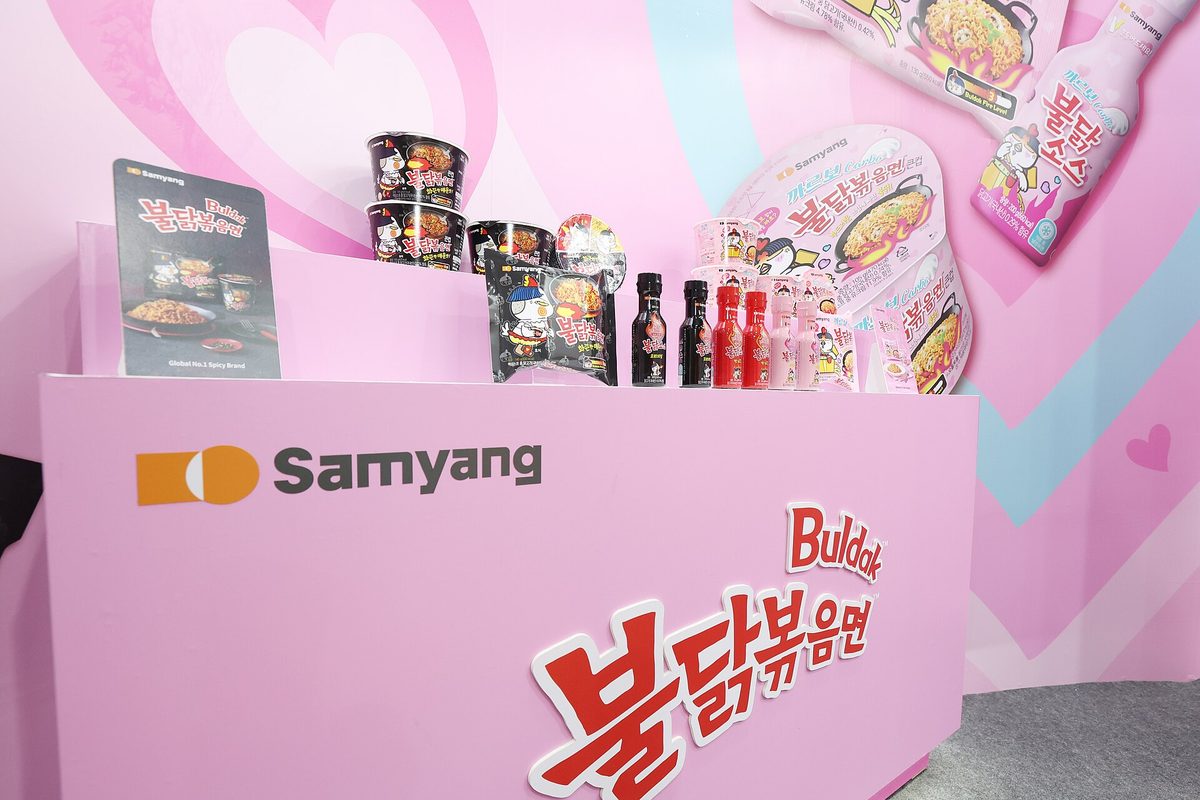
Buldak Bokkeumyeon (불닭볶음면) is an instant noodle made by Samyang Foods, one of Korea’s oldest ramyeon companies. The name breaks down simply: bul is fire, dak is chicken, and bokkeum-myeon means stir-fried noodles. It came out in 2012. The aim was to recreate the very spicy chicken dishes Korean diners queue for. The cartoon chicken on the pack is the brand mascot, Hochi (호치).
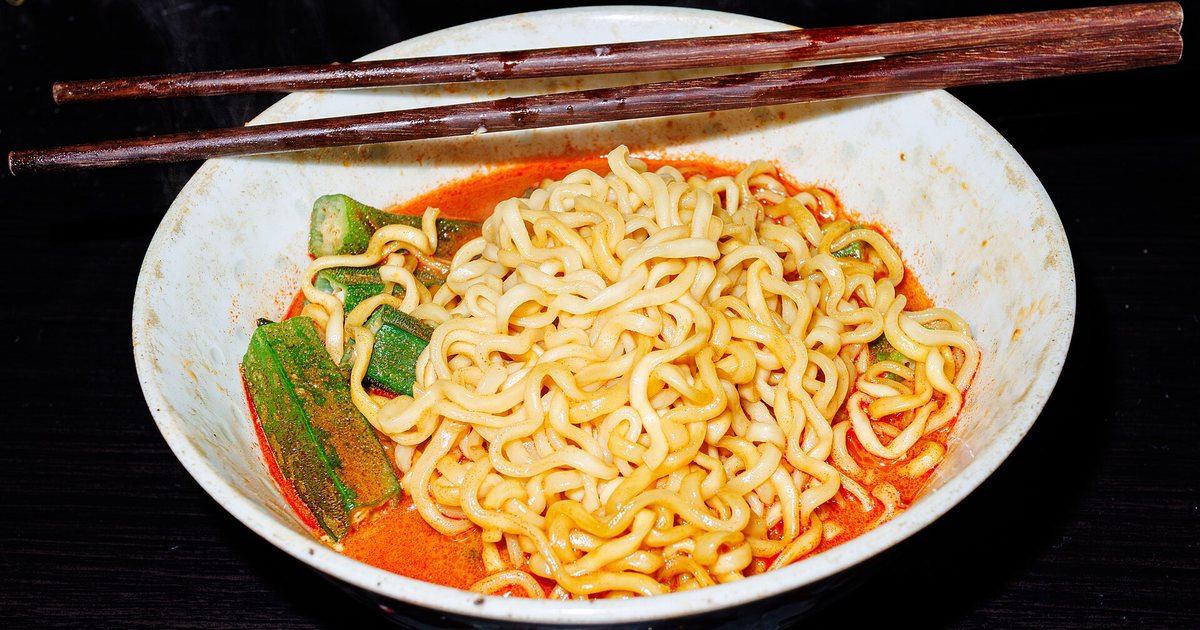
The format is what sets it apart from a normal bowl of ramyeon (Korean instant noodles). You boil thick, chewy wheat noodles, pour off nearly all the water, then stir in a dark red, sweet-hot sauce and a sachet of toppings, usually toasted seaweed and sesame. What you get is closer to a sticky stir-fry than a soup, and because the sauce clings to every strand, the heat feels stronger than in a soup noodle of similar spiciness.
It reached the rest of the world through YouTube. In the mid-2010s the “Fire Noodle Challenge” took off: creators filmed themselves trying to finish a full portion while sweating and reaching for milk. That gave Buldak a reputation outside Korea well before most foreign shoppers had seen a pack. Today it’s one of the Korean food brands people abroad know best, and Samyang keeps the attention going with spin-off flavors, sauces and limited editions.
Every main Buldak flavor, explained
Samyang’s lineup changes often and differs by market, so treat this as a map of the flavor families rather than a complete catalogue. Each one keeps the Buldak sauce as its base and changes what goes with it.
Original Buldak (불닭볶음면)
This is the black-and-red pack, and it’s the benchmark the others are measured against. The sauce is sweet first, then hot. The heat comes from chilli and a smoky, roasted-chicken flavor. For most people who eat spicy food regularly it’s hot but manageable. If you’ve never had anything spicier than a mild salsa, it will feel like a lot.
2x Spicy, or Haek Buldak (핵불닭볶음면)
Haek means “nuclear” in Korean slang, and that’s the idea. The sauce is noticeably hotter than the Original and less sweet, so the burn has nothing to cover it. This is the pack used in most challenge videos. Samyang has also sold limited extra-hot editions in some markets, including a 3x Spicy version, so check the pack before you assume black means 2x.
Carbonara Buldak (까르보불닭볶음면)
Pink packaging, and a powdered cream-and-cheese sachet that turns the sauce orange and silky. Carbonara here means a creamy Korean take on the idea, not the Roman egg-and-pork dish. It’s still spicy, but the dairy flavor softens the heat a lot. Ask Koreans which Buldak to try first and this is the one they’ll usually name.
Cheese and Quattro Cheese Buldak (치즈불닭, 쿼트로치즈불닭)
Yellow packs with cheese powder added to the sauce. The plain cheese version has a salty, snack-like flavor. Quattro Cheese blends several cheese flavors and tastes richer. Both are in the gentler half of the lineup.
Rosé Buldak (로제불닭볶음면)
Rosé is the Korean name for a tomato-cream sauce that became hugely popular in Korean cafés and tteokbokki shops (spicy rice-cake restaurants). The Buldak version is creamy and slightly tangy, and it’s one of the mildest in the range. If you liked vodka-sauce pasta, this one will feel familiar.
Jjajang Buldak (짜장불닭볶음면)
Jjajang is the black bean sauce from jjajangmyeon, the Korean-Chinese noodle dish delivered to offices and homes across Korea. Mixing it with Buldak gives an earthy, slightly sweet, savory flavor and less sharp heat than the Original. It works for people who want depth more than fire.
Curry Buldak (커리불닭볶음면)
Korean-style curry is mild and turmeric-yellow, the kind sold in powder blocks at every supermarket. Here it’s layered over the Buldak sauce, and the warm spice taste spreads the heat out. It’s moderately hot and more aromatic than the Original.
Habanero Lime Buldak (하바네로라임불닭)
This one is citrusy and sharp, with the fruity burn habanero chillies are known for. The lime cuts through the sweetness. Heat-wise it’s around the Original or a little above, and the sourness makes it feel lighter even though it isn’t milder.
Other spin-offs: mala, kimchi, stew-style and sauces
Samyang regularly adds variations. Over the years these have included mala (the numbing Sichuan peppercorn spice), kimchi, soup-style “tang” versions, Buldak tteokbokki, and a bottled Buldak sauce you can put on anything. Some are permanent, some are seasonal, and some are only made for certain countries. Samyang’s official site and the shelves of your local Asian grocer will show what’s sold where you live.
Buldak flavors ranked by spice level, mildest to hottest
Here is our 1 to 10 order. Rather than quoting Scoville (SHU) figures, which vary by pack and market, we’ve placed each flavor by how its sauce is built: dairy and other base flavors pull the heat down, while extra chilli concentrate pushes it up. Many packs show a spice-level indicator on the front, and Samyang’s official site lists products by region. Check both for the exact pack you’re holding.
| Rank | Flavor | Heat tier | What tames or raises the heat | Best for |
|---|---|---|---|---|
| 1 | Rosé | Gentle | Tomato-cream powder coats the chilli | First-timers, kids who like a bit of spice |
| 2 | Carbonara | Gentle | Cream-and-cheese powder coats the chilli | First-timers |
| 3 | Quattro Cheese | Gentle | A blend of cheese flavors adds fat and salt | Richer snack-style bowls |
| 4 | Cheese | Gentle | Cheese powder adds fat and salt | Snack-style bowls, mixing with toppings |
| 5 | Jjajang | Warm | Black bean sauce adds sweetness and body | People who want savory more than fiery |
| 6 | Curry | Warm | Curry spice spreads the heat out | Eating with rice |
| 7 | Original | Hot | The baseline sweet-hot sauce, nothing added | Anyone who eats spicy food weekly |
| 8 | Habanero Lime | Hot | Fruity habanero chilli, lime instead of sweetness | Heat fans who want a sharper burn |
| 9 | Mala | Hot | Numbing Sichuan peppercorn on top of the chilli | Heat fans who want a different kind of burn |
| 10 | 2x Spicy (Haek Buldak) | Very hot | Stronger chilli concentrate, less sweetness | Seasoned chilli-heads, challenge attempts |
| * | 3x Spicy (limited) | Extreme | Samyang’s hottest widely sold limited edition | Only if 2x feels easy |
* 3x Spicy sits outside the 1 to 10 ranking because it’s a limited edition sold only in some markets, not part of the regular lineup.
Two warnings with this table. Between neighboring ranks, people often disagree about which flavor is hotter, because sweetness and acidity change how heat feels. And cup versions can taste stronger than the packet of the same flavor, because the noodles are smaller and less of the water gets drained. More on that below.
How Koreans actually eat Buldak
In Korea, Buldak is mostly a convenience-store meal, and the way people eat it has its own routine. Students and office workers buy a cup, add hot water from the dispenser by the window counter, then eat it with whatever else is in the fridge section. Very few people treat it as a test of endurance.
The cheese slice
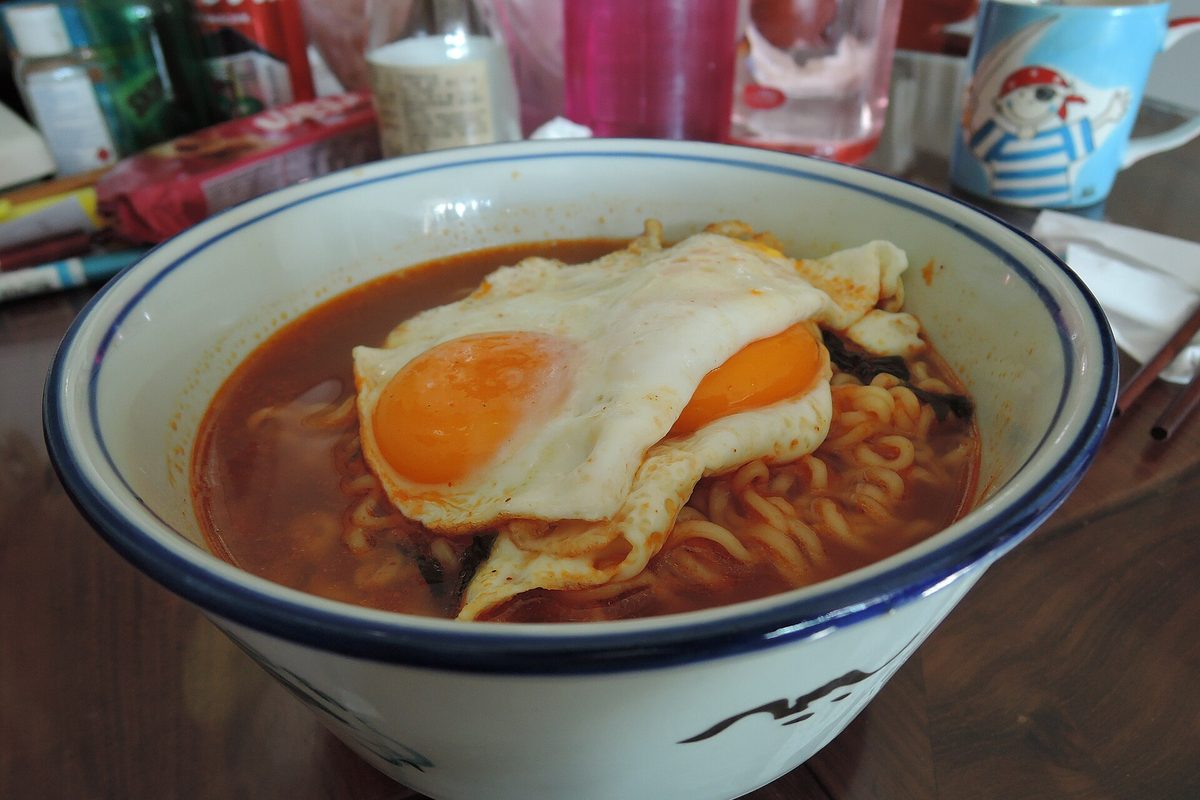
The most common upgrade is a slice of processed cheese laid on the hot noodles to melt. Shredded mozzarella, microwaved for a few seconds, does the same thing more stretchily. Either way the fat cuts the burn. Samyang later released Cheese versions of Buldak too.
Egg, mayo and rice
A fried egg with a runny yolk, or a soft-boiled egg from the convenience store, goes on top. Some people add a squiggle of mayonnaise, a habit borrowed from Korean street snacks. When the noodles are gone, a lot of Koreans tip a bowl of rice into the leftover sauce and mix it into a quick fried rice. Nobody wastes the sauce.
The convenience store combo
A typical combo is a Buldak cup with a samgak gimbap (a triangle-shaped rice ball wrapped in seaweed) and a cold drink. Milk-based drinks work best: banana milk or Coolpis (쿨피스), a sweet peach-yogurt drink that Koreans often drink with spicy food. Water just spreads the chilli oil around your mouth.
Mixing it with plain ramyeon
Another common trick is to cook one Buldak and one plain, non-spicy ramyeon together, drain them, and use only the Buldak sauce. Twice the noodles with the same amount of sauce roughly halves the heat. Some people mix in jjajang instant noodles instead, and Samyang later released a Jjajang Buldak.
How to make Buldak less spicy
None of these tricks need special ingredients, and you can combine them.
- Use half the sauce. This is the simplest fix and it works. Keep the rest in the fridge for fried rice or to brush on chicken.
- Add dairy. A slice of cheese, a splash of milk or a spoonful of cream cheese stirred in while the pan is still hot. The fat binds capsaicin (the compound that makes chilli burn).
- Add volume. More noodles, an egg, cabbage, bean sprouts or leftover chicken thin the sauce out across more food.
- Add sugar or honey. A small amount takes the edge off the burn without making the bowl dessert-sweet.
- Drink milk, not water. Keep a glass of milk or a yogurt drink nearby before you start, not after the burn has set in.
How to make Buldak with cheese and egg (치즈 불닭볶음면)
- 1 packet Buldak ramen, any flavor
- 600 ml water for boiling
- 1 slice processed cheese or a small handful of shredded mozzarella
- 1 egg
- 2 tablespoons milk (optional, for a creamier, milder sauce)
- 1 teaspoon neutral cooking oil
- 1 spring onion, thinly sliced (optional)
- Fry the egg in the oil in a small pan until the white sets but the yolk is still runny. Set it aside.
- Bring the water to a boil, add the noodle block and cook for the time printed on the pack, loosening the noodles with chopsticks.
- Pour off the water, leaving only a few spoonfuls in the pot. That bit of starchy water helps the sauce coat the noodles.
- Turn the heat to low, stir in as much of the sauce sachet as you want (start with half if you’re unsure) and the milk if using. Toss for about 30 seconds.
- Take it off the heat, lay the cheese on top and cover for a minute so it melts.
- Tip into a bowl, add the egg, the seaweed and sesame flakes from the pack, and the spring onion. Mix the yolk through as you eat.
If you can’t find processed cheese slices where you live, any mild melting cheese works: young cheddar, Monterey Jack or mozzarella. Gochujang (Korean fermented chilli paste) isn’t needed, since the sachet already has all the chilli you could want. Most Asian grocers abroad stock Korean cheese slices and banana milk if you want the full convenience-store version.
Cup vs packet: which Buldak format should you buy?
Both formats use the same flavor names, but you won’t get the same bowl from each.
| Format | How you make it | Pros | Watch out for |
|---|---|---|---|
| Packet (봉지) | Boil on a stove, drain, stir in sauce | Chewier noodles, full control over how much water stays in, easy to add egg or cheese while cooking | Needs a stove or a microwave-safe bowl |
| Big cup (큰컵) | Add hot water to the fill line, wait, drain through the lid holes, stir in sauce | Works anywhere with a kettle; the standard convenience-store choice in Korea | Draining through the lid is messy; leftover water dilutes the sauce unevenly |
| Small cup | Same as big cup, smaller portion | A good way to try a new flavor without committing to a full bowl | Smaller portion means less noodle to carry the heat, so it can taste stronger |
The packet makes the better bowl. Buy cups when you’re testing several flavors, travelling, or eating at a convenience store counter in Korea, which is what most Koreans do with them.
Where to buy Buldak in Korea
You’ll have no trouble finding it. Every major convenience store chain in Korea (CU, GS25, 7-Eleven and emart24) keeps Buldak cups next to the hot-water machine, and most have the packets too. Big supermarkets such as E-mart, Lotte Mart and Homeplus sell multi-packs, and they’re the place to find the less common flavors and the bottled sauces.
If you’re visiting, the area around Myeongdong has convenience stores on nearly every block. Our Myeongdong guide covers what else to do there. Plenty of travellers buy multi-packs on their last day and pack them in checked luggage. Check your home country’s customs rules on bringing back food products before you fill a suitcase, and keep the packs in their original sealed packaging.
Supermarkets usually sell the same flavor in multi-packs for less per bowl than single cups. Prices vary by store and change often, so compare on the shelf rather than trusting a figure from a blog.
Where to buy Buldak abroad, and why the lineup varies
Outside Korea, look in Korean and pan-Asian grocery chains, the international aisle of large supermarkets, warehouse clubs and online marketplaces. Buldak is now one of the most widely stocked Korean instant noodles in the world, so you may not even need a specialist shop.
The catch is that the lineup is not the same everywhere. Samyang adapts products for different markets. Some flavors are made only for export, some Korean-market flavors never leave Korea, and ingredients or labelling can be changed to meet local rules. Some markets get halal-certified versions, for example. That’s why a flavor you saw in a video may not be on your local shelf, and why the same name can taste slightly different from one country to the next.
Before you order online, check three things on the listing: the flavor name in English and Korean (it helps you spot imports from a different market), the best-before date, and whether the seller is an authorised distributor. Samyang’s official global site lists the products for each region and is the most reliable place to check what’s sold where you live.
Common Buldak mistakes first-timers make
- Starting with 2x Spicy because it’s the famous one. The challenge videos are entertainment. Go Carbonara, then Original, then decide.
- Eating it on an empty stomach. Koreans eat it as part of a meal, with rice, eggs and kimbap. That’s partly about flavor and partly about comfort afterwards.
FAQ
What is the least spicy Buldak flavor?
Rosé and Carbonara are the gentlest, because their cream and cheese powders soften the chilli; see the tips for making Buldak less spicy if even those are too hot.
What does Buldak mean in Korean?
Buldak (불닭) combines “bul” (fire) and “dak” (chicken), so it means fire chicken. The full product name, Buldak Bokkeummyeon, adds “stir-fried noodles.” The name describes the very spicy chicken dishes the noodles were designed to taste like.
Is 2x Spicy Buldak twice as hot as the Original?
The name suggests it, and it is clearly the hotter of the two. It’s also less sweet, so the burn feels sharper than the label alone suggests. Samyang’s official site and the pack itself are the places to check for the version you’re buying.
How do Koreans make Buldak less spicy?
Mostly with cheese, egg, half the sauce and a milk drink on the side, as laid out in How to make Buldak less spicy.
Why can’t I find a certain Buldak flavor in my country?
Samyang tailors its lineup by market. Some flavors are export-only, some are Korea-only, and limited editions come and go. Samyang’s regional site and authorised local distributors will tell you what’s officially sold where you live.
Can I bring Buldak home from Korea?
Many travellers do, usually as sealed multi-packs in checked luggage. Rules on importing food products differ by country, and some restrict meat-derived ingredients, so check your home customs authority’s guidance before you buy in bulk. Our Incheon Airport guide helps with the rest of the trip logistics.
Which Buldak to try next
Here’s a sensible order. Start with Carbonara or Rosé and add an egg. Try the Original with a slice of cheese, then the Original without it. If that feels comfortable, have a go at Habanero Lime for a different kind of heat, and only then the black 2x Spicy pack, with milk already poured.
Keep an eye on Samyang’s official site and your local Asian grocer for new flavors, since the lineup changes regularly and limited editions often reach overseas stores later than Korea. And if you’re planning a trip, set aside one evening for a convenience-store Buldak dinner the way Seoul students eat it. Our 7-day Seoul itinerary leaves room for that kind of slow night.
Related reading



Sources samyangfoods.com · k-korea.blog
Prices, opening hours and availability change. Check the official page before you buy or travel.