13 min read
This kimbap recipe makes 4 rolls in about 1 hour: sesame-oil rice, 7 classic fillings and a bamboo mat. Kimbap (김밥, literally “seaweed rice”) is Korea’s everyday rolled lunch. Whether yours turns out right comes down to two things: how you season the rice and how tightly you roll.
It looks like sushi but tastes very different. The rice gets sesame oil and salt instead of vinegar, the fillings are cooked or pickled rather than raw fish, and Koreans eat it at room temperature on hikes, at school picnics and from convenience store fridges. Below you’ll find the rice ratio, every filling and what to swap it for abroad, how to roll and cut it, and the variations Koreans order most.
Key takeaways
- Season 4 cups of warm cooked rice with about 1 tablespoon sesame oil and 1/2 teaspoon salt. No vinegar, no sugar.
- A classic roll holds 7 fillings: danmuji (yellow pickled radish), spinach, carrot, egg, ham, fish cake and burdock root.
- Cover two thirds of the seaweed with rice, leave the far edge bare, and roll in one firm, continuous push.
- Oil your knife, cut each roll into about 8 pieces, and eat it the same day, because the fridge turns kimbap rice hard.
What is kimbap, and how is it different from sushi?
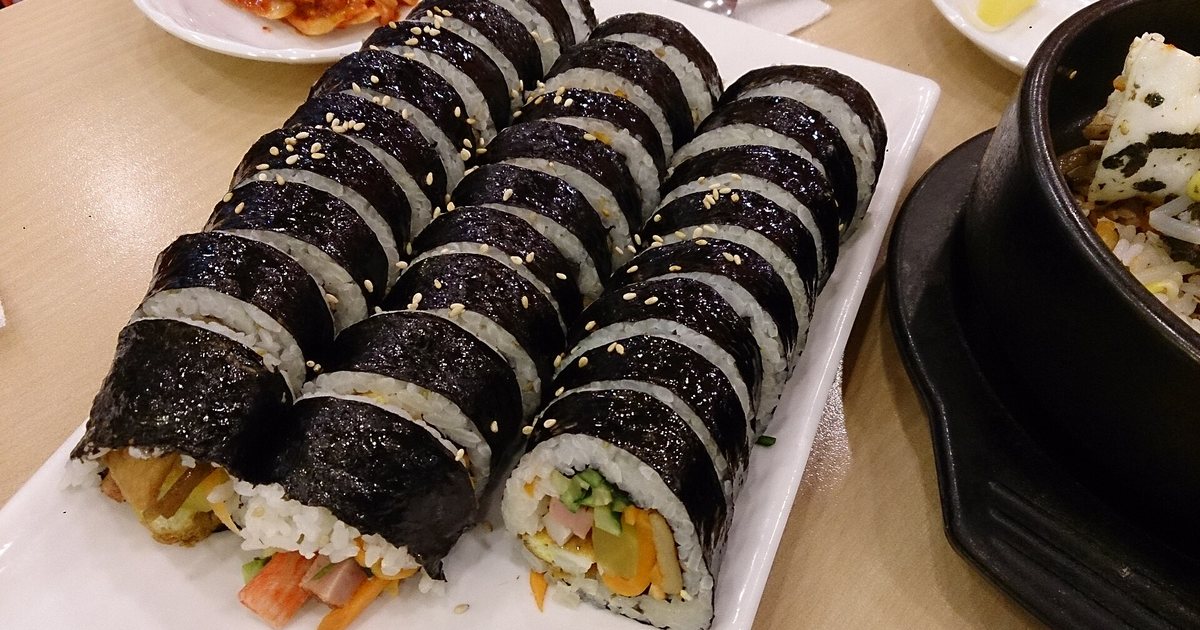
Kimbap is a sheet of roasted seaweed (gim, 김) spread with seasoned rice (bap, 밥), filled with strips of vegetables, egg and meat, then rolled into a log and sliced. You’ll also see it spelled gimbap, which is the official Revised Romanization. Search either spelling and you’ll land on the same dish.
Food historians usually link the rolled shape to Japanese norimaki, which spread in Korea in the early 20th century. Some Koreans also point to an older habit of wrapping rice in seaweed. Wherever the shape came from, Koreans gave it a completely different flavor and turned it into the default food for days out.
Kimbap vs sushi: the differences you can taste
| Feature | Kimbap (김밥) | Japanese sushi rolls (maki) |
|---|---|---|
| Rice seasoning | Sesame oil and salt, sometimes sesame seeds | Rice vinegar, sugar and salt |
| Typical fillings | Cooked or pickled: egg, ham, spinach, carrot, pickled radish, fish cake | Often raw fish, plus cucumber or avocado |
| Size | Thick, with many fillings in every slice | Usually thinner, with one to three fillings |
| Dipping | Usually eaten plain, with pickled radish or kimchi on the side | Soy sauce and wasabi |
| How it’s eaten | Packed for picnics and lunchboxes, eaten at room temperature | Often made to order and eaten right away |
In practice, don’t season kimbap rice like sushi rice. If you use vinegar and sugar, you’ll make a decent California roll, but it won’t taste like kimbap. The nutty smell of sesame oil when you open a foil-wrapped roll is the whole point.
Kimbap recipe ingredients: the 7 classic fillings
The kimbap sold at a Seoul snack shop (bunsikjip, 분식집, a casual eatery for kimbap, tteokbokki and ramyeon) almost always has some version of this lineup. Each filling is cooked and seasoned separately, which is why kimbap takes time. That prep is also what keeps every slice from tasting flat.
- Danmuji (단무지): bright yellow pickled radish, sold pre-cut into long strips for kimbap. It brings the crunch and the sweet-sour bite. Leave it out and you’ll miss it.
- Spinach (sigeumchi namul, 시금치나물): blanched, squeezed dry, and seasoned with salt, sesame oil and a little garlic.
- Carrot: julienned and stir-fried briefly with a pinch of salt so it softens but keeps its color.
- Egg: beaten, cooked into a thick flat omelet and cut into long strips.
- Ham: a rectangular strip of processed ham, pan-fried. Korean groceries sell it pre-cut for kimbap.
- Fish cake (eomuk, 어묵): flat sheets cut into strips and stir-fried with soy sauce and a touch of sugar.
- Burdock root (ueong, 우엉): braised in soy sauce until sweet and chewy. You usually buy it already seasoned in the same pack as the danmuji.
Imitation crab sticks and cucumber are common extras. Some families swap ham for crab sticks, and a lot of home cooks use cucumber when spinach is out of season.
Where to buy kimbap ingredients outside Korea
Korean supermarkets such as H Mart, along with most larger Asian grocers, sell a kimbap set: one vacuum pack holding danmuji strips and seasoned burdock. For seaweed, look for sheets labeled for kimbap or sushi (gimbap-gim, 김밥김). These are plain roasted sheets. Don’t use the small salted snack seaweed, because it’s too oily and too salty and it tears.
If you can’t find fish cake, leave it out. Kimbap still works with five or six fillings. If you can’t find danmuji, use a sweet pickled daikon or a crisp dill pickle cut into strips. It won’t taste the same, but the roll still gets the crunch and acidity it needs.

How to season kimbap rice the Korean way
The rice makes up most of every bite, so this is where most failed rolls go wrong. Koreans use short-grain white rice, the same sticky rice served with every meal. Medium-grain Calrose, sold widely in the US, also works well.
Cook it slightly drier than usual
Use a little less water than you normally would. Soft, wet rice turns mushy, makes the seaweed soggy and squashes when you roll. You want grains that hold their shape and still stick together.
The ratio Korean home cooks use
For 4 cups of freshly cooked rice (enough for 4 rolls), add about 1 tablespoon toasted sesame oil, 1/2 teaspoon salt and 1 teaspoon toasted sesame seeds. Taste a few grains. They should taste lightly salted on their own, because the fillings aren’t very salty.
Mix with a rice paddle in a cutting and folding motion rather than stirring, so the grains don’t break. Spread the rice in a wide bowl and let it cool until it’s warm but not steaming. If it’s too hot, the seaweed wilts and shrinks. If it’s cold, the rice won’t stick to anything.
Should you add vinegar?
Traditional kimbap doesn’t use vinegar. Some Korean home cooks add a small splash in summer, believing it helps the rice keep a little longer on a hot picnic day. It’s optional. Go easy, or it’ll drift toward sushi.
How to make kimbap (김밥)
- 4 cups freshly cooked short-grain rice
- 4 sheets roasted seaweed for kimbap (gim)
- 1 tablespoon toasted sesame oil, plus extra for brushing
- 1/2 teaspoon salt, plus pinches for the vegetables
- 1 teaspoon toasted sesame seeds, plus extra for topping
- 4 strips danmuji (yellow pickled radish)
- 4 strips seasoned burdock root (ueong)
- 1 bunch spinach
- 1 medium carrot, julienned
- 3 eggs
- 4 long strips kimbap ham
- 2 sheets flat fish cake (eomuk), cut into strips
- 1 tablespoon soy sauce and 1 teaspoon sugar for the fish cake
- 1 small garlic clove, minced
- Neutral cooking oil
- Season the warm rice with 1 tablespoon sesame oil, 1/2 teaspoon salt and the sesame seeds, folding gently. Spread it out to cool until just warm.
- Blanch the spinach in boiling salted water for about 30 seconds, rinse in cold water and squeeze out as much water as you can. Toss with a pinch of salt, the garlic and a few drops of sesame oil.
- Stir-fry the carrot in a little oil with a pinch of salt for 1 to 2 minutes until just soft. Set aside.
- Beat the eggs with a pinch of salt and cook them over low heat in an oiled pan as one thick, flat omelet, flipping once. Cool and cut into long strips about a finger wide.
- Pan-fry the ham strips until lightly browned. In the same pan, stir-fry the fish cake strips with the soy sauce and sugar until the liquid is gone.
- Drain the danmuji and burdock on paper towels so they don’t wet the rice. Arrange every filling on a tray in the order you’ll use it.
- Lay a seaweed sheet rough side up on a bamboo mat. Spread about 1 cup of rice thinly over the bottom two thirds, leaving a bare strip at the top edge.
- Line the fillings across the lower third of the rice, packing them close together. Lift the near edge of the mat, fold it over the fillings, squeeze firmly and keep rolling to the bare edge. Seal with a few grains of rice.
- Rest each roll seam side down for a few minutes. Brush the outside with sesame oil, sprinkle with sesame seeds and slice with an oiled sharp knife.
How to roll kimbap tight without tearing the seaweed
A loose roll falls apart when you slice it. A roll with too much rice splits the seaweed. Both problems come from the same few habits.
Which side of the seaweed faces up?
Gim has a shiny side and a rougher, duller side. Put the rough side up so the rice grips it, and the shiny side ends up on the outside of the roll. Line the sheet up with the slats of your bamboo mat running sideways, so the mat bends along the length of the roll.
Use less rice than you think
Spread the rice in a thin, even layer, about one or two grains deep, so you can almost see the seaweed through it. Wet your fingertips or lightly oil your hands so the rice doesn’t stick to you. Leave a bare strip of about two finger-widths at the far edge. That strip seals the roll.
The tuck is the whole technique
Stack the fillings on the lower third, then hold them in place with your fingertips while your thumbs lift the near edge of the mat. Roll the seaweed up and over until it touches the rice on the far side of the fillings, then squeeze along the whole length before you roll any further. That first squeeze sets how tight the roll will be. Then keep rolling, pulling the mat edge back so it doesn’t get rolled inside.
No bamboo mat? Roll by hand
Plenty of Korean home cooks roll kimbap with bare hands, using the same tuck-and-squeeze motion. A sheet of plastic wrap or a clean kitchen towel under the seaweed also does the job. A mat makes the roll more even, but you don’t need one to start.
How to cut kimbap cleanly
A dull knife crushes the roll and tears the seaweed. Use your sharpest knife, either a long chef’s knife or a serrated bread knife, and slice with long, light sawing strokes instead of pressing down.
The Korean trick is oil. Brush the outside of the roll with sesame oil, then wipe a few drops on the blade. Wipe the knife again with a damp cloth every few cuts as starch builds up.
For even slices, cut the roll in half, cut each half in half, then halve those pieces. You’ll get 8 slices of the same thickness. Many snack shops cut 10 thinner slices instead.
Arrange the slices cut side up so the colored center shows, the way you’ll see it in every Korean lunchbox.
Kimbap variations: tuna, cheese, veggie and the ones Koreans order
Once you can roll the classic, everything else is a filling swap. Every snack shop menu in Seoul lists a column of these, and you’ll see the same names on menus abroad.
| Variation | Korean name | What changes | Best for |
|---|---|---|---|
| Tuna kimbap | Chamchi gimbap (참치김밥) | Drained canned tuna mixed with mayonnaise, wrapped in a perilla leaf | A creamy, filling lunch |
| Cheese kimbap | Chijeu gimbap (치즈김밥) | A slice or two of processed cheese added to the classic fillings | Kids and anyone who finds kimbap plain |
| Veggie kimbap | Yachae gimbap (야채김밥) | Skip ham and fish cake, add more vegetables or tofu | Vegetarians (check labels) |
| Bulgogi kimbap | Bulgogi gimbap (불고기김밥) | Sweet soy-marinated beef replaces ham | A heartier roll |
| Mini “addictive” kimbap | Mayak gimbap (마약김밥) | Finger-size rolls with a few fillings, served with a mustard and soy dip | Market snacking, party platters |
| Chungmu kimbap | Chungmu gimbap (충무김밥) | Plain rice rolls with spicy squid and radish kimchi on the side | A taste of the southern coast |
| Triangle kimbap | Samgak gimbap (삼각김밥) | Triangle rice ball wrapped in seaweed with one filling | Grab-and-go from convenience stores |
How to make tuna kimbap
Drain canned tuna very well, then mix it with mayonnaise and a little black pepper. Lay one or two perilla leaves (kkaennip, 깻잎, a minty, slightly anise-flavored herb) on the rice, spoon the tuna onto the leaf, then add danmuji, egg and carrot. The leaf keeps the mayonnaise from soaking the rice and adds a fresh, herbal note Koreans love. If you can’t find perilla, use a lettuce leaf.
Vegetarian and vegan kimbap
Leave out the ham and fish cake, and add pan-fried firm tofu strips, cucumber, extra spinach or sautéed mushrooms. For vegan rolls, drop the egg too. Check the labels on danmuji and seasoned burdock, because recipes vary by brand.

Kimbap in Korea: picnics, lunchboxes and convenience stores
Ask Koreans what kimbap means to them and many will talk about sopung (소풍), the school field trip. On those mornings parents got up early to roll kimbap for the lunchbox (dosirak, 도시락), and the smell of sesame oil in the kitchen meant it was a special day. Kimbap still goes on hikes, family outings and picnics on the Han River lawns, because it doesn’t need reheating, cutlery or a plate.
On a normal weekday, kimbap is fast food. Kimbap chains and neighborhood bunsikjip roll to order, wrap the roll in foil and hand it over in minutes. A common snack shop combination is kimbap with a bowl of ramyeon or tteokbokki (spicy rice cakes). At home, people pair it with instant noodles; if that’s your plan, our guide to Buldak flavors ranked by heat will help you pick one.
Convenience stores fill their fridges with samgak gimbap and full-size rolls every day. They’re one of the cheapest quick meals for visitors, and our Korea travel tips for first-time visitors cover how to make the most of those stores. If you’d rather bring Korean flavors home in your suitcase, kimbap won’t survive the flight, but the snacks in our guide to Korean snacks to take home will.
Common kimbap mistakes and how to fix them
- Wet fillings. Spinach that isn’t squeezed and pickles that aren’t drained make the seaweed soggy and split. Squeeze and blot everything.
- Too much rice. A thick rice layer means the seaweed can’t close and the roll tears. Spread it thin enough to see the seaweed through it.
- Hot rice. Steaming rice shrinks the seaweed and tears it. Cool it to just warm.
- Fillings spread out. If the fillings are scattered across the rice instead of packed into the lower third, the center ends up off to one side. Stack them tight.
- Cutting right away with a dry knife. Let the roll rest a few minutes seam side down, oil the blade and saw gently.
- Seasoning only the rice. Kimbap tastes flat when the vegetables go in plain. A pinch of salt and a drop of sesame oil on each one makes a big difference.
FAQ
Is kimbap the same as sushi?
No. Both are seaweed and rice rolls, but kimbap rice is seasoned with sesame oil and salt, while sushi rice uses vinegar and sugar. Kimbap fillings are cooked or pickled rather than raw fish, and kimbap is usually eaten without soy sauce.
Can I make kimbap the night before?
You can prep the fillings the night before and keep them in the fridge, but roll on the day you’ll eat it. Rolled kimbap stored overnight in the fridge goes hard. If that happens, pan-fry the slices in beaten egg to make kimbap-jeon.
What do you dip kimbap in?
Usually nothing, because the rice and fillings are already seasoned. Koreans eat it with danmuji or kimchi on the side, often with a bowl of soup or ramyeon. Mini mayak kimbap is the exception and comes with a mustard and soy dipping sauce.
Can I use sushi nori for kimbap?
Yes. Plain roasted sushi nori sheets work the same as Korean kimbap seaweed. Avoid the small pre-salted, oiled snack seaweed, which is too greasy and tears when you roll.
Is kimbap gluten-free?
Not reliably. Fish cake, ham, soy sauce and seasoned burdock often contain wheat. If you avoid gluten, make it at home with tamari or gluten-free soy sauce and check every label.
Why does my kimbap fall apart when I cut it?
The roll is usually too loose, or the knife is dull and dry. Squeeze firmly after the first tuck, let the roll rest seam side down, then cut with an oiled sharp knife using light sawing strokes.
What to try after your first kimbap roll
Once you’ve made the classic, make tuna kimbap with perilla leaves. It’s the variation most Koreans pick when they want something richer. After that, try a tray of finger-size mayak kimbap with mustard-soy dip for a party, and make kimbap-jeon the morning after with whatever’s left.
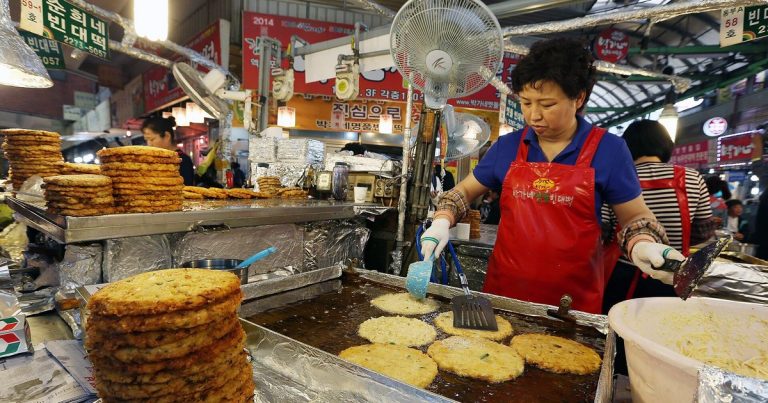
If you’re planning a trip to Seoul, eat kimbap the way locals do: from a foil wrap on a hiking trail, a snack shop counter with a bowl of ramyeon, or the mini rolls at a traditional market stall like Gwangjang Market. Check the market’s official page for current opening days before you go.
Related reading


Sources k-korea.blog
Prices, opening hours and availability change. Check the official page before you buy or travel.