14 min read
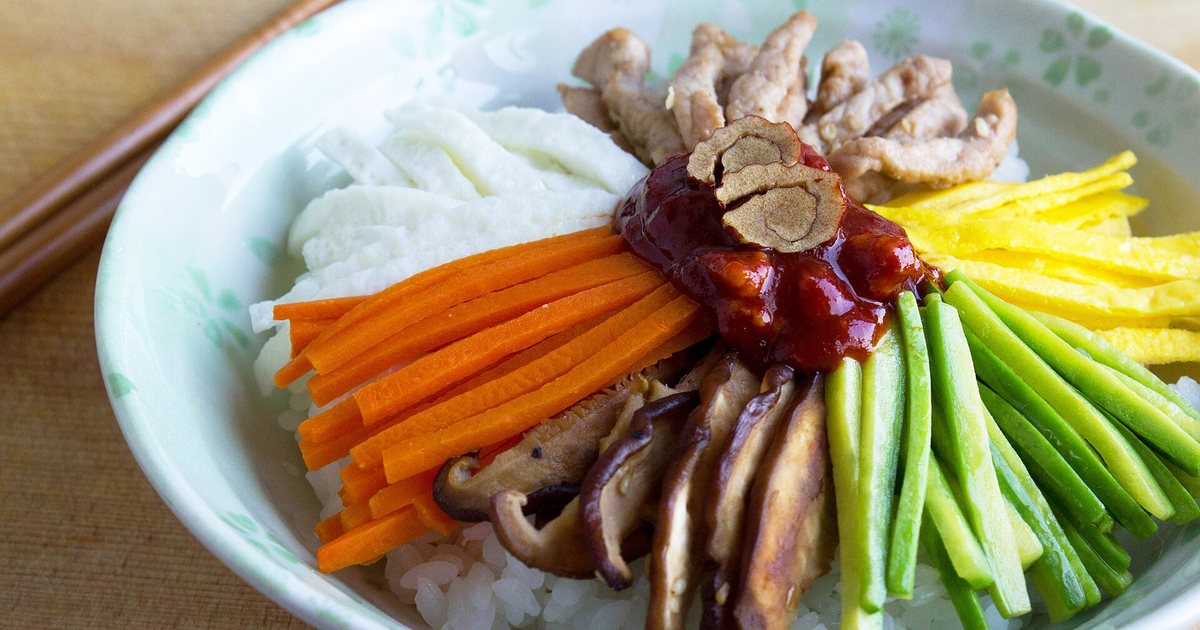
This bibimbap recipe (비빔밥) makes 2 bowls in about 50 minutes, with 6 toppings and an egg. Bibimbap means “mixed rice”: warm rice topped with seasoned vegetables, a little beef, a fried egg and a spoonful of gochujang (고추장, fermented red chili paste), all stirred together at the table. Below is the version Korean home cooks actually make, plus how to get the crackling crust of dolsot (돌솥, hot stone bowl) bibimbap, what makes Jeonju bibimbap different and how to make the whole thing vegetarian.
Key takeaways
- Six toppings are plenty: spinach, soybean sprouts, carrot, zucchini, shiitake and beef, each seasoned separately.
- The sauce is 2 tablespoons of gochujang loosened with sesame oil and a little sugar, and Koreans add it a spoon at a time.
- For dolsot-style crispy rice without a stone bowl, use a heavy cast-iron pan, oiled and hot before the rice goes in.
- On a weeknight, most Korean households make bibimbap from leftover namul and yesterday’s rice, not from scratch.
What is bibimbap (비빔밥) and how do Koreans eat it?
Bibim (비빔) means mixing and bap (밥) means cooked rice. The dish is exactly that: a bowl of rice with toppings arranged on top, which you then stir into one even, sauced mass before eating. The neat arrangement is for the eyes. The mixing is for the mouth.
Outside Korea, bibimbap is often treated as a showpiece. Inside Korea it is mostly a practical meal. Korean fridges are full of banchan (반찬, small side dishes), and when there are a few spoonfuls of spinach, bean sprouts and radish left over, someone pulls out a big bowl, adds rice, cracks an egg into a pan and calls it lunch. That is the real home version, and it is why bibimbap tastes different in every house.
There are several origin stories. Food historians often point to Siuijeonseo (시의전서), a 19th-century Korean cookbook, as one of the earliest written records of a mixed rice dish, and popular explanations link it to sharing out food left over from ancestral rites or clearing the pantry before the Lunar New Year. Treat those as traditions, not settled history.
Spoon, not chopsticks
One local habit worth copying: Koreans mix bibimbap with a spoon, pressing and folding rather than stirring in circles, so the rice grains stay whole and every bite gets sauce. Chopsticks come out afterwards for side dishes.
What goes in bibimbap: the 6 toppings and namul
Most bibimbap toppings are namul (나물), the Korean word for vegetables that are blanched or quickly sautéed and then seasoned with sesame oil, salt and a little garlic. Each one is cooked on its own so it keeps its own texture and flavor. That separate seasoning is what makes a good bowl taste layered instead of like a stir-fry over rice.
These are the six toppings that show up most often in Korean home kitchens and casual restaurants, plus the egg.
| Topping | Korean name | How it’s cooked | What it adds |
|---|---|---|---|
| Spinach | 시금치 (sigeumchi) | Blanched, squeezed dry, seasoned with sesame oil, salt, garlic | Soft, slightly sweet green |
| Soybean sprouts | 콩나물 (kongnamul) | Boiled with the lid on, then seasoned | Crunch and a nutty bean flavor |
| Carrot | 당근 (danggeun) | Julienned, sautéed briefly with a pinch of salt | Sweetness and orange color |
| Zucchini (Korean squash) | 애호박 (aehobak) | Julienned, salted, sautéed until just soft | Mild, juicy bite |
| Shiitake mushrooms | 표고버섯 (pyogo beoseot) | Sliced, sautéed with soy sauce and sesame oil | Savory depth |
| Beef | 소고기 (sogogi) | Minced or thinly sliced, marinated like bulgogi, stir-fried | Richness and protein |
| Egg | 계란 (gyeran) | Fried sunny-side up, or a raw yolk in some regional styles | A runny yolk that coats the rice |
Extra toppings Koreans add
Restaurants and home cooks often go beyond six. Gosari (고사리, dried fernbrake rehydrated and sautéed) gives a chewy, earthy bite. Doraji (도라지, bellflower root) is crisp and slightly bitter. Mu saengchae (무생채, spicy shredded radish salad) brings acidity and heat. Strips of gim (김, roasted seaweed), raw cucumber, lettuce or a spoon of chopped kimchi are all normal additions, especially in a quick lunch bowl.
Why the colors matter
Bibimbap is often described in terms of obangsaek (오방색), the traditional Korean five-color palette of blue-green, red, yellow, white and black. You don’t need to follow it strictly, but the idea is a good cooking rule: if your bowl has something green, something orange or red, something white, something dark and a yellow yolk, it will almost always taste balanced too.

Gochujang sauce for bibimbap: the 2 versions Koreans use
Gochujang straight from the tub is thick and salty, so almost nobody uses it plain. It gets loosened and rounded out first. There are two common approaches.
Quick bibimbap sauce (양념고추장)
This is the everyday version: gochujang, toasted sesame oil, a little sugar or honey and toasted sesame seeds, with a splash of water or rice vinegar if you want it pourable. It takes one minute to make. The sesame oil softens the paste and the sugar takes the edge off the salt.
Yakgochujang (약고추장), the make-ahead sauce
Yakgochujang is gochujang stir-fried with minced beef, sesame oil and honey or sugar until glossy. It is richer and less sharp than the quick sauce, and it keeps in the fridge, which is why Korean households make a jar of it and spoon it over rice all week. Many bibimbap restaurants serve this style instead of raw gochujang.
If you don’t like spicy food
Use half the gochujang, or skip it and make ganjang (간장, soy sauce) bibimbap: soy sauce, sesame oil and a pinch of sugar mixed into the rice. Korean kids are often given bibimbap this way. It is a perfectly normal option, not a compromise.
On buying gochujang abroad: Korean and pan-Asian grocery stores (H Mart in North America is the best known chain) carry several brands in red plastic tubs. Sunchang (순창), a county in North Jeolla, is the name most associated with gochujang in Korea, and you will see it on many labels. Check the spice level printed on the tub, since brands sell mild, medium and hot versions.
Bibimbap recipe game plan: what to cook first
The cooking itself is easy. What makes bibimbap feel like a lot of work is the number of small jobs. Do them in the right order and you only need one pot and one pan.
- Start the rice. Everything else fits inside its cooking time.
- Boil the soybean sprouts, then the spinach in the same pot of water. Sprouts first, because spinach turns the water green.
- Sauté the light vegetables in one pan, in this order: carrot, zucchini, then mushrooms. Wipe the pan between batches instead of washing it.
- Cook the beef last, since the marinade browns and sticks to the pan.
- Mix the sauce while the beef cooks.
- Fry the eggs at the very end so the yolks are still runny when you sit down.
Common bibimbap mistakes
- Wet spinach. Squeeze it hard with your hands after blanching. Water left in the greens dilutes the sauce and makes the rice soggy.
- Overcooked vegetables. Carrot and zucchini should still have some bite. They soften a little more once they meet hot rice.
- Too much salt. Gochujang is salty, so season each namul lightly. You can always add sauce; you can’t take salt out.
- Cold, hard rice. Leftover rice is fine, but warm it until soft first. Cold rice won’t absorb the sauce.
- All the sauce at once. Koreans start with one spoonful, mix, taste and add more.
Substitutions if you live outside Korea
Korean squash (aehobak) is paler and more tender than Western zucchini, but regular zucchini works well. If you can’t find soybean sprouts, mung bean sprouts (숙주, sukju) are the usual swap; they cook in about half the time and are less crunchy. Use short-grain or medium-grain white rice (often sold as sushi rice or Calrose); long-grain rice like basmati stays separate and won’t mix properly. Make sure your sesame oil is the toasted, dark kind, since the pale untoasted oil has almost no flavor. Dried gosari and doraji are sold in Korean groceries and online if you want the fuller restaurant spread.
If you are also making kimbap at home, cook a double batch of spinach and carrot: the two dishes share the same namul, and Korean cooks often make them on the same day.
How to make Bibimbap (비빔밥)
- 2 cups (about 2 bowls) cooked short-grain white rice, warm
- 150 g (5 oz) spinach
- 150 g (5 oz) soybean sprouts (or mung bean sprouts)
- 1 small carrot, cut into thin matchsticks
- 1 small zucchini, cut into thin matchsticks
- 4 fresh shiitake mushrooms, sliced
- 100 g (3.5 oz) minced or thinly sliced beef
- 2 eggs
- 2 cloves garlic, minced (divided)
- 2 tbsp soy sauce (divided)
- 2 tsp sugar (divided)
- 3 tbsp toasted sesame oil (divided), plus neutral oil for frying
- 1 tbsp toasted sesame seeds, plus salt to taste
- 2 tbsp gochujang
- Optional: roasted seaweed (gim) strips, chopped kimchi
- Marinate the beef with 1 tbsp soy sauce, 1 tsp sugar, 1 tsp sesame oil and half the garlic. Set aside while you prepare the vegetables.
- Bring a pot of salted water to a boil. Add the soybean sprouts, cover and cook about 4 to 5 minutes until tender but still crunchy. Lift them out with a slotted spoon, drain and toss with a pinch of salt, 1 tsp sesame oil and a few sesame seeds.
- In the same water, blanch the spinach for about 30 seconds. Rinse under cold water, squeeze out as much water as you can, then season with a pinch of salt, the rest of the garlic, 1 tsp sesame oil and sesame seeds.
- Heat a little neutral oil in a pan over medium heat. Sauté the carrot with a pinch of salt for 1 to 2 minutes and set aside. Repeat with the zucchini until just soft. Sauté the mushrooms with 1 tsp soy sauce and a drop of sesame oil until glossy.
- Turn the heat up and stir-fry the marinated beef for 2 to 3 minutes until cooked through.
- Make the sauce: mix the gochujang with 1 tbsp sesame oil, 1 tsp sugar, 1 tsp sesame seeds and 1 to 2 tsp water until smooth.
- Fry the eggs sunny-side up in a little oil until the whites are set and the yolks are still runny.
- Divide the warm rice between 2 wide bowls. Arrange the toppings in sections around the edge, put the beef and egg in the center, add a spoon of sauce and a drizzle of sesame oil. Serve the rest of the sauce on the side and mix everything at the table.
Fried egg or raw yolk: which egg goes on bibimbap?
At home, the standard is a fried egg, gyeran-hurai (계란후라이), cooked sunny-side up with crisp edges and a runny yolk. When you mix, the yolk becomes part of the sauce and makes the gochujang taste rounder. If you prefer a fully set yolk, that is fine too, but you lose some of that silkiness.
Some restaurant styles, including many Jeonju bibimbap places and some dolsot versions, use a raw egg yolk instead. In a sizzling stone bowl the yolk partly cooks as you stir it into the hot rice. In a regular room-temperature bowl it stays raw.
Dolsot bibimbap (돌솥비빔밥): how to get crispy rice at home
Dolsot bibimbap is served in a heavy stone bowl heated until it is very hot. The bowl is brushed with sesame oil, rice goes in, toppings go on top and the bowl arrives at the table still crackling. The rice touching the stone turns into a golden crust called nurungji (누룽지, scorched rice), and that crust is the whole point. Many Koreans order dolsot specifically to scrape it up at the end.
With a real dolsot
- Season a new bowl following the maker’s instructions; stone bowls usually need to be oiled and heated before first use.
- Brush the inside with sesame oil and heat it gradually on the stove, starting low and raising the heat, since sudden temperature changes can crack stone.
- Add the warm rice and press it gently against the sides.
- Arrange the toppings and egg, then keep the bowl on medium-low heat until you hear a steady crackle and the rice at the edge looks golden.
- Move it to a heatproof trivet. Add sauce, mix right away and leave a thin layer on the bottom to crisp a little longer.
Without a dolsot
A cast-iron skillet or heavy enameled pot does nearly the same job. Heat it with a tablespoon of sesame oil (or half sesame, half neutral oil, which burns less easily), press the rice into an even layer, top it and let it sit over medium heat without stirring until the bottom crisps. Serve it straight from the pan.
Dolsot safety
A stone bowl stays dangerously hot long after it leaves the stove. Always use a wooden or cork trivet, warn anyone at the table and never pour cold water into a hot dolsot. Wait until it has cooled before washing.

Jeonju bibimbap vs dolsot vs everyday: what’s different?
Jeonju (전주), a city in North Jeolla in southwestern Korea, is the place Koreans name first when bibimbap comes up. It is known nationally for its food and for its hanok (한옥, traditional house) village, and its bibimbap is the most famous regional style.
What sets Jeonju bibimbap apart, in its traditional form: the rice is often cooked in beef broth rather than water, the soybean sprouts are a point of local pride, and the toppings commonly include yukhoe (육회, seasoned raw beef) and hwangpomuk (황포묵, mung bean jelly tinted yellow with gardenia). It is typically served with many toppings and sometimes in a brass bowl called yugi (유기). Restaurants vary, so read the menu rather than expecting every element.
| Style | Bowl | Rice | Signature toppings | Where you’ll find it |
|---|---|---|---|---|
| Everyday home bibimbap | Any big bowl | Plain, often leftover | Whatever namul is in the fridge, fried egg | Korean homes, office canteens |
| Restaurant bibimbap | Ceramic or metal bowl | Plain white or mixed grain | 5 to 8 namul, beef, egg, gochujang | Casual Korean restaurants everywhere |
| Dolsot bibimbap | Heated stone bowl | Plain, crisped against the stone | Namul, beef, raw or fried egg | Korean restaurants in Korea and abroad |
| Jeonju bibimbap | Often brass (yugi) or stone | Traditionally cooked in beef broth | Soybean sprouts, yukhoe, yellow mung bean jelly, many namul | Jeonju, and Jeonju-style restaurants nationwide |
Other bibimbap Koreans order
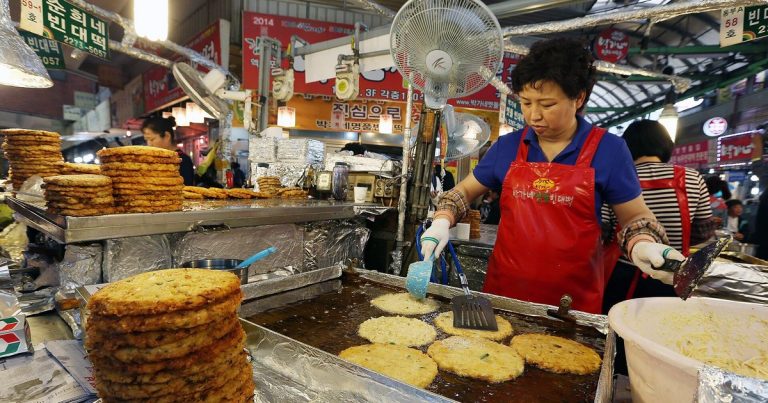
Around Seoul at lunchtime you’ll also see boribap (보리밥, barley rice served with a spread of namul to mix yourself), yeolmu bibimbap (열무비빔밥, with young summer radish kimchi) and hoedeopbap (회덮밥, raw fish over rice with greens and chojang, a vinegared gochujang). They follow the same logic: rice, toppings, sauce, mix. Traditional markets are a good place to see namul sold by the scoop; our guide to Gwangjang Market and other Seoul food markets covers what to eat there.
Vegetarian and vegan bibimbap: what to swap
Bibimbap is one of the easiest Korean dishes to make meat-free, because almost everything in the bowl is already a vegetable.
- Replace the beef with firm tofu, pressed, cubed and pan-fried, then glazed with soy sauce, a little sugar and sesame oil. Extra shiitake or king oyster mushrooms also work and give a meaty chew.
- For vegan bowls, skip the egg and add a second protein such as tofu, or more mushrooms and roasted seaweed for savoriness.
- For the sauce, use the quick gochujang sauce (not yakgochujang, which contains beef), sweetened with sugar or maple syrup instead of honey.
- Read the gochujang label. Ingredients differ between brands, and most gochujang contains wheat, so people avoiding gluten need a product labeled gluten-free.
Korea has its own long tradition here: Buddhist temple food (사찰음식, sachal eumsik) is plant-based and also traditionally leaves out the pungent vegetables, such as garlic and green onion. A temple-style bibimbap leans on sesame oil, soy sauce and mountain greens instead, and it shows how little the dish depends on meat.
FAQ
Is bibimbap spicy?
Only as spicy as the gochujang you add. The toppings themselves are mild. Start with one teaspoon of sauce per bowl, or use the soy sauce version, and build up from there.
Is bibimbap healthy?
A home bibimbap is mostly vegetables and rice with a small amount of meat and an egg, which makes it a fairly balanced meal. Gochujang and soy sauce add sodium, so go easy on the sauce if you are watching salt. If you have specific dietary needs, check with a doctor or dietitian.
Can I make bibimbap ahead for meal prep?
Yes, this is how Korean households do it. Cook the namul and beef ahead, keep each in its own container in the fridge and eat them within a couple of days. Warm fresh or reheated rice and fry the egg just before eating.
What rice is best for bibimbap?
Short-grain or medium-grain white rice, the slightly sticky kind Koreans eat every day. It holds the sauce and mixes evenly. Many Koreans also use multigrain rice (잡곡밥, japgokbap) with a bit of barley or brown rice for more texture.
Do you eat bibimbap hot or cold?
The rice should be warm, and the egg hot. The namul are usually served at room temperature, straight from the fridge-to-counter routine of Korean banchan. Dolsot bibimbap is the exception: everything ends up very hot.
What’s the difference between bibimbap and kimbap?
Both use rice and similar namul, but kimbap rolls the rice and fillings in seaweed and is sliced to eat by hand, while bibimbap is mixed in a bowl with gochujang and eaten with a spoon. Our kimbap recipe shows how the same fillings become a roll.
What to cook next, and where to eat bibimbap in Korea
Once you have made bibimbap twice, make a jar of yakgochujang and a double batch of spinach and bean sprout namul on the weekend. That turns bibimbap into a ten-minute weeknight meal, which is exactly how it works in Korean homes.
If you are planning a trip, put Jeonju on the list. It is reachable from Seoul by train, and its hanok village area is packed with bibimbap restaurants; check Korail’s official site for routes and schedules, and each restaurant’s own page or map listing for current hours. In Seoul, any casual Korean restaurant will have bibimbap or dolsot bibimbap on the menu, and our list of Korean dishes to try covers what to order alongside it.
Related reading


Sources k-korea.blog
Prices, opening hours and availability change. Check the official page before you buy or travel.