11 min read
Will Trump meet Kim Jong Un at the November 18-19 APEC summit in Shenzhen? As of November 17, 2026, no meeting has been announced, and Donald Trump has put the decision in Xi Jinping’s hands: “That’s up to President Xi.” South Korea’s presidential office and several security analysts say a meeting looks unlikely. North Korea’s most recent public word, from Kim Jong Un’s sister, was a refusal to sit down with Washington.
This explainer keeps what has been confirmed apart from what has only been reported. It covers what Trump, Seoul and Pyongyang have each said, the three earlier Trump-Kim meetings, and how a meeting could still happen even though North Korea is not an APEC member.
Key takeaways
- On November 16, Trump said Kim Jong Un “may come” to China while he is there, adding: “That’s up to President Xi.”
- Kim Yo Jong said through state media that Pyongyang has “no need to sit face-to-face” with “unreliable and hostile persons” in Washington (reported November 4).
- A senior South Korean presidential official said Kim joining APEC-related diplomacy, or direct US-North Korea contact, remained unlikely.
- North Korea is not one of APEC’s 21 member economies, so any meeting would have to happen outside the official summit program.
Will Trump meet Kim Jong Un at APEC 2026? What we know
Start with the confirmed facts. The 2026 APEC leaders’ meeting (APEC is the Asia-Pacific Economic Cooperation forum) is scheduled for November 18-19 in Shenzhen, the southern Chinese city next to Hong Kong, according to the Korea Times. No Trump-Kim meeting is on any published schedule.
What Trump said on November 16
On November 16, Trump said he might meet Kim Jong Un (김정은), North Korea’s leader, while he is in China. His words, as reported by Bloomberg, SBS News and the Korea Times, were: “We might have Kim Jong Un. He may come. I don’t know. That’s up to President Xi.”
Read that statement closely. Trump did not say a meeting had been arranged, and he did not say he had been in contact with Pyongyang. He said he doesn’t know, and that the host decides. Reuters, CBS News and The Wall Street Journal ran the same news under headlines saying Trump “might” or “may” meet Kim, which matches that hedged wording.
Why Trump says it is up to Xi Jinping
China is hosting APEC this year, so Xi Jinping, China’s president, controls who comes to Shenzhen as a guest. Bloomberg reported that Trump suggested Xi might invite Kim to Shenzhen during APEC. That is Trump’s suggestion as reported, not an announced plan. Beijing has not said, in any source available as of November 17, that it has invited Kim.
What North Korea said through Kim Yo Jong (김여정)
Pyongyang’s latest public position points the other way. Kim Yo Jong, Kim Jong Un’s sister and a senior official who often issues the government’s statements on the United States and South Korea, spoke through KCNA, the Korean Central News Agency (North Korea’s state news outlet). According to the Japan Times on November 4, she said Pyongyang has “no need to sit face-to-face with such unreliable and hostile persons” and demanded that Washington drop its “hostile policy”.
“Hostile policy” is a phrase North Korea has used for decades. It covers the US pressure Pyongyang objects to, such as sanctions and joint US-South Korea military drills. When North Korea demands an end to it, that usually means it wants concessions before any talks begin.
What Kim Jong Un has demanded
Kim Jong Un has said North Korea is ready for either peace or war with the United States, and that any talks would require Washington to accept its nuclear status, as reported by UPI and the Arms Control Association. That is a large gap. Since the 2018 Singapore summit, the US position has centered on denuclearization of the Korean Peninsula. Pyongyang now says its nuclear weapons are off the table.
These are North Korea’s own statements, carried by its state media. Outside observers can’t verify them, and Pyongyang has changed its tone quickly in the past. As of November 17, though, North Korea has published nothing on the record that welcomes a meeting in Shenzhen.

What South Korea’s Lee Jae Myung (이재명) expects in Shenzhen
Seoul is watching more closely than any other capital, and its officials sound cautious. Lee Jae Myung is South Korea’s president. His office briefs reporters regularly on North Korea, and its assessments set the tone for coverage in Seoul.
Lee’s four-day trip: Manila, then Shenzhen
Lee left on November 16 for a four-day trip, according to the Korea Times and Korea JoongAng Daily. He goes first to ASEAN meetings in Manila (ASEAN is the Association of Southeast Asian Nations), then to the APEC summit in Shenzhen, which includes a dinner hosted by Xi Jinping.
The Lee-Xi summit plan
South Korea’s presidential office said Seoul and Beijing are working out the details of a Lee-Xi summit on the APEC sidelines, according to Seoul Economic Daily and Korea JoongAng Daily. It would be their third meeting. The first was at APEC 2025 in Gyeongju (경주), the historic South Korean city that hosted last year’s summit. The second came during Lee’s state visit to China in January 2026. No date for the Shenzhen meeting has been announced.
This matters for the Trump-Kim question because Beijing is the one capital with regular high-level ties to both Washington and Pyongyang. If Xi raises North Korea with Lee, any public readout from either side will show how the host is thinking.
Why Seoul’s officials sound cautious
On November 12, a South Korean presidential official and security analysts said a Trump-Kim meeting at APEC appeared unlikely, the Korea Times reported. After Lee’s departure, a senior presidential official told Korea JoongAng Daily that Kim taking part in APEC-related diplomacy, and direct US-North Korea contact, remained unlikely.
The two statements are consistent. Seoul’s assessment did not change after Trump’s November 16 remarks, at least not in public. That is the most useful data point for anyone trying to judge the odds, because South Korea’s government has more reason than anyone to want North Korea back at the table.
Why North Korea is not at APEC, and how a meeting could still happen
North Korea is not a member of APEC. The forum is made up of 21 Pacific Rim “member economies”, including the United States, China, South Korea, Japan and Russia, and North Korea has never been one of them. Kim Jong Un has no seat at the leaders’ table and no automatic invitation to Shenzhen.
That doesn’t rule out a meeting in the city. Koh Yu-hwan (고유환) of Dongguk University, a Seoul university known for North Korea studies, said Kim and Trump could meet outside the APEC venue itself, since North Korea is not a member, according to the Korea Times. Bilateral meetings on the sidelines of summits happen all the time, in hotels, guesthouses and side venues, separate from the official program.
What would have to happen first
Based on what officials have said in public, three things would need to line up:
- An invitation from Beijing. Trump has said it is Xi’s call, and Bloomberg reported he suggested Xi might invite Kim.
- A yes from Pyongyang. Kim Yo Jong’s November 4 statement rejected sitting down with Washington, so this would be a reversal.
- Travel and security arrangements. Kim visited China several times in 2018 and 2019, so the route exists, but any trip would be a major security operation that both governments usually keep quiet until it is underway.
None of these has been publicly confirmed as of November 17.
Trump and Kim’s 3 past meetings: Singapore, Hanoi, Panmunjom
If they meet this week, it would be their fourth time. All three earlier meetings took place in Trump’s first term, and each one ended differently.
| Meeting | When | Where | What came out of it |
|---|---|---|---|
| 1st summit | June 2018 | Singapore | First-ever meeting of sitting US and North Korean leaders; a joint statement committing to work toward complete denuclearization of the Korean Peninsula |
| 2nd summit | February 2019 | Hanoi, Vietnam | Ended early with no agreement, after the two sides failed to agree on sanctions relief versus denuclearization steps |
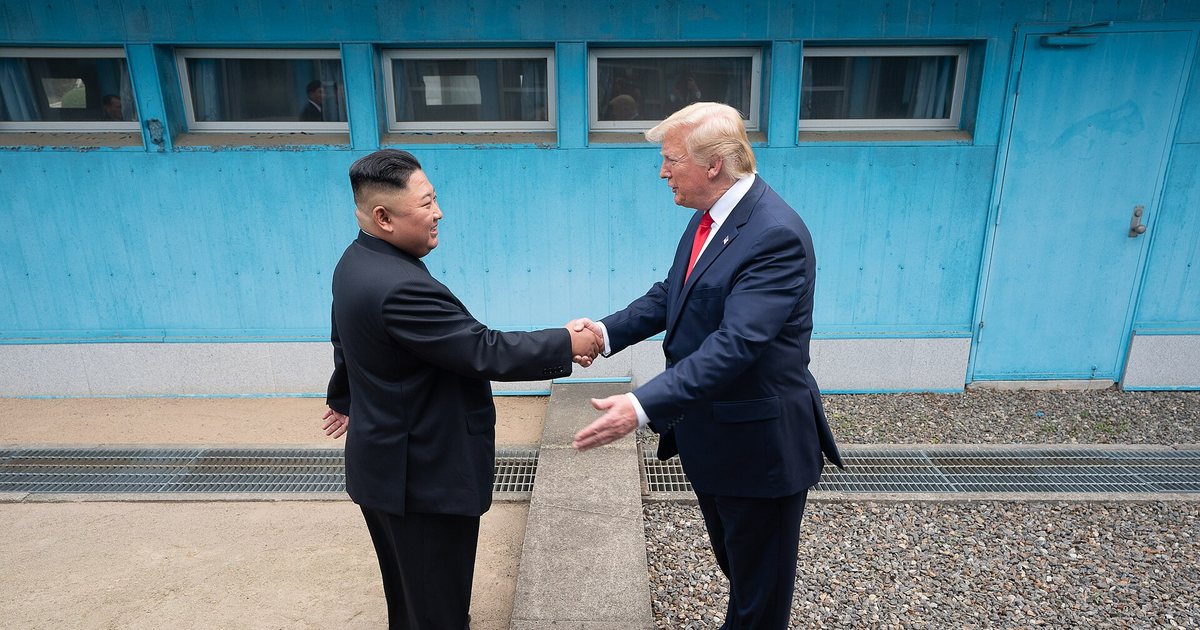
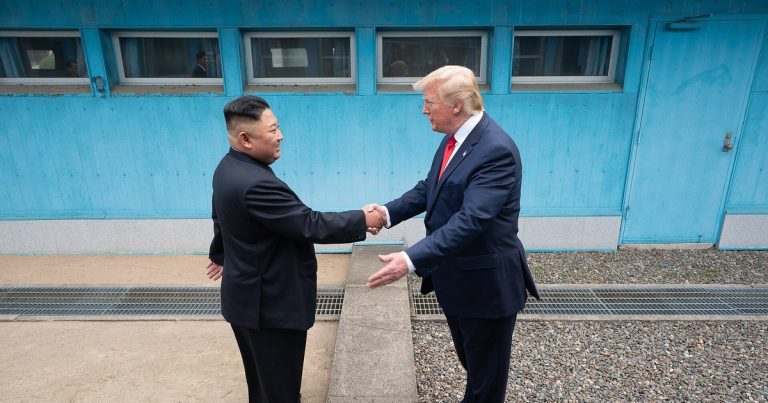
| 3rd meeting | June 2019 | Panmunjom (판문점), in the DMZ | Arranged at short notice; Trump briefly stepped onto North Korean soil, and the two sides agreed to restart working-level talks |
Why the DMZ meeting matters for this week
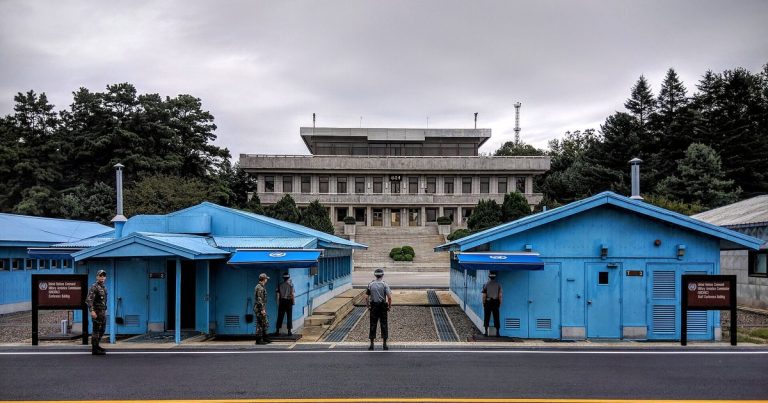
Panmunjom is the truce village inside the DMZ (the Demilitarized Zone, the roughly 4 km-wide buffer strip along the border between the two Koreas), where the 1953 Korean War armistice was signed. The June 2019 meeting there came together within about a day, after Trump floated the idea publicly during a trip to Asia. That precedent explains why Trump’s “he may come” is being taken seriously in the press even though Seoul calls it unlikely: these two leaders have met before on very little notice.
The Hanoi result explains the caution. That summit broke down over the same question that now separates them, which is what North Korea gives up on nuclear weapons and what it gets in return. Pyongyang’s current demand, that Washington accept its nuclear status, makes the gap wider than it was in 2019.
If you are planning a trip and want to see the place where the third meeting happened, our guide to day trips from Seoul, from the DMZ to Jeonju explains how DMZ tours work. The 7-day Seoul itinerary shows how to fit one into a week. Access to the Joint Security Area at Panmunjom is restricted and can close at short notice, so check the tour operator’s official page before you book.
Timeline: Trump, Kim and APEC 2026 key dates
The key dated events, with the outlet that reported each one:
| Date | Event | Source |
|---|---|---|
| June 2018, February 2019, June 2019 | Trump and Kim meet in Singapore, Hanoi and Panmunjom | Background |
| January 2026 | Lee Jae Myung’s state visit to China, his second meeting with Xi | Seoul Economic Daily, Korea JoongAng Daily |
| October 28, 2026 | UPI reports Kim Jong Un saying North Korea is ready for peace or war with the US, and that talks would require acceptance of its nuclear status | UPI |
| November 4, 2026 | Kim Yo Jong, via KCNA: “no need to sit face-to-face” with “unreliable and hostile persons” | Japan Times |
| November 12, 2026 | A South Korean presidential official and analysts say a Trump-Kim meeting at APEC appears unlikely | Korea Times |
| November 16, 2026 | Trump: “He may come. I don’t know. That’s up to President Xi.” | Bloomberg, SBS News, Korea Times |
| November 16, 2026 | Lee leaves for Manila (ASEAN), then Shenzhen (APEC) | Korea Times, Korea JoongAng Daily |
| November 18-19, 2026 | APEC leaders’ meeting in Shenzhen | Korea Times |
| Date being arranged | Lee-Xi summit on the APEC sidelines | Seoul Economic Daily, Korea JoongAng Daily |
What we don’t know yet
The public record leaves several things open. These are the ones that will decide the answer.
Will Xi Jinping invite Kim to Shenzhen, and would Pyongyang accept?
Trump has made Xi the gatekeeper, at least in his public remarks. Beijing has not announced an invitation in any source available as of November 17. Even if Xi did invite Kim, the only recent North Korean statement on the record, Kim Yo Jong’s, rejects face-to-face talks with Washington.
Will the Lee-Xi summit produce any message on North Korea?
The summit’s date is still being arranged. Readouts from Seoul and Beijing after the meeting will show whether North Korea came up and how each side described it. Compare the two versions: governments often stress different points from the same conversation.
If not at APEC, could there be a fourth Trump-Kim meeting later?
Nothing in the sources rules out a later meeting, and nothing schedules one. Pyongyang’s stated conditions are clear, though: Washington drops its “hostile policy” and accepts North Korea’s nuclear status. Any future meeting will turn on whether one side moves on those terms.
FAQ
Is Kim Jong Un going to APEC 2026?
Nothing announced so far says he is. North Korea is not an APEC member, so he has no seat at the summit. Trump said on November 16 that Kim “may come” and that it is “up to President Xi”, while South Korea’s presidential office has called his participation unlikely.
Where and when is APEC 2026?
The APEC leaders’ meeting is scheduled for November 18-19, 2026, in Shenzhen, China, according to the Korea Times. China is the host this year. South Korea hosted the previous summit in Gyeongju in 2025.
How many times have Trump and Kim Jong Un met?
Three times, all in Trump’s first term: Singapore in June 2018, Hanoi in February 2019 and Panmunjom in the DMZ in June 2019. Singapore produced a joint statement and Hanoi ended without a deal. Panmunjom was a short, hastily arranged meeting at the border.
What did Kim Yo Jong say about meeting Trump?
Through North Korea’s state news agency KCNA, she said Pyongyang has “no need to sit face-to-face with such unreliable and hostile persons” and demanded that Washington drop its “hostile policy”, the Japan Times reported on November 4. This is North Korea’s stated position and can’t be independently verified.
Why isn’t North Korea a member of APEC?
APEC is a forum of 21 Pacific Rim economies built around trade and economic cooperation, and North Korea has never joined it. North Korea’s economy is largely closed and under international sanctions, which keeps it outside most regional economic groups. That is why any Trump-Kim meeting in Shenzhen would have to take place outside the official summit.
What does South Korea’s President Lee Jae Myung want from APEC?
Lee is attending the summit and a dinner hosted by Xi Jinping, and his office is arranging a separate Lee-Xi summit on the sidelines, which would be their third meeting. A senior official in his office has said direct US-North Korea contact at APEC remains unlikely.
What to watch on November 18-19 and after
Over the next few days, these are the signals that matter, roughly in the order they are likely to come:
- KCNA. Any new statement from Pyongyang, especially from Kim Yo Jong, is the clearest sign either way. A new refusal would close the door for this trip. A softer line would be news.
- Beijing’s guest list. Watch for any Chinese announcement of an invitation to Kim, which is the condition Trump himself named.
- The White House schedule. Trump’s remarks were open-ended. A formal schedule or briefing in Shenzhen would show whether anything has changed.
- The Lee-Xi summit readouts. Once the date is set, compare what Seoul and Beijing each say about North Korea.
- Seoul’s presidential office. Its officials have called a meeting unlikely twice. If that changes, it will probably show up first in South Korean outlets such as Korea JoongAng Daily and the Korea Times.
For now, Trump has said Kim “may come”, Seoul says it is unlikely and Pyongyang’s last word was no. We will update this page with sourced information if any of those positions change.
Related reading


Sources koreatimes.co.kr · bloomberg.com · news.sbs.co.kr · japantimes.co.jp · upi.com · koreajoongangdaily.com · en.sedaily.com · k-korea.blog
Prices, opening hours and availability change. Check the official page before you buy or travel.