13 min read
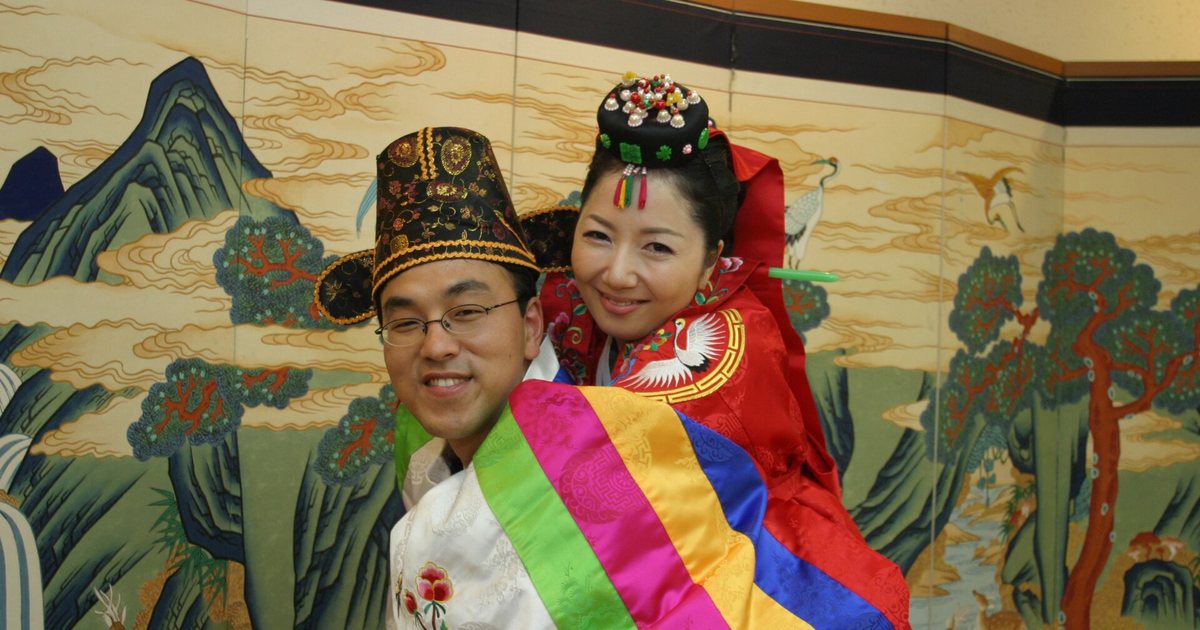
Korean wedding traditions now come down to 3 parts: a short hall ceremony, a buffet and the pyebaek bow. Guests hand in a cash envelope at a desk, watch a ceremony that’s usually over well within an hour, eat and go home. Meanwhile the couple changes into hanbok (한복, traditional Korean dress) for a private family ritual that dates back to the Joseon dynasty.
If you’ve been invited, the things to get right are money, timing and clothes. None of them is hard once you know how the day runs. This guide covers each part, what it means and where foreign guests usually slip up.
Key takeaways
- Bring cash, not a wrapped present. It goes in a white envelope that you hand in at the reception desk.
- There are 2 desks, one for the groom’s side and one for the bride’s. Go to the one belonging to whoever invited you, because the money is recorded under that family.
- White and ivory are for the bride only. Smart office wear in a color is the safe choice for guests.
- Pyebaek (폐백) is a family-only bow ceremony held after the main ceremony. Guests aren’t expected to attend.
What happens at a Korean wedding hall, step by step
Most Korean couples marry in a yesikjang (예식장), a wedding hall built for exactly this. One building often holds several halls, and each hall runs ceremonies in back-to-back time slots. That’s the single most useful fact for a guest: the schedule is tight, the start time is real and the next couple is already waiting.
Before the ceremony: the desk and the meal ticket
Outside the hall you’ll see two tables, usually labeled for the groom’s side (신랓측, sillang-cheuk) and the bride’s side (신부측, sinbu-cheuk). Relatives or close friends sit there with a guest book and a box. You hand over your envelope and they write down your name. In return you usually get a sikgwon (식권), a meal ticket for the buffet or dining room.
Near the entrance you’ll also find large framed photos of the couple, taken in a studio shoot weeks or months before. Guests often take a quick picture with them.
The ceremony itself
The running order differs from couple to couple, but a typical hall ceremony goes like this:
- Candle lighting (화촉점화, hwachok jeomhwa). The two mothers, both in hanbok, walk up together and light candles at the front. Traditionally the groom’s mother wears blue tones and the bride’s mother wears pink or red tones.
- The groom enters, often to cheers. Friends sometimes ask him to do a playful stunt, like shouting to the room.
- The bride enters. She traditionally walks in with her father. More couples now walk in together or with both parents.
- The speech. In older-style weddings a jurye (주례), an officiant who is usually a respected elder or a former teacher, gives a speech. Weddings without a jurye (주례 없는 결혼식) are now common: parents read letters or the couple reads their own vows instead.
- Chukga (축가), a congratulatory song performed live by a friend or relative.
- Bows to the parents. The couple bows to both sets of parents, a public echo of the older family rituals.
- The march out, usually with confetti or applause from the MC, called the sahoeja (사회자), who is often the groom’s friend.
After the ceremony: photos and the buffet
Next come group photos at the front of the hall: family first, then friends and colleagues. If the photographer calls for friends, go up. Being in that picture is a way of showing you were there. The bouquet toss usually isn’t a free-for-all. The bride throws it to a friend chosen in advance.
Then everyone eats. The buffet or set meal is where the real socializing happens, and the couple often comes round the tables to greet people. For table manners at a shared meal, our guide to Korean dining etiquette for foreigners covers the basics.
Which Korean wedding traditions survive in a modern ceremony
A modern hall wedding looks Western at first: a white dress, a suit, an aisle lined with flowers. Underneath, much of the structure comes from the Confucian wedding rites of the Joseon dynasty (1392 to 1910). Back then a wedding was a deal between two families, and in many ways it still is. The parents who host the wedding are called honju (혼주). Many guests are there for the parents, not the couple.
| Element | Traditional version | Modern hall version | What it means for guests |
|---|---|---|---|
| Venue | Courtyard of the bride’s family home | Commercial wedding hall, hotel or church | Arrive early; slots run on time |
| Couple’s clothes | Hwarot or wonsam robe for the bride, official’s robe and hat for the groom | White dress and suit, then hanbok for pyebaek | Don’t wear white or ivory |
| Mothers | Central to family rites | Light the opening candles in hanbok | Greet them; they’re the hosts |
| Fidelity symbol | Wooden geese (기러기, girogi) given to the bride’s family | Sometimes kept as decor or a wedding gift | Carved geese make a thoughtful extra gift |
| Bows | Formal deep bows between families | Bow to parents in the ceremony, full bows at pyebaek | Guests just bow lightly to the parents |
| Gifts | Goods and food exchanged between families | Cash envelopes logged at the desk | Bring cash in an envelope |
The family logic explains a lot. A desk for each side exists because each family keeps its own record. The meal matters because feeding guests is the hosts’ duty. The short ceremony is fine because for many guests the real point is turning up for the family.
How cash gifts work at a Korean wedding (chuguigeum 축의금)
The standard gift is chuguigeum (축의금), congratulatory money. It isn’t seen as tacky. It works as a reciprocal system: families keep a record of who gave what, and they return the gesture when it’s the giver’s turn to host a wedding. Parents who have attended other people’s weddings for decades often see some of that come back on their own child’s wedding day.
How much to give at a Korean wedding
We won’t give you a number, because typical amounts change with prices and depend on your circle. What Koreans actually weigh is this:
- Closeness. A coworker you barely know, a good friend and a close relative are three different levels.
- Whether you’ll eat. Many Koreans give more if they’re attending and eating than if they only send money, because the hosts pay for each meal.
- Whether you bring someone. Coming as a couple usually means a larger envelope.
- Number customs. Amounts traditionally start with an odd digit, and many people avoid anything with 4 (사, sa), because it sounds like the word for death.
The best move is to ask a Korean friend or coworker from the same circle what’s normal. Nobody minds the question, and it saves you from giving far too much or too little.
How to write the wedding envelope
Use a plain white envelope. The reception desk usually has a stack. Many people write 축결혼 (祝結婚, chuk gyeolhon) or 축화혼 (祝華婚, chuk hwahon) on the front, which both mean “congratulations on your marriage”. Write your full name on the back, usually in the lower left. Add your company or how you know the couple if they might not recognize your name.
What if you can’t attend?
Most invitations now come as a mobile cheongcheopjang (모바일 청첩장), a link with a map, photos and often the bank account numbers of the couple or their parents. Sending money to the account listed for your side is normal and polite. You can also send an envelope with a friend who’s going. Add a short message by text or KakaoTalk (Korea’s main messaging app) so the couple knows it came from you.
What to wear to a Korean wedding as a guest
Think smart office wear, not black tie. Korean wedding halls are bright and busy, and guests dress neatly but not formally.
- Men: a suit or a blazer with trousers is safe, and a tie is optional for friends. Our Korean fashion guide for men shows what a clean Seoul smart-casual look involves.
- Women: a dress, a skirt, or tailored trousers with a blouse, in a color. Avoid anything very revealing.
- Avoid white, ivory and cream. Those are the bride’s colors.
- Go easy on all-black. A black suit is fine for men. Some older guests read a woman in head-to-toe black as funeral wear, so a colored scarf or top helps.
- Skip the hanbok. At most modern weddings hanbok is worn by the mothers and the couple. A guest in hanbok can look like they’re trying to stand in for family.
In winter you’ll need a proper coat to get between subway and hall, so plan your outfit to look good once the coat comes off.
What is pyebaek (폐백)? The family bow ceremony explained
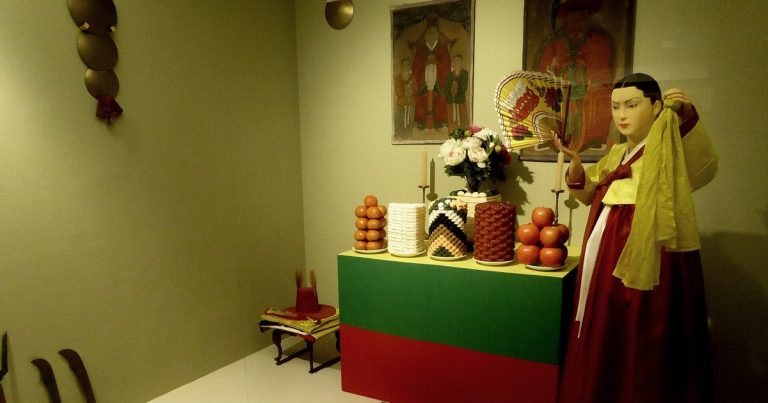
Pyebaek is the oldest piece of the modern day. After the hall ceremony the couple changes into traditional wedding clothes and goes to a small side room, the pyebaek-sil (폐백실). There, family elders sit behind a low table set with symbolic food.
What happens at a pyebaek ceremony
The bride often wears a hwarot (활옷) or wonsam (원삼), embroidered ceremonial robes, with a small crown called a jokduri (족두리). Red dots called yeonji gonji (연지곤지) are painted on her cheeks and forehead, traditionally to ward off bad luck. The groom wears a robe and hat modeled on a Joseon official’s dress.
The couple does a keunjeol (큰절), the deep formal bow that goes all the way to the floor, toward the parents and then other elders. Elders pour a drink, give marriage advice and hand over an envelope of money, sometimes called jeolgap (절값), “bow money”.
Then the moment everyone photographs: the parents toss jujubes (대추, daechu) and chestnuts (밤, bam), and the couple tries to catch them in the bride’s skirt. Tradition says the number caught hints at how many children they’ll have. Often the groom then carries the bride on his back around the table, which gets a lot of laughs.
Why pyebaek was for the groom’s family
In the Joseon system the bride joined her husband’s household, so pyebaek was her formal greeting to her new in-laws. Many couples now include both families. Plenty skip pyebaek entirely to save time and cost, and nobody treats that as disrespectful.
Can guests watch pyebaek?
Usually not, and you shouldn’t expect to. It’s a family event. If you’re a close friend and the couple invites you in, stand to the side, keep quiet during the bows and ask before you take photos.
Before the wedding: sanggyeonnye, ham, yedan and the photo shoot
A Korean wedding starts months before the hall date, with steps that are mostly between the two families.
- Sanggyeonnye (상견례): the formal first meeting of both families over a meal. It’s often the point where the wedding becomes official.
- Yedan (예단) and yemul (예물): gifts exchanged between the families, such as bedding or household goods, and jewelry or watches for the couple. How much of this happens now differs a lot from family to family, and many couples cut it back.
- Ham (함): a box of gifts for the bride that the groom’s friends used to deliver to her family’s home. They’d chant “Ham for sale!” and bargain at the door for money and food. The friend carrying it, the hamjinabi (함진아비), sometimes wore a dried-squid mask. You’ll rarely see this in a Seoul apartment block today.
- The “studio, dress, makeup” package: often shortened to seudeume (스드메). Couples book a pre-wedding photo shoot, dress rental and hair and makeup together. Those studio photos are the framed portraits you see at the hall entrance.
- Invitations (청첩장, cheongcheopjang): printed cards are still handed out to elders and coworkers, often at a meal. Friends mostly get the mobile version.
If a Korean friend or colleague invites you to an invitation lunch or dinner before the wedding, it’s a sign they genuinely want you there. Go if you can.
The traditional Korean wedding (hollye 혼례) before wedding halls
Before halls took over in the 20th century, a wedding, called hollye (혼례), took place in the courtyard of the bride’s family home. The couple faced each other across a ceremonial table, the choryesang (초례상), set with candles, pine and bamboo branches, and often a pair of chickens wrapped in cloth.
One of the first rites was jeonallye (전안례): the groom presented a wooden goose (or a real one in earlier times) to the bride’s family. Geese were believed to mate for life, so the goose stood for faithfulness. That’s why carved wooden wedding geese, often a pair, are still sold in Korean craft shops and given as wedding gifts.
The bride and groom bowed to each other, shared a drink from a cup made from one gourd split in two, and so became one household. The bride’s hwarot, the jokduri crown and the red cheek dots all come from this tradition and live on in today’s pyebaek.
Where to see a traditional Korean wedding
Some couples still choose a full traditional ceremony at a hanok (traditional Korean house) venue or a heritage site. Hanok villages and folk museums in Korea hold traditional wedding demonstrations or performances from time to time. Namsangol Hanok Village in Seoul is one place known for them. Programs and dates change, so check the venue’s official site or VisitKorea, the Korea Tourism Organization’s site, before you plan around one.
Korean wedding etiquette for foreign guests: 7 mistakes to skip
Koreans are generally relaxed with foreign guests, and nobody expects you to know every custom. These are the slips that actually get noticed:
- Bringing a wrapped gift instead of cash. A present isn’t wrong, but on its own it can leave the couple unsure how to log it. If you want to give an object, give it separately, alongside or after the envelope.
- Going to the wrong desk. If the groom invited you, use the groom’s side, even if you also know the bride.
- Arriving exactly on time. Come 15 to 30 minutes early so you can hand in your envelope, see the photos and find a seat. The ceremony won’t wait.
- Wearing white or ivory. Easy to avoid, and noticed straight away when people don’t.
- Bringing an unannounced plus-one or children. Meals are counted per head. Ask first.
- Expecting a Western reception. There’s usually no seating plan, no first dance and no evening party at the hall. Friends sometimes arrange a separate after-party, called dwipuri (뒤풀이), and our guide to Korean drinking etiquette helps there.
- Leaving without congratulating anyone. Many guests leave after eating, and that’s fine. Before you go, find the couple or a parent, bow slightly and say “결혼 축하합니다” (gyeolhon chukahamnida), “congratulations on your marriage”, in the polite form.
For the parents, use respectful titles rather than first names. Our Korean honorifics guide explains which forms to use with elders.
FAQ
How long does a Korean wedding last?
The hall ceremony is short, usually well under an hour, because halls book weddings in back-to-back slots. With the envelope desk, the photos and the meal, most guests are there for roughly two hours. Pyebaek happens afterward and only involves family.
Do you give cash or a gift at a Korean wedding?
Cash in a white envelope is the standard and expected gift. Close friends sometimes add a present on top, but the envelope is the part the families record. If you’re unsure how much to give, ask a Korean friend from the same circle.
Is it rude to leave a Korean wedding right after eating?
No. Many guests hand in their envelope, watch the ceremony or skip part of it, eat and leave. What matters is that you came and congratulated the couple or their parents before going.
Can a foreign guest wear hanbok to a Korean wedding?
At a modern hall wedding, guests generally don’t, because hanbok marks the mothers and the couple. The exception is when the couple asks guests to wear it, which can happen at a traditional-themed wedding. Then follow the invitation.
Do Korean couples still do pyebaek?
Many do, often in a shorter form that includes both families. A growing number skip it to save time and money, and that’s widely accepted. If pyebaek happens, guests usually aren’t involved.
What do you say at a Korean wedding?
“결혼 축하합니다” (gyeolhon chukahamnida), “congratulations on your marriage”, works for everyone, including parents and elders. Say it with a slight bow. With close friends, a warm “축하해” (chukahae) is fine.
What to plan next if you’re invited to a Korean wedding
Start with the invitation link. Check the hall name, floor and hall number (big buildings have several halls), then look up the route on Naver Map or KakaoMap, the two map apps Koreans use, since Google Maps directions in Korea are limited. Ask a Korean friend what amount is normal for your relationship, get crisp notes ahead of time and pick an outfit in a color that isn’t white.
On the day, arrive early, go to the right desk and pick up your meal ticket. Stay for the friends’ photo if you’re called, and congratulate the couple or a parent before you leave. If the older rituals interest you more than the hall, look for a traditional wedding demonstration at a hanok venue on your next trip, and check the venue’s official page for current programs first.
Related reading
Sources k-korea.blog
Prices, opening hours and availability change. Check the official page before you buy or travel.