13 min read
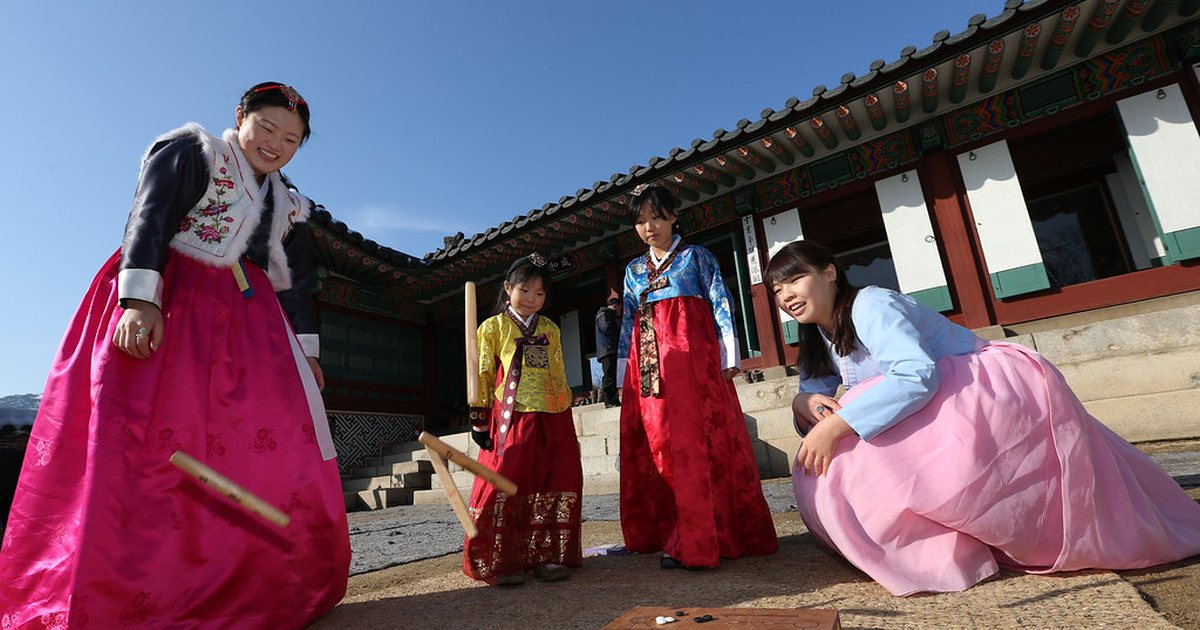
Gyeongbokgung hanbok comes down to 3 steps: rent near the station, walk in free, shoot early. Visitors wearing hanbok (한복, traditional Korean clothing) have long been admitted to Gyeongbokgung (경복궁) and Seoul’s other royal palaces without a ticket, so the rental partly pays for itself.
The rest is detail that makes or breaks the day: which style to rent, which courtyard to shoot in, what time to get there and how to walk on to Bukchon without annoying the people who live there. This guide covers the free-entry rule, the four rental styles, a photo-spot route and the Bukchon rules.
Key takeaways
- Walk the palace south to north (Gwanghwamun, Geunjeongjeon, Gyeonghoeru, then Hyangwonjeong) and leave by the east side toward Bukchon, so you never double back.
- Wear clean white sneakers under the full chima: the hem hides them, and the gravel courtyards are hard on thin slippers.
- Rent near Anguk Station (Line 3) if you’ll finish in Bukchon, and near Gyeongbokgung Station (Line 3) if the palace is your only stop.
Where the rules come from
Seoul’s royal palaces are run by the Korea Heritage Service, the government body formerly called the Cultural Heritage Administration, and its royal palaces website is the one place that lists current hours, closing days, fees and hanbok entry rules. According to the heritage administration, free entry for visitors in hanbok began in 2013. The debate over guidelines for what counts as “proper” hanbok started in 2018. Check that site once before your trip. Everything below assumes the rules it lists at the time you go.
How free entry in hanbok works at Gyeongbokgung
Gyeongbokgung was built in 1395 as the main palace of the Joseon dynasty (the kingdom that ruled Korea for about five centuries until the early 20th century). The palace is run by the Korea Heritage Service, the government body formerly called the Cultural Heritage Administration, and it has long let visitors in hanbok enter without buying a ticket. The idea was simple: get more people wearing traditional dress in the places it was made for.
The same perk applies at the other royal sites in central Seoul: Changdeokgung, Changgyeonggung, Deoksugung and Jongmyo Shrine (종묘, the Joseon kings’ ancestral shrine). The one big exception is the Changdeokgung Secret Garden (Huwon, 후원), which still needs its own ticket even if you’re in hanbok. That’s why you’ll see hanbok groups hopping between palaces in one afternoon.
Does fusion hanbok count for free entry?
This is the question everyone asks, and the honest answer is: it has been debated. Officials have in the past proposed guidelines on what counts as “proper” hanbok, partly because some rental styles mix in Western cuts, lace and short skirts. Rules and how strictly staff apply them can shift, so read the current entry policy on the official Gyeongbokgung page before you choose your outfit. If you want zero doubt at the ticket gate, rent a classic style (more on that below).
Where to rent hanbok near Gyeongbokgung Palace
Most rental shops sit within a short walk of the palace, around Gyeongbokgung Station (Line 3) on the west side and Anguk Station (Line 3) on the east side toward Bukchon. Shops near Gyeongbokgung Station suit you if the palace is your main stop. Shops near Anguk work better if you plan to finish in Bukchon Hanok Village or Insadong.
Koreans pick rental shops mostly on Instagram and Naver reviews, looking at three things: how fresh the dresses look in recent customer photos, whether hair styling is included, and how generous the time slot is. Big shops have hundreds of outfits; small shops tend to have better-kept fabric and calmer fitting rooms. Neither is automatically better.
How a hanbok rental works, step by step
- Book a time slot online or walk in. Weekday mornings usually have walk-in space; weekends and holidays fill up.
- Pick your outfit from the racks. Staff help you match the jeogori (저고리, the short jacket) with the chima (치마, the full wrap skirt) or baji (바지, loose trousers for men).
- Get dressed with help. Staff tie the goreum (고름, the long ribbon on the jacket front) and adjust the skirt height. Let them do it; tying it well takes practice.
- Add hair and accessories if you want: braided styles, a daenggi (댕기, hair ribbon), a binyeo (비녀, ornamental hairpin) or a norigae (노리개, a tasseled charm that hangs from the jacket).
- Store your bags and clothes in the shop’s lockers, take a small bag, and head to the palace.
- Return on time. Late returns usually cost extra, so build in 20 minutes for the walk back.
How to book a hanbok rental from abroad
Travel booking apps such as Klook, KKday and Creatrip list many Gyeongbokgung-area shops with English descriptions, and plenty of shops take bookings through their own Instagram or KakaoTalk (Korea’s main messaging app). Before you pay, check the shop’s current price list, what’s included (hair, accessories, shoes), the rental length, ID or deposit rules and the cancellation policy. Prices vary by shop, outfit tier and season, so compare a few rather than trusting an old blog post.
If this is your first time in Seoul, our first-trip South Korea travel guide covers the apps, transit card and data setup that make a morning like this run smoothly.
Traditional vs fusion hanbok: which should you rent?
Rental racks near the palace fall into three broad families. What you choose changes how you look in photos, how comfortable you are, and how relaxed you’ll feel at the entry gate.
| Style | What it looks like | Best for | Watch out for |
|---|---|---|---|
| Traditional (전통 한복) | Short jeogori, high-waisted full chima to the ankle, solid colors or subtle gold print | Palace photos that look timeless, no doubts at the gate | The long skirt needs a hand on stairs and in wind |
| Fusion (퓨전 한복) | Hanbok shapes mixed with Western details: lace, tulle, shorter or puffier skirts, bold patterns | Playful, bright photos, younger look | The style most likely to be questioned under any “proper hanbok” rule; check current policy |
| Royal and period costume | Embroidered robes modeled on Joseon court dress, such as a red dragon robe for men or layered court outfits | Big, dramatic photos in front of throne halls | Heavy and warm; usually a higher rental tier |
| Modern daily hanbok (생활한복) | Simplified hanbok-inspired pieces you could wear on the street | People who want comfort and a subtle look | Fewer rental shops carry it; looks less “palace” in photos |
What Koreans actually rent
Korean high school and university students, and couples on dates, are a big share of the palace hanbok crowd. Most of them go traditional or soft fusion: pastel jeogori, a deep-colored skirt, braided hair with a ribbon. The loudest tulle outfits are mostly picked by tourists, which is fine, but if you want photos that look like a Korean friend took them, choose classic shapes in two or three colors that contrast (a pale jacket with a navy, burgundy or dark green skirt is a safe Seoul favorite).
Outside rentals, Koreans wear hanbok for weddings, a baby’s first birthday party (dol, 돌), and the two big holidays, Seollal (Lunar New Year) and Chuseok (the autumn harvest holiday). Seeing children in tiny hanbok at the palace on those holidays is one of the sweetest sights in Seoul.
Men’s hanbok and what to pair with it
Men usually rent baji trousers, a jeogori and a vest, sometimes with a durumagi (두루마기, a long overcoat) on top. Many shops also offer a gat (갓, the wide-brimmed black horsehair hat of Joseon scholars), which became famous abroad through historical K-dramas. It photographs beautifully but sits high on the head, so ask staff to secure it if the day is windy.
Best photo spots inside Gyeongbokgung in hanbok
The palace is large, and the best frames are spread across it. Walk it in this order from the main gate and you’ll hit the iconic shots without doubling back.
| Spot | What it is | Photo idea | Best light |
|---|---|---|---|
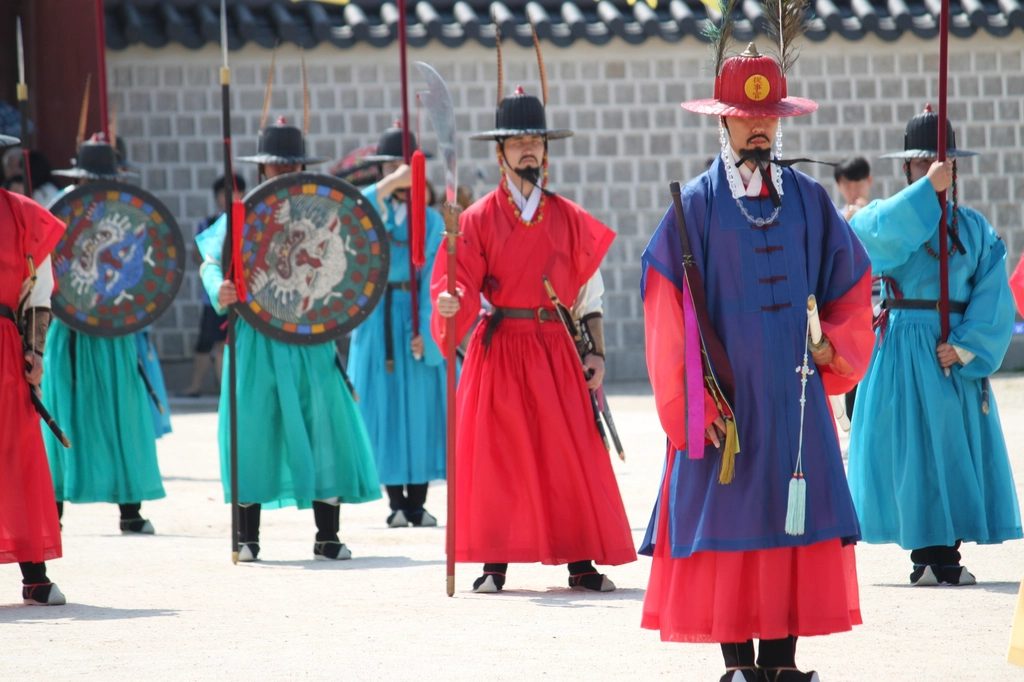
| Gwanghwamun (광화문) | The palace’s main southern gate | Full-length shot centered on the gate, with the guard ceremony if it’s running | Morning |
| Heungnyemun courtyard | The second gate and its stone-paved yard | Wide shot showing the scale of the palace behind you | Morning |
| Geunjeongjeon (근정전) | The main throne hall, where state ceremonies were held | Stand among the stone rank markers in the courtyard for a royal-court look | Morning or late afternoon |
| Gyeonghoeru (경회루) | The royal banquet pavilion on a pond | Shoot from the pond edge to catch the pavilion and its reflection behind you | Calm mornings, late afternoon |
| Hyangwonjeong (향원정) | A small hexagonal pavilion on an island, reached by a wooden bridge | Side angle from the pond path, with trees framing the pavilion | Autumn foliage, early spring |
| Back-courtyard walls and side gates | Quiet residential quarters with low walls and wooden doors | Close-up portraits against painted doors and tiled walls | Any time, often empty |
The shot locals queue for
Gyeonghoeru is the one. On a still morning the pavilion doubles in the water, and a hanbok in a strong color (red, royal blue, deep green) pops against the gray stone and green trees. Koreans often turn slightly away from the camera and look back over the shoulder, which shows off the jeogori collar and the line of the skirt.
Small details that make palace photos look better
- Shoot full-length from slightly below waist height; it makes the skirt look longer and the palace taller.
- Use the long corridors and gate frames to put a “window” around you.
- Hold the skirt lightly at one side when walking; it adds motion and keeps the hem clean.
- Leave your modern bag out of the frame, or rent a small fabric pouch from the shop.
Best time and season for Gyeongbokgung hanbok photos
Arrive at opening time. The first hour is when tour groups haven’t reached the inner courtyards yet, the light is soft, and you can get Gyeonghoeru without fifty strangers in the background. Check the official site for current opening hours, since they shift slightly by season.
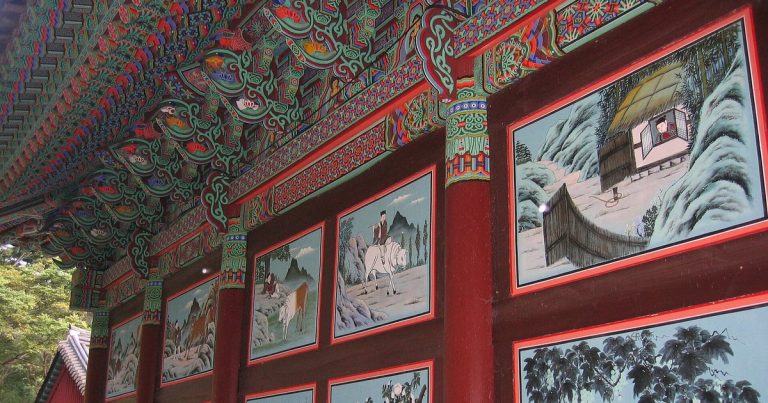
Late afternoon is the second-best window: warmer light on the painted eaves (dancheong, 단청, the green-red-blue patterns on palace woodwork) and fewer people near closing. Midday on weekends is the worst time for clean shots.
What to rent in each season
- Spring: cherry and apricot blossoms around the grounds. Light pastel jeogori fit the mood.
- Summer: it’s hot and humid in Seoul. Ask for a lighter fabric such as ramie (mosi, 모시) and keep rental time short. Bring water and a fan.
- Autumn: the most popular hanbok season, with red and yellow leaves around Hyangwonjeong. Book shops ahead for weekends.
- Winter: cold and dry. Many shops lend fur-trimmed shawls, vests or overcoats. Wear thermal layers underneath; the full chima hides them well.
Night openings
Gyeongbokgung has run limited evening openings in some seasons, with the palace lit up after dark. Tickets for these tend to be booked online and sell quickly, and the free-entry rule may not work the same way.
Gyeongbokgung to Bukchon in hanbok: half-day route
Bukchon Hanok Village (북촌한옥마을) sits on the hill east of the palace, a cluster of hanok (한옥, traditional Korean houses with curved tile roofs) that people still live in. A palace-then-Bukchon loop is the classic hanbok half-day, and it’s why many people rent for longer than the palace alone needs.
- Area
- Gyeongbokgung, Jongno-gu, central Seoul
- Nearest station
- Gyeongbokgung Station (Line 3); Gwanghwamun Station (Line 5) for the main gate
- Time needed
- 2 to 3 hours for the main halls and pavilions at a photo pace
- Before you go
- check opening days and fees on the official page
- Area
- Bukchon, Jongno-gu, between Gyeongbokgung and Changdeokgung
- Nearest station
- Anguk Station (Line 3)
- Time needed
- 1 to 1.5 hours for the main hanok lanes
- Before you go
- check visiting-hour limits posted by Jongno-gu and on signs in the village
A worked example: a half-day hanbok route
Here’s how a smooth morning looks. You book a rental near Gyeongbokgung Station for a slot long enough to cover the palace and Bukchon, dress and get your hair done, and walk to the palace for opening. You start at Gwanghwamun, move north through Geunjeongjeon, then spend your best time at Gyeonghoeru and Hyangwonjeong.
From the palace’s east side you walk up toward Bukchon, keeping your voice down in the lanes, and take a few photos on the sloping alleys with tiled roofs behind you. If your rental shop is on the west side, factor in the walk back before your return time, or choose a shop near Anguk from the start and do the route in reverse. Finish with lunch in Insadong or Samcheong-dong; our list of 30 Korean dishes to try helps you order like a local.
Bukchon rules you need to know
Residents have complained for years about noise and crowds. According to Jongno-gu, the district office that covers Bukchon, part of the village has been a special management area (widely called the “red zone”) with restricted visitor hours since November 2024, and fines apply to violators after a grace period. The hours are posted on signs at the lane entrances, so read them as you walk in. Don’t open gates or sit on doorsteps, and never photograph into windows. Seochon, the older neighborhood west of the palace, is a quieter alternative with cafés and small hanok streets.
Hanbok etiquette at the palace
Wearing hanbok as a visitor is welcomed in Korea. Koreans generally take it as appreciation, not appropriation, as long as you treat the clothes and the place with respect.
- Stay off the buildings. Don’t climb on stone platforms, railings or steps that are roped off, and don’t sit on the palace floors to pose.
- Share the frame. At Gyeonghoeru and Hyangwonjeong, take your shots and step aside. Long photo shoots that block paths draw glares.
- No drones. Central Seoul around the palace is restricted airspace, and flying a drone there isn’t allowed without permission.
- Check rules for big kits. Tripods and professional or commercial shoots can be limited or need permission; check the official palace rules before you bring a full setup.
- Keep the outfit tidy. Let shop staff tie the goreum, and don’t drag the skirt through puddles or dirt. You’re responsible for damage under most rental terms.
- Be polite to staff. A simple “gamsahamnida” (감사합니다, thank you) goes a long way; see our basic Korean phrases for travel for more.
Common Gyeongbokgung hanbok mistakes to avoid
Booking the rental on the palace’s closing day
It happens every week. Gyeongbokgung has traditionally closed on Tuesdays, while some other palaces close on Mondays. Pick your palace day first, then book the rental.
Renting too short a slot
Dressing, hair, walking to the palace, queues at the photo spots and the walk back eat up time fast. If you want the palace and Bukchon, pick a longer slot rather than racing the clock and paying late fees.
Wrong shoes
The palace has wide gravel and stone courtyards. Some shops offer kkotsin (꽃신, embroidered traditional slippers), but many Koreans simply wear clean white sneakers under the full skirt, since the hem hides most of the shoe. Comfortable beats authentic here.
Ignoring the weather
Summer heat in layered fabric is tiring, and winter wind goes straight through a light jeogori. Ask the shop about seasonal fabrics and outer layers, and check Seoul’s forecast the night before.
Assuming every outfit gets free entry
If a style sits far from traditional hanbok, don’t build your budget around free entry. Keep a little money for a ticket just in case.
FAQ
Is Gyeongbokgung free if you wear hanbok?
Yes, visitors in hanbok get in without a ticket; see how free entry in hanbok works at Gyeongbokgung for the style question and the other royal sites that do the same.
How long should I rent a hanbok for Gyeongbokgung?
Plan on 2 to 3 hours for the palace at a relaxed photo pace, plus time for dressing and walking. If you’re adding Bukchon or another palace, book a longer slot. Shops list their own time options, so compare before you book.
Can foreigners wear hanbok in Korea?
Yes. Koreans generally see foreigners in hanbok as a sign of interest in Korean culture, and the palace free-entry policy exists to encourage it. Wear it neatly and behave respectfully at historic sites.
Do I need to book a hanbok rental in advance?
On weekday mornings you can often walk in. For weekends, Korean holidays and autumn foliage season, book ahead through a travel app or the shop’s Instagram or KakaoTalk. Booking also lets you check hair styling and what’s included.
What should I wear under a hanbok?
Thin, close-fitting clothes work best: a fitted T-shirt or camisole and leggings or shorts. In winter, add thermal layers. Most shops have changing rooms and lockers for the rest of your things.
Should I tip the hanbok rental staff?
No. Tipping isn’t part of Korean service culture, and rental shops don’t expect it. A thank-you or a kind online review is the local way to show appreciation; read more in our guide to tipping in Korea.
What to plan next after your hanbok day
Open the official Gyeongbokgung page first: confirm the closing day, current hours and any free-entry rules for hanbok. Then pick a rental shop on the side of the palace that matches your route, Gyeongbokgung Station for a palace-only visit or Anguk for a palace-and-Bukchon loop.
If you have a second free morning, try another palace in hanbok. Changdeokgung pairs naturally with Bukchon, and Deoksugung near City Hall is calmer and photogenic at dusk. If your trip lands on Seollal or Chuseok, check for holiday events at the palaces, when Korean families come out in hanbok of their own.
Related reading

Sources k-korea.blog
Prices, opening hours and availability change. Check the official page before you buy or travel.