
13 min read
Do you tip in Korea? No. At restaurants, cafes, taxis and hair salons, the normal tip is 0 won. The price on the menu is the price you pay, tax included, and the staff are paid by the business, not by your generosity.
That makes Korea one of the easiest places in the world to pay. The few exceptions sit at the international end of travel: upscale hotels that add a service charge to the bill, private tour guides booked through foreign agencies, and a handful of foreign-style bars. Everywhere else, you can stop doing percentage math in your head.
Key takeaways
- Restaurants, cafes, taxis, salons and spas: tip 0 won. The menu or meter price is the full price.
- Upscale hotels may print a service charge on the bill. That replaces tipping, so don’t add more on top.
- The “배달팁” (baedal tip) in Korean delivery apps is a fixed delivery fee set by the restaurant, not a gratuity.
- To thank staff the Korean way, say “jal meogeosseumnida” at the counter or leave a review on Naver Map or Kakao Map.
Do you tip in Korea? The answer, situation by situation
The short version holds almost everywhere you’ll spend money. Here’s how it plays out in the places foreign visitors actually ask about, and what Koreans do instead of reaching for extra cash.
| Situation | Tip expected? | What Koreans actually do |
|---|---|---|
| Restaurant, including Korean BBQ | No | Pay the bill at the counter, say “jal meogeosseumnida” (I ate well) on the way out |
| Cafe or bakery | No | Order at the counter or kiosk, bus your own tray to the return shelf |
| Taxi | No | Pay the meter by card or T-money transit card; small change is sometimes left, never expected |
| Hair salon, nail shop, spa | No | Pay the posted price; regulars come back and leave a review |
| Upscale or international hotel | Usually no, a service charge may be on the bill | Read the bill; the service charge is the tip |
| Private tour guide or driver (booked from abroad) | Sometimes, at the agency’s suggestion | Follow the guideline on the booking page; Korean group tours don’t expect it |
| Food delivery app | No, the “tip” is a fee | The delivery fee is charged automatically at checkout |
| Golf caddie | A caddie fee, not a tip | The group pays the fee set by the course, often in cash |
Notice what’s missing: no tip line on card receipts, no tip prompt on payment terminals at ordinary restaurants, no jar by the register. The system was never built around it.
Why Korea doesn’t have a tipping culture
Korean service work has always been paid as a wage by the owner, and prices are set to cover it. Menu prices in Korea are shown with the 10% value-added tax already included, so the number on the wall is the number on your receipt. Nothing gets bolted on at the end.
There’s a cultural reason too. Good service is treated as part of doing the job properly, and many Koreans would feel odd being handed extra money for it, as if they were being paid for a favor or, worse, given charity. Money changes hands in Korea all the time (wedding and funeral envelopes, New Year’s money for kids), but each of those has a clear social meaning. A tip to a stranger doesn’t fit any of them.
The Korean reverse tip: “service”
Korea does have a gesture of extra goodwill, but it runs the other way. When a restaurant owner sends over a free bottle of soda, a plate of rolled omelet or an extra portion of meat, Koreans call it “서비스” (seobiseu, from the English word service). It means “on the house.”
Regulars get it most. So do big groups, friendly customers and anyone who compliments the food. If you want to be on the receiving end, the trick isn’t tipping. It’s coming back, ordering well and being warm. The feeling behind it is “정” (jeong), the Korean word for the affection and loyalty that build up between people over repeated contact, including between a neighborhood restaurant and its customers.
Owners, not tips, set the pay
Many Korean restaurants are small family businesses where the person at the grill or the register is the owner, a relative or a long-time employee. Service is shared across the room, not assigned table by table, so there’s no single server “earning” your table the way there is in North America. That structure alone makes tipping awkward: who would it even go to?
What happens if you leave a tip anyway
In most places, someone will assume you forgot your money. It’s common for staff to follow customers out to the door or the street holding the cash or coins left on the table. That isn’t rudeness. They’re trying to return something they think you lost.
If you hand it over directly, expect a polite refusal, sometimes two or three. Some staff will accept to avoid an awkward moment, especially in tourist areas used to foreign visitors, but many are uncomfortable taking it, and some workplaces have rules about it. Pushing hard after a refusal turns a nice gesture into a small social problem.
Is tipping in Korea rude?
Not rude, more confusing. Nobody will be offended that a foreign visitor tried to be generous. But it puts the worker in the position of deciding whether to refuse you, which is the opposite of what you intended. The smoother move is to say thank you in Korean and leave it there.
The exceptions: where tips and service charges do show up
A few corners of Korean travel work differently, mostly because they serve international guests or follow international industry habits. None of them require you to calculate a percentage on top of a normal bill.
Upscale and international hotels
Some higher-end hotels in Seoul and Busan add a service charge to room service, restaurant and bar bills, printed as its own line alongside VAT. That charge replaces a tip. At international chains, some guests hand a bellhop or concierge a small note for unusual help, and it may be accepted, but it isn’t expected, and Korean guests generally don’t do it.
Private tours and drivers booked from abroad
If you book a private guide or a car-and-driver day through an international agency, the agency may suggest a tip, because its customers come from tipping countries. Follow what the booking page or the agency says. Standard Korean group bus tours, palace guides and DMZ (the Demilitarized Zone, the heavily guarded strip along the border with North Korea) day tours don’t build tipping into the experience, so check the operator’s official page before you assume either way.
Foreign-style bars
A small number of bars run by or for foreigners, often in neighborhoods like Itaewon, may have a tip jar. That’s a house custom imported from abroad. Leave something if you like the bartender, skip it if you don’t. You won’t find this at a Korean pojangmacha (포장마차, a tented street-side bar) or a chicken-and-beer place.
Golf caddies
Korean golf courses charge a caddie fee per group, set by the course and often paid in cash directly to the caddie. It looks like a tip because cash is handed over at the end, but it’s a fixed fee. Check the course’s own page for how it works.
The “delivery tip” in Korean apps
Open Baemin or Coupang Eats in Korea and you’ll see “배달팁” (baedaltip), literally “delivery tip.” Despite the name, it’s a delivery fee the restaurant sets, charged automatically at checkout. You don’t choose it and you don’t add more to the rider.
How Korean restaurants work without tips
Because no server is working a table for a tip, Korean restaurants are designed so you need staff as little as possible. Once you understand the system, it’s faster than table service almost anywhere.
The call bell on your table
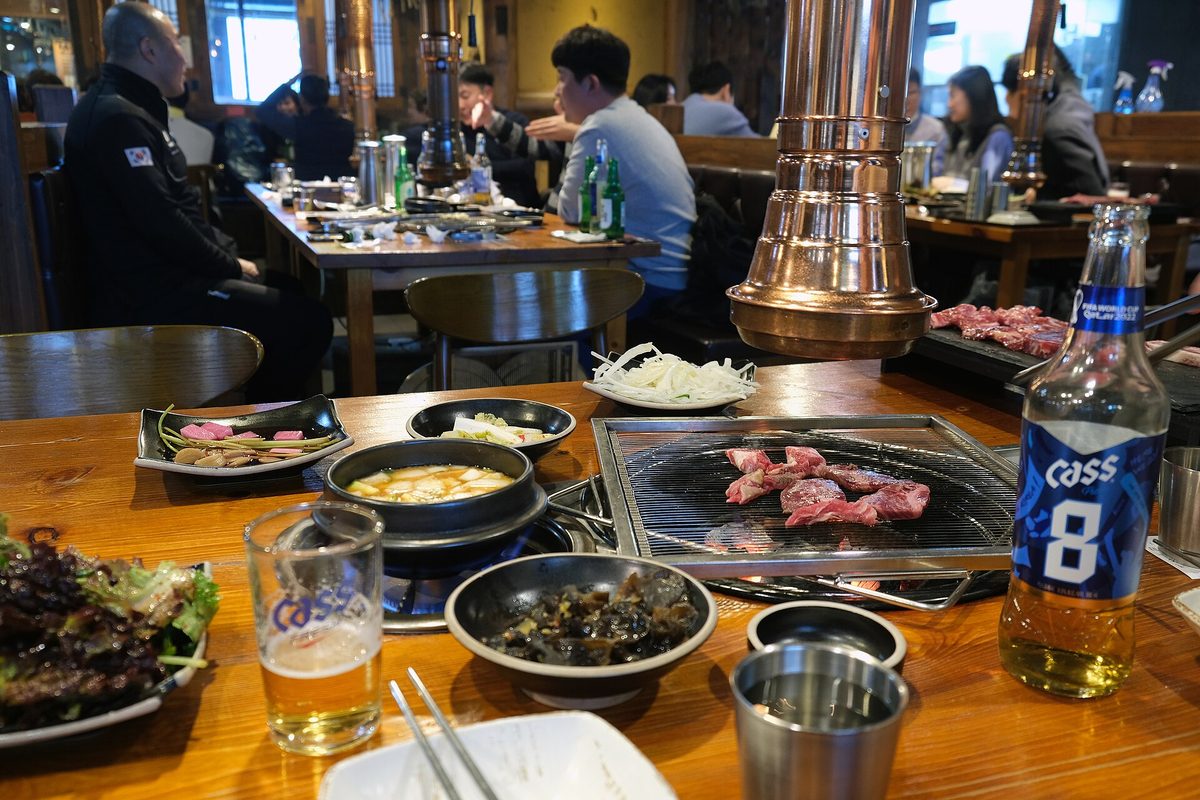
Many restaurants have a small button on the table or wall, the “호출벨” (hochulbel, call bell). Press it and a number lights up on a board by the kitchen. Staff come over, you order or ask for more side dishes, they leave. No hovering, no checking in every ten minutes.
If there’s no bell, Koreans raise a hand and call out “yeogiyo!” (여기요, over here) or “jeogiyo!” (저기요, excuse me). It feels loud to some visitors, but it’s normal and polite. More restaurants now use a tablet on the table for ordering, which removes the need to call anyone at all.
“Water is self-service”
Look for a sign reading “물은 셀프” (mureun selpeu), water is self-service. It points to a water dispenser or fridge with stainless steel cups, often in a UV sterilizer cabinet. You fetch your own water, free. Many places also have a “셀프바” (selpeu-ba, self bar) where you refill banchan (반찬, the free side dishes like kimchi and seasoned vegetables) and lettuce for BBQ wraps.
Cutlery is in the drawer
Spoons and chopsticks are often in a drawer built into the side of the table or in a box on top. Napkins sit in a holder or a roll on the wall. Nobody brings them to you, and that’s not bad service.
Pay at the counter on the way out
At most casual Korean restaurants, you don’t wait for a bill. When you’re done, you walk to the counter by the door, tell them your table (or hand over the order slip), and pay. One person typically pays for the group; splitting the bill, called “더치페이” (deochi pei, Dutch pay), is fine, but it’s easier at the counter if one person pays and the rest settle up by bank transfer later, which is what younger Koreans usually do.
For dish ideas before you go, our list of 30 Korean dishes Koreans would order for you covers what to point at once you’re seated.
How to show thanks in Korea instead of tipping
Koreans thank people constantly. They just do it with words, loyalty and small gestures instead of percentages. These are the moves that land.
Four phrases that do the job of a tip
- “Jal meogeosseumnida” (잘 먹었습니다): “I ate well.” Said at the counter after paying. This is the single best thing you can say to a restaurant owner.
- “Gamsahamnida” (감사합니다): the standard polite “thank you,” fine anywhere.
- “Masisseoyo” (맛있어요): “It’s delicious.” Say it mid-meal and watch the mood change.
- “Sugohaseyo” (수고하세요): roughly “keep up the good work,” what Koreans often say to staff as they leave a shop.
For pronunciation and more polite forms, see our 30 basic Korean phrases for travel.
Leave a review on Naver Map or Kakao Map
Koreans rely on Naver Map and Kakao Map far more than Google Maps for restaurants, and small businesses watch their reviews closely. A short positive review, with a photo of the food, does more for a family restaurant than a cash tip would. Some Naver listings let you verify a review with a photo of your receipt, which gives it more weight.
Come back, and bring friends
Repeat visits are how jeong builds. Return to the same place twice in a trip and there’s a fair chance the owner remembers you, and that’s when the “service” plate appears.
A cold drink for people working in your space
When movers, repair technicians or installers work in a Korean home, it’s a common courtesy to hand them a cold drink, often a small bottle of an energy tonic like Bacchus (박카스) or a can of coffee. Some households also give money “for a meal” on a long, hard job. For visitors, the same spirit applies to anyone who goes well beyond the job: a drink or a snack is a natural Korean way to say thanks.
What Koreans think about tipping
Most Koreans see tipping as a foreign custom they meet when traveling, especially in the United States, where working out 15 to 20 percent on every meal is a common source of confusion and complaint among Korean tourists. At home, the idea of a menu price that isn’t the real price feels strange.
When Korean businesses have experimented with adding tip options or tip jars, they have tended to draw public criticism rather than enthusiasm, because many customers see it as a hidden price increase. The prevailing view is simple: if service costs more, put it in the price.
Gifts have legal limits in some jobs
Korea also takes gifts to certain professions seriously. The Improper Solicitation and Graft Act, often called the Kim Young-ran Act, took effect in 2016 and limits gifts and meals given to public officials, teachers and journalists. It doesn’t apply to waiters or taxi drivers, but it shows how carefully Koreans think about money handed over outside a clear price.
Common tipping mistakes foreigners make in Korea
Most slip-ups are harmless, but a few cause real awkwardness or cost you money for nothing.
- Leaving cash on the table. Staff will likely chase you with it or set it aside as lost property. If you must, hand it over with both hands and accept a refusal gracefully.
- Tipping on top of a hotel service charge. Read the bill first. If the service charge line is there, you’ve already tipped.
- Waiting for the bill at your table. In casual places it won’t come. Walk to the counter.
- Waiting for water. If you see “물은 셀프,” go get it.
- Thinking Korean BBQ staff who grill your meat expect a tip. Cutting and turning meat is part of the service at many BBQ restaurants. A “gamsahamnida” covers it.
- Adding money for a delivery rider because the app says “tip.” The 배달팁 is already a fee.
Worked example: a full day in Seoul, tips owed 0 won
Here’s how a typical day for a visitor plays out, and where the tipping question comes up.
- Morning coffee: you order at a kiosk, pick up when your number is called, return the tray to the shelf. No tip, no tip prompt.
- Subway to a palace: tap your T-money card. (Our Seoul subway guide covers cards, apps and exits.)
- Lunch at a kimchi stew restaurant: fetch your own water, refill banchan at the self bar, press the bell for a second bowl of rice, pay at the counter, say “jal meogeosseumnida.” No tip.
- Taxi back to the hotel: pay the meter by card. If it’s a round number plus a few hundred won in coins, some people say “keep the change” (잔돈은 괜찮아요, jandoneun gwaenchanayo). Optional, small, not expected.
- Korean BBQ dinner: staff grill and cut the meat, an owner might bring a free soda as “service.” Pay at the counter, thank them. No tip.
- Hotel bar nightcap: the bill shows a service charge. That’s the tip, done.
Total tips: 0 won. Total thank-yous: about a dozen. That’s the Korean ratio.
FAQ
Is it rude to tip in Korea?
It isn’t considered rude, but it’s unusual and can be awkward. Staff may refuse, or chase you down thinking you left money by mistake. A spoken thank-you in Korean is the better gesture.
Do you tip taxi drivers in Korea?
No. Pay what the meter shows, by card, T-money or cash. Telling the driver to keep small coins is fine but not expected, and some drivers will insist on giving change.
Do you tip at hotels in Korea?
Generally no. Upscale and international hotels may add a service charge to bills, which takes the place of a tip. A small note for a bellhop at an international chain may be accepted, but it isn’t part of Korean custom.
Do you tip tour guides in Korea?
For Korean group tours, it isn’t expected. For private guides or drivers booked through international agencies, the agency may suggest a tip, so follow the guidance on your booking page or the operator’s official site.
Do you tip at Korean BBQ restaurants?
No. Grilling and cutting the meat at your table is part of the service and included in the menu price. If you enjoyed it, say “jal meogeosseumnida” at the counter and leave a review on Naver Map or Kakao Map.
Should I tip at a Korean restaurant outside Korea?
Yes, follow the custom of the country you’re in. A Korean restaurant in the United States or Canada runs on local wages and local tipping norms, so tip as you would at any other restaurant there.
Before your trip: what to sort out for paying in Korea
With tipping off your list, the payment prep that matters is simpler. Bring a card that works abroad without heavy foreign transaction fees, since cards are accepted almost everywhere, from convenience stores to taxis. Get a T-money card at the airport or any convenience store for the subway and buses.
Download Naver Map or Kakao Map before you land, both for directions and for leaving those thank-you reviews. Then practice two phrases until they’re automatic: “gamsahamnida” and “jal meogeosseumnida.” In Korea, those do the work your wallet does back home.
Related reading

Sources k-korea.blog
Prices, opening hours and availability change. Check the official page before you buy or travel.