
13 min read
A Korean corn dog is sausage or mozzarella on a stick, fried for about 3 minutes in a thick batter. It usually gets rolled in sugar straight out of the oil and finished with a zigzag of ketchup and mustard. In Korea it’s simply called hat-dogeu (핫도그), and the versions you’ll find run from all-cheese to potato-studded to coated in crushed ramen.
This guide covers each main type, why the sugar goes on, where to buy one in Seoul or back home, and a home recipe for 6 corn dogs that still have a proper cheese pull.
Key takeaways
- Koreans call it hat-dogeu (핫도그). “Korean corn dog” is the name it picked up abroad, and most batters use wheat or rice flour, with little or no cornmeal.
- Half-and-half (반반, banban) means mozzarella on the top half and sausage on the bottom, so one stick gives you both the cheese pull and the salty meat.
- Sugar goes on first and sauce second: a light roll in sugar while the crust is still hot, then ketchup, mustard or both.
- At home, a yeasted batter rested for about 1 hour and oil held near 170°C (340°F) come closest to the street version.
What is a Korean corn dog?
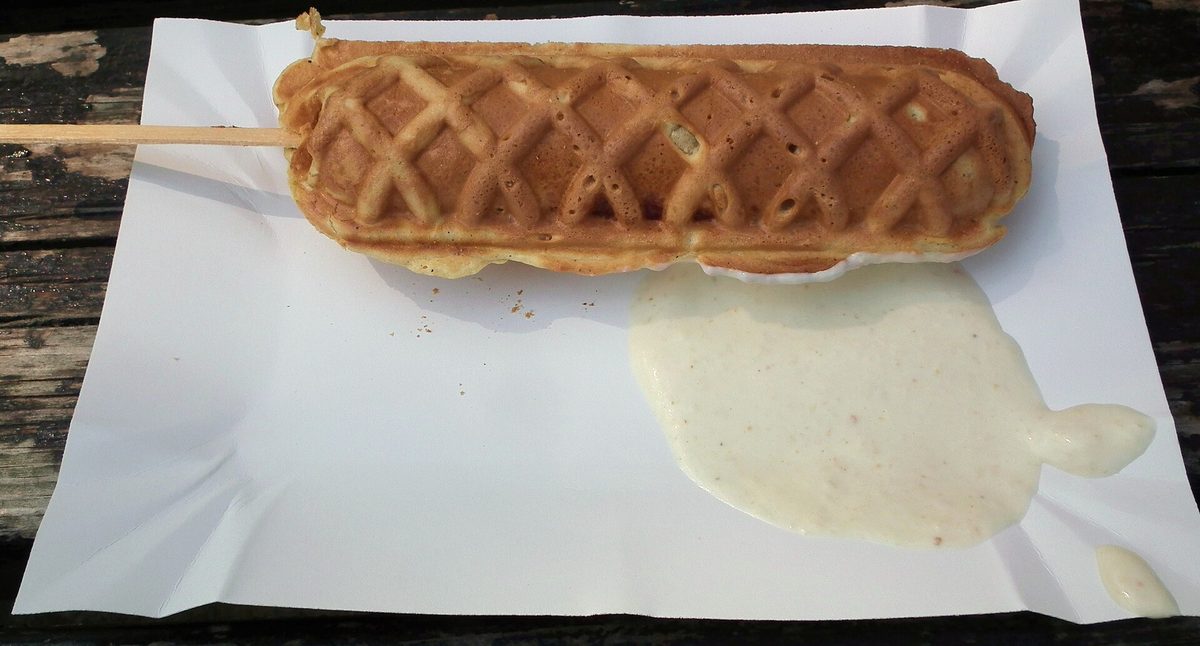
A Korean corn dog is a skewered filling, usually a sausage, a block of mozzarella or both. It’s dipped in a dense batter, often rolled in panko breadcrumbs and deep-fried until the shell turns golden and crackly. The batter is what sets it apart. An American corn dog uses a cornmeal batter that cooks up soft and cakey. The Korean one uses wheat flour, rice flour or a mix, often raised with yeast, so the inside stays chewy and a little bready while the outside crunches.
The name comes from a translation problem. In Korea, hat-dogeu (the Korean pronunciation of “hot dog”) has long meant the battered snack on a stick. It’s sold at bunsikjip (분식집, cheap casual snack shops that serve tteokbokki, gimbap and fried food) and at highway rest stops. Calling it a “Korean hot dog” in the US would have confused everyone, so English speakers named it after the closest local relative.
The fillings are what changed. Stretchy mozzarella, potato cubes on the outside and new coatings turned an old rest-stop snack into a street food built for the mid-bite photo. That photo is a big reason it spread so fast on social media far beyond Korea.
Korean corn dog vs American corn dog: what’s different
If you grew up on state-fair corn dogs, the sweetness won’t surprise you. The crunch and the chew will. Here’s how the two compare.
| Feature | American corn dog | Korean corn dog (핫도그) |
|---|---|---|
| Batter | Cornmeal, lightly sweet, cakey | Wheat or rice flour, often yeasted, chewy and bready |
| Outer coating | Smooth batter only | Panko crumbs, potato cubes, crushed ramen or plain batter |
| Filling | Beef or pork frankfurter | Sausage, mozzarella, half-and-half, fish cake and more |
| Toppings | Mustard and ketchup | Sugar first, then ketchup, mustard, cheese or spicy sauces |
| Texture | Soft all the way through | Crunchy shell, chewy middle, stretchy cheese |
| Where you find it | Fairs, ballparks, frozen aisle | Street stalls, chains, rest stops, convenience stores |
The coating matters most. Panko or potato gives a Korean corn dog its jagged, shattering surface. A plain batter shell can’t get that, however long you fry it.
The 6 main types of Korean corn dog and how to choose
Most stalls and chains build their menus from the same handful of styles, then add their own coatings and sauces. Once you know these six, you can read almost any Korean menu board.
Classic sausage (소시지 핫도그)
This is the original: one sausage, one batter, often with no breadcrumbs at all. It’s the version from highway rest stops and school-gate snack shops, and it’s the cheapest thing on most menus. Pick it for nostalgia, or if you aren’t into melted cheese.
Mozzarella (모짜렐라 핫도그)
The whole stick is cheese. Stalls use low-moisture mozzarella, which melts into long strings without turning watery. It’s the one you’ve seen stretched between a hand and a mouth. It’s also the richest, so one is usually enough.
Half-and-half (반반 핫도그, banban)
Mozzarella sits on the top half and sausage on the bottom. You get the cheese pull in your first bites and the salt later. If you can only order one, order this, because it gives you the best of both.
Potato (감자핫도그, gamja hat-dogeu)
Small cubes of potato get pressed into the batter before frying, so the outside comes out knobbly and crisp, like hash browns wrapped around a sausage. It’s the heaviest type and the most filling, and it holds its crunch longer than panko does.
Ramen or crispy noodle
Crushed instant noodles replace the breadcrumbs. They fry into a shaggy, extra-crunchy shell with a salty, snack-chip edge. It’s easy to make at home, since a packet of instant ramen from any grocery store does the job.
Specialty batters and fillings
Some stalls dye the batter black with squid ink or add cheddar. Others use fish-cake sausage or swap panko for flakes of sweet potato. Don’t mix these up with sotteok sotteok (소떡소떡), a related rest-stop favorite: sausage and rice cake threaded on a skewer and glazed in sauce, with no batter at all.
| Type | On the stick | Outside | Pick it if |
|---|---|---|---|
| Classic sausage | Sausage | Plain batter or panko | You want the original rest-stop taste |
| Mozzarella | All cheese | Panko | The cheese pull is the point |
| Half-and-half | Cheese on top, sausage below | Panko | It’s your first Korean corn dog |
| Potato | Sausage or cheese | Potato cubes | You want maximum crunch and a meal-sized snack |
| Ramen | Sausage or cheese | Crushed instant noodles | You like salty, chip-like crunch |
| Specialty | Varies | Squid ink, sweet potato, cheddar | You’ve tried the basics and want something new |
Why Koreans roll corn dogs in sugar
Sweet and salty is the whole idea, the same reason kettle corn and chocolate-dipped pretzels work. The batter is already lightly sweet. The sugar coating adds crunch and a burst of sweetness right before the salty sausage or rich cheese, and ketchup brings in some acidity.
Timing matters too. Vendors roll the corn dog in a tray of granulated sugar the moment it leaves the oil, while the surface is still slick enough for the crystals to stick. Once it cools, the sugar just falls off.
If sugar on a sausage sounds wrong to you, try it once anyway. Most first-timers come around after a bite. You can still skip it: say seoltang ppaejuseyo (설탕 빼주세요), which means “please leave out the sugar.”
Which sauces go on a Korean corn dog
Most stalls and chains keep squeeze bottles on the counter so you can add your own. The usual lineup:
- Ketchup: the default, squeezed on in a zigzag over the sugar.
- Yellow mustard: often paired with ketchup on the same stick.
- Honey mustard: sweeter and milder, popular on potato corn dogs.
- Cheddar cheese sauce: extra cheese on top of the cheese, at chains that offer it.
- Spicy or sweet chili sauces: for heat, often built on gochujang (Korean fermented chili paste).
A rough rule: plain ketchup and mustard on sausage, honey mustard on potato, and go light on mozzarella so the sauce doesn’t drown the cheese.
Where to eat Korean corn dogs in Korea
You don’t need to search hard. Korean corn dogs are sold almost everywhere that sells snacks, but the experience varies a lot by place.
Street food streets and markets
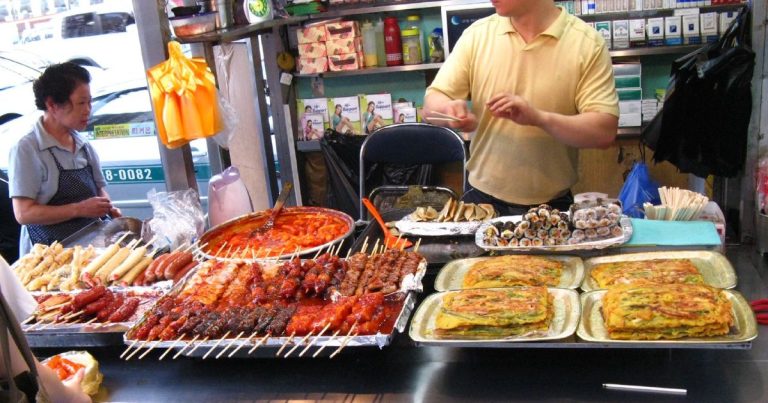
Myeongdong’s evening street stalls, the streets around Hongdae and Gwangjang Market (a traditional market known for its food alleys) all sell corn dogs fried to order alongside tteokbokki and skewers. Corn dog stalls are a natural stop on a food walk after dark; our guide to things to do in Seoul at night covers the best areas and how to get home. If you’re shopping anyway, most of the neighborhoods in where to shop in Seoul have a corn dog counter within a few minutes’ walk.
Corn dog chains
Dedicated chains sit near subway exits, universities and busy shopping streets. Myungrang Hotdog (명랑핫도그) is one of the best-known names and is associated with rice-flour batter. Chains usually post their full menu on a wall board with photos, so you can point. Menus and prices change, so check the brand’s official site or the board in the store.
Highway rest stops and convenience stores
Highway rest stops, called hyugeso (휴게소), are where many Koreans first ate hat-dogeu on family road trips. The classic sausage version is still a staple there. Convenience stores such as GS25, CU and 7-Eleven sell packaged corn dogs that you heat in the in-store microwave. They’re fine at midnight, but they aren’t the fresh-fried version.
How to order and pay
Point at the photo and say the name plus hana juseyo (하나 주세요), “one, please.” For example, “banban hana juseyo” gets you a half-and-half. Chains take cards, while some market stalls prefer cash. Our guide on how to pay in Korea as a foreigner explains when to carry won.
Where to buy Korean corn dogs outside Korea
In the US and Canada, Korean-style corn dog chains such as Two Hands and Chungchun Rice Dog have opened in many cities, often in malls and Koreatowns. Locations open and close, so use each brand’s official store locator before you drive across town.
The frozen route is easier. Korean supermarkets such as H Mart and other Asian grocers stock frozen Korean corn dogs, usually mozzarella or half-and-half. Some mainstream supermarkets and warehouse clubs carry them too, but it depends on the store and the season.
Frozen vs fresh: how to get the crunch back
Frozen corn dogs are already fried, so reheat them in a way that dries the crust. An air fryer or a hot oven does that well; follow the times on the package. A microwave works if you’re in a hurry, but the crust goes soft. Roll the hot corn dog in sugar right after reheating, and it gets surprisingly close to a stall version.
How to make a Korean corn dog at home (핫도그)
This makes 6 half-and-half corn dogs with a yeasted batter. Prep time includes about 1 hour of resting for the batter. The batter should be thick and sticky, closer to a loose dough than a pancake batter. That’s what lets it cling to the cheese.
- 3 hot dogs or precooked sausages, halved crosswise
- 3 sticks low-moisture mozzarella string cheese, halved crosswise
- 6 wooden skewers or disposable wooden chopsticks
- 1 1/4 cups (160 g) all-purpose flour
- 1/4 cup (40 g) glutinous (sweet) rice flour, or more all-purpose flour
- 2 tablespoons sugar, plus about 1/2 cup for rolling
- 1/2 teaspoon salt
- 1 1/2 teaspoons instant yeast
- 1 large egg
- 3/4 cup (180 ml) warm milk
- 1 1/2 cups panko breadcrumbs
- 1 cup frozen diced potatoes or hash brown cubes, thawed and patted dry (optional, for the potato version)
- About 4 cups (1 liter) neutral oil for deep-frying
- Ketchup and yellow mustard to finish
- Whisk the flour, rice flour, 2 tablespoons sugar, salt and yeast in a bowl. Beat the egg into the warm milk (warm to the touch, not hot), then stir it into the dry mix until no dry flour is left. Cover and rest in a warm spot for about 1 hour, until puffy and bubbly.
- While the batter rests, push each skewer through half a sausage, then through half a cheese stick so the cheese sits on top. Pat everything dry and freeze the skewers for 15 to 20 minutes so the cheese is firm when it hits the oil.
- Stir the batter to knock out the large bubbles and scrape it into a tall glass. Spread the panko on a plate (and the potato cubes on another, if using). Heat the oil in a heavy, deep pot to 170°C (340°F).
- Dip a skewer into the glass and twist it as you pull it out, so the batter covers everything, including the very top of the cheese. Roll it in panko, pressing gently. For the potato version, press potato cubes all over the batter first, then dab panko into the gaps.
- Fry 2 or 3 at a time, turning often, for 3 to 4 minutes until deep golden all over. Lift them onto a wire rack and let the oil come back to temperature before the next batch.
- While each corn dog is still hot, roll it in sugar, then zigzag ketchup and mustard on top. Wait a minute before biting, because the cheese inside is much hotter than the crust.
Ingredient swaps when you live outside Korea
You can find almost everything in a regular Western supermarket. The few specialty items have easy substitutes.
- Glutinous rice flour: sold as sweet rice flour or mochiko in Asian grocers and many larger supermarkets. It adds chew. Without it, use all-purpose flour only, and the batter will be a bit more bready.
- Yeast: in a hurry, swap the yeast for 2 teaspoons baking powder and skip the rest. You’ll lose some chew but keep the crunch.
- Mozzarella: use low-moisture string cheese or a block cut into sticks. Fresh mozzarella in water is too wet and bursts through the batter. Cheddar alone gets oily, though a cheddar and mozzarella mix works.
- Sausage: any precooked hot dog or frankfurter, Korean fish-cake sausage from an Asian grocer, or a plant-based sausage.
- Potato: frozen diced hash browns are the shortcut. If you use fresh potato, cut it into small dice and parboil for 2 minutes, or it won’t cook through in the fryer.
- Ramen coating: crush one packet of instant noodles into rough bits and use it in place of the panko. Noodles brown faster, so fry nearer 165°C (330°F).
- Skewers: the disposable wooden chopsticks from takeout bags are thick enough to hold a heavy potato corn dog.
Common mistakes with homemade Korean corn dogs
Most home failures come from one of five problems, and each has a simple fix.
- Batter too thin. It slides off and leaves bald patches. Add flour a spoonful at a time until the batter hangs off a spoon in a thick ribbon.
- Cheese not frozen. Warm cheese melts before the crust sets and leaks into the oil. Those 15 minutes in the freezer prevent most blowouts.
- Gaps in the coating. Any spot where cheese shows through will burst. Twist the skewer in the glass and seal the top completely.
- Wrong oil temperature. Oil that’s too hot browns the outside while the cheese stays cold. Oil that’s too cool soaks into the batter and makes it greasy.
- Sugar too late. Once the corn dog cools, the sugar won’t stick. Roll each one as soon as it comes off the rack.
FAQ
Why is it called a corn dog if there’s no corn in it?
The name is borrowed from the American corn dog, the closest snack English speakers already knew. In Korea it’s called hat-dogeu (핫도그), and most Korean batters use wheat or rice flour. A few recipes add a little cornmeal, but it isn’t essential.
What cheese is in a Korean corn dog?
Low-moisture mozzarella. It melts into long, stretchy strings without releasing much water, which keeps the batter intact. Some chains also offer cheddar versions or cheddar sauce on top.
Why do Koreans put sugar on corn dogs?
For a sweet and salty contrast, plus extra crunch. The sugar goes on while the corn dog is still hot so it sticks. You can ask for no sugar by saying “seoltang ppaejuseyo.”
Can you make Korean corn dogs in an air fryer?
Raw battered corn dogs don’t work well in an air fryer, because the wet batter drips and never crisps evenly. The air fryer is excellent for reheating frozen or leftover corn dogs that are already fried. For homemade ones, deep-frying is the reliable method.
How do you reheat leftover Korean corn dogs?
Use an air fryer or a hot oven until the crust is crisp and the cheese is soft again. Check the center before eating. A microwave heats the inside fastest but leaves the crust soft.
Are Korean corn dogs spicy?
Not by default. The standard version is sweet and salty, with ketchup and mustard. Spice only comes in if you choose a spicy sauce or a hot-sausage filling.
What to try after your first Korean corn dog
If you’re in Korea, eat your first corn dog where it’s fried to order, ideally a half-and-half, so you get both textures. Then work along the same street food counter. Tteokbokki (chewy rice cakes in a sweet-spicy chili sauce), eomuk (fish cake on skewers, served in hot broth) and hotteok (pan-fried pancakes filled with brown sugar syrup) are usually a few steps away.
At home, start with the half-and-half recipe above. Once your batter holds without gaps, move on to potato, then ramen. For a fast comparison, pick up a frozen pack from H Mart or an Asian grocer, fry a homemade batch the same night and taste them side by side. You’ll learn more about batter from that than from any recipe note.
Related reading
Sources k-korea.blog
Prices, opening hours and availability change. Check the official page before you buy or travel.