13 min read
The 6 Korean street food snacks to try first are tteokbokki, odeng, hotteok, gyeran-ppang, bungeoppang and tornado potato. For the old-school versions go to Gwangjang Market. For the busy evening strip aimed at tourists, go to Myeongdong. And for the everyday version Koreans eat, stop at any pojangmacha (포장마차, a covered street stall) by a subway exit.
These snacks are quick, cheap and usually eaten standing at the counter, so Koreans grab them between meals rather than planning a trip around them. If you only get one evening, eat something spicy first and finish with something sweet.
Key takeaways
- Order tteokbokki and odeng together. The hot fish-cake broth is the stall’s built-in drink for cooling down the chili.
- Hotteok, bungeoppang and gyeran-ppang are cold-weather snacks. They’re easiest to find from late autumn through winter.
- Go to Gwangjang Market for bindaetteok (mung bean pancake) and mayak gimbap. Go to Myeongdong for newer, photogenic snacks like tornado potato and cheese corn dogs.
- Point and say “igeo juseyo” (this one, please). That handles nearly every street food order in Korea.
What Korean street food should you try first?
Begin with the snacks every Korean grew up on. Most fall under bunsik (분식), the word for cheap flour-and-rice snack food sold at stalls and small diners. Tornado potato is the one newer addition, and it’s now standard at markets, festivals and tourist streets.
| Snack | Korean | What it is | Taste | When you’ll find it |
|---|---|---|---|---|
| Tteokbokki | 떡볶이 | Chewy rice cakes simmered in a gochujang (fermented chili paste) sauce | Spicy and sweet | All year |
| Odeng / eomuk | 오뎅 / 어묵 | Sheets of fish cake folded onto skewers and kept in hot broth | Savory, mild | All year, busiest in winter |
| Hotteok | 호떡 | Yeast-dough pancake fried on a griddle, filled with brown sugar, cinnamon and often nuts | Sweet, molten center | Mostly autumn and winter |
| Gyeran-ppang | 계란빵 | A small oblong loaf of sweet batter baked with a whole egg on top | Sweet and savory | Mostly winter |
| Bungeoppang | 붕어빵 | Fish-shaped crisp pastry filled with sweet red bean paste or custard | Sweet | Mostly winter |
| Tornado potato (hoeori gamja) | 회오리감자 | A whole potato spiral-cut onto a skewer, deep-fried and seasoned | Salty, crunchy | All year at markets and festivals |
If you don’t do spicy food, start with odeng, which is all savory broth and no heat. If you’re hungry, start with tteokbokki, because it’s the closest thing on the street to a meal. Leave the sweets for last. Hot sugar syrup right before chili sauce is a bad order.
Tteokbokki (떡볶이) and odeng (어묵): the pair every stall sells
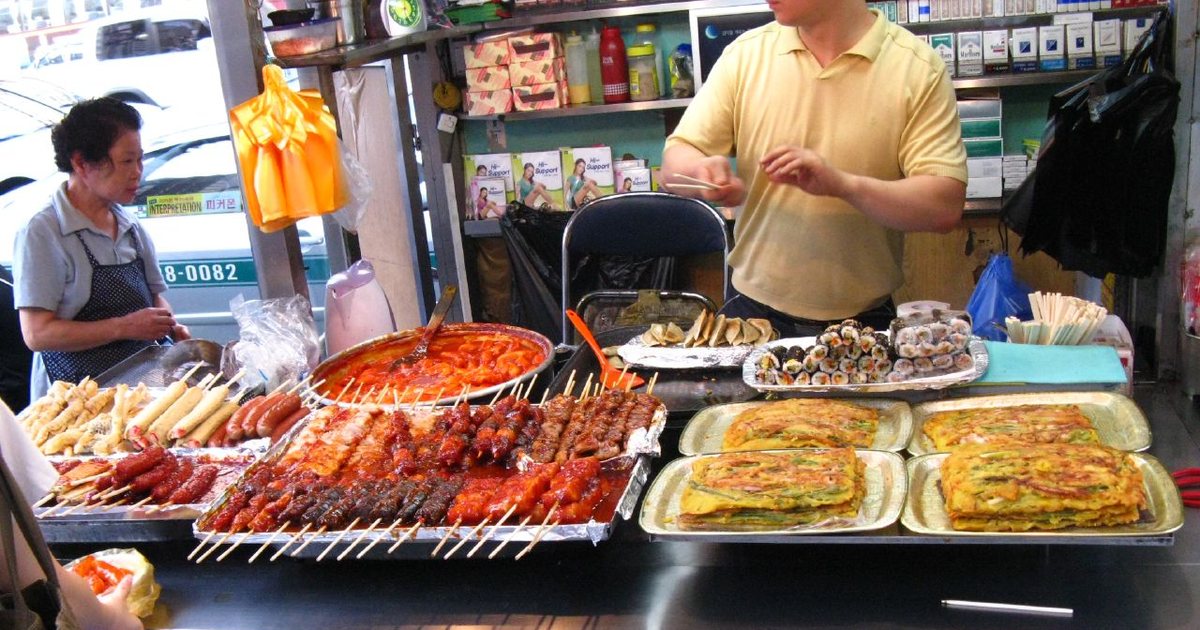
A classic Korean street food counter is two steel trays side by side. One holds a wide pan of tteokbokki bubbling in thick red sauce. The other holds odeng skewers standing in a long trough of broth. Stalls sell them as a pair because each one fixes what the other lacks.
How spicy is street tteokbokki?
Street tteokbokki is sweeter than most foreigners expect, and the heat builds. The sauce is gochujang, gochugaru (Korean chili flakes), sugar and stock, cooked down until it clings to the rice cakes. You’ll often find a few triangles of fish cake, a boiled egg or green onion in the pan too.
The whole pan is made in one batch, so you can’t really order it milder. If heat worries you, ask for a small portion and a cup of odeng broth, which is how Koreans handle it as well.
How odeng works at a stall
Odeng comes from the Japanese word oden. Eomuk is the standard Korean term, and you’ll see both on signs. Pick a skewer from the broth, dip it in the soy sauce if there’s a pot of it out, and eat it at the counter. Keep the empty stick. Many stalls count your sticks at the end to work out what you owe.
The broth is usually ladled into a paper cup, or there’s a self-serve ladle. On a cold night it’s the best part of the order.
What else sits on the same counter
Most stalls that sell tteokbokki also sell twigim (튀김, fried snacks such as squid, sweet potato, dumplings and gimmari, which is seaweed rolled around glass noodles) and sundae (순대, Korean blood sausage stuffed with glass noodles, served with salt or a dipping sauce). Order all three and you’ve got the combo Koreans call tteok-twi-sun (떡튀순). Ask the vendor to spoon tteokbokki sauce over your twigim. It’s normal, and it’s the best way to eat it.
Hotteok, bungeoppang and gyeran-ppang: Korea’s winter street sweets
When the weather turns cold, a second wave of Korean street food comes out: small carts with griddles and cast-iron molds. These three are the sweets of that season. Many vendors set up only in the colder months, and Koreans pass stall locations around on community map apps once they appear.
Hotteok (호떡): mind the syrup
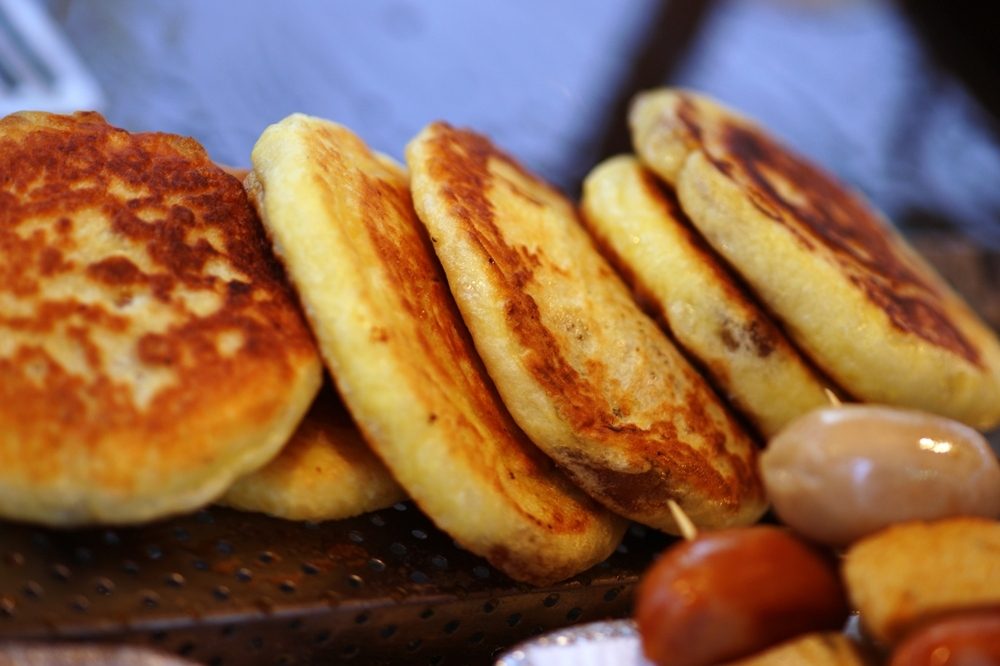
The vendor presses a ball of dough flat on an oiled griddle, and the brown sugar filling melts into syrup as it cooks. The usual result is a crisp-edged pancake you get in a folded paper cup. Busan has its own version, ssiat hotteok (씨앗호떡), which is split open and packed with sunflower and pumpkin seeds. It’s linked to the Nampo-dong area near BIFF Square.
Take a small first bite and wait. The syrup inside stays very hot well after the outside feels fine to hold, and it’s the most common burn first-timers get.
Bungeoppang (붕어빵): red bean or custard
Bungeo means crucian carp, the fish the mold is shaped like. There’s no fish inside. The classic filling is pat (팥), sweetened red bean paste. Many carts also sell a custard version called shu-cream.
Get the red bean if you want what Koreans picture as winter, or the custard if bean paste isn’t your thing. Whether to bite off the head or the tail first is a running joke in Korea, so either is fine.
Gyeran-ppang (계란빵): the breakfast-like one
This is a soft, lightly sweet loaf with a whole egg baked on top, and the yolk sets as it cooks. It’s the most filling of the three and the least sugary, so it works if you want something warm in the morning or late afternoon. If you’re planning a cold-weather trip, our guide to things to do in Seoul in winter shows how to fit these stalls into a day out.
Tornado potato, corn dogs and Myeongdong’s newer snacks
The second kind of Korean street food is newer, built to be photographed and always changing. Myeongdong, the shopping district in central Seoul, is where it’s most concentrated. Stalls along the main shopping lanes roll out in the late afternoon and stay through the evening.
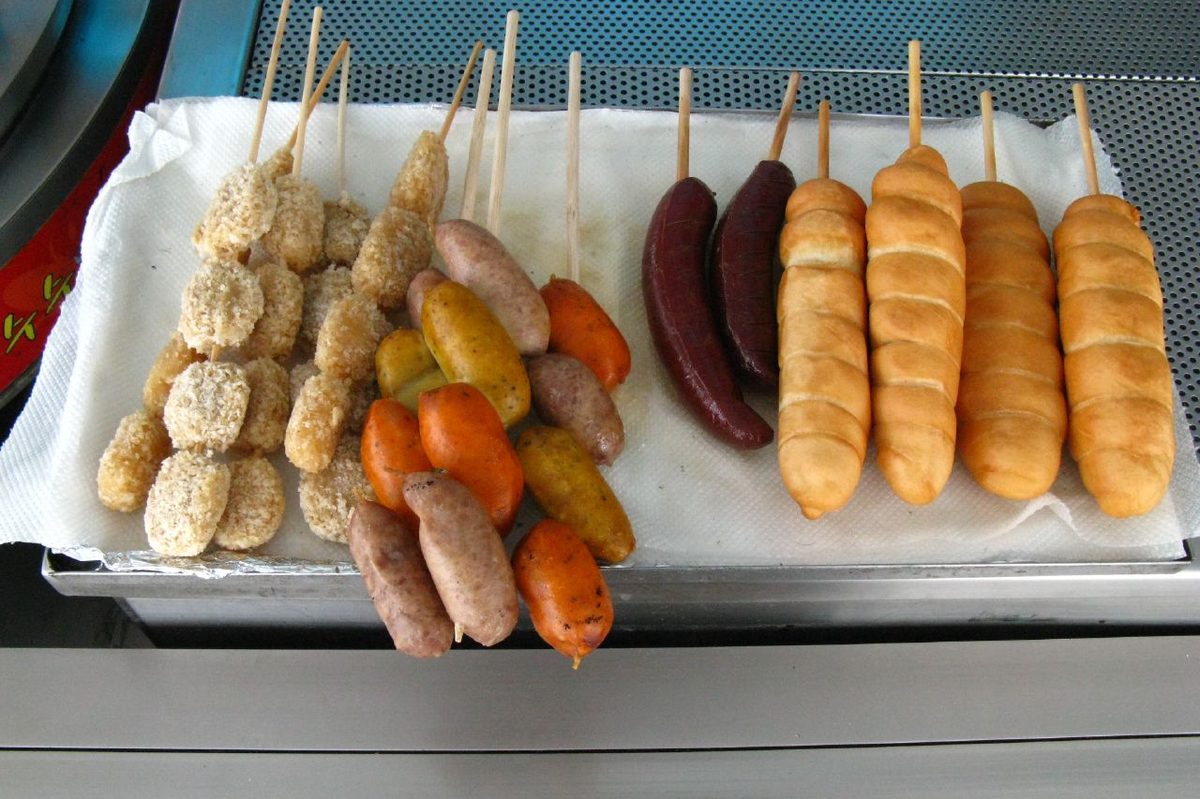
- Tornado potato (회오리감자): one potato cut into a long spiral, fried on its skewer and dusted with seasoning such as cheese or onion powder. It’s easy to share and easy to eat while walking.
- Korean corn dog (핫도그, hatdogeu): a sausage, mozzarella or both, coated in batter and sometimes potato cubes, fried and rolled in sugar, then finished with ketchup and mustard. It’s sweeter and heavier than an American corn dog.
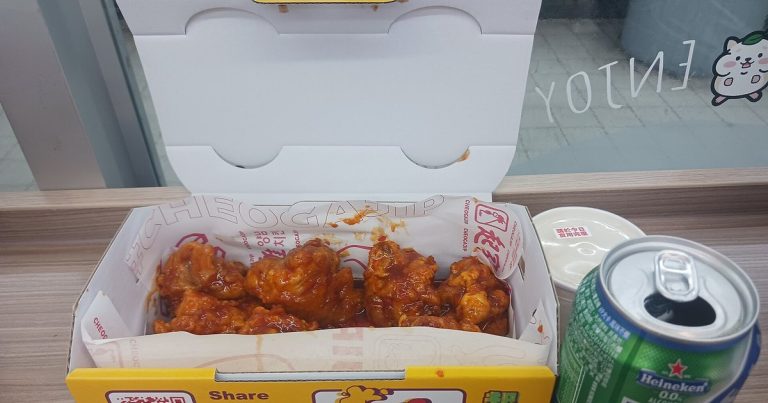
- Dakkochi (닭꼬치): grilled chicken skewers brushed with a soy or spicy glaze. It’s the most filling savory option on the strip.
- Tteok-kkochi (떡꼬치): rice cakes on a stick, fried and coated in a sweet chili glaze. Think of it as tteokbokki you can walk with.
Expect to pay more in Myeongdong than at a neighborhood stall, and expect the lineup to keep changing. Go for the atmosphere and one or two snacks you can’t get elsewhere. Do your serious eating at a market.
Where to find Korean street food in Seoul and Busan
Each area is good at something different. This table matches places to what they do best, so you don’t spend a whole evening in the wrong one.
| Place | Best for | Nearest station | Feel |
|---|---|---|---|
| Gwangjang Market (광장시장) | Bindaetteok, mayak gimbap, yukhoe (seasoned raw beef), kalguksu (knife-cut noodles) | Jongno 5-ga (Line 1) | Old covered market, sit at the counters |
| Myeongdong (명동) | Tornado potato, corn dogs, trend snacks | Myeongdong (Line 4) | Crowded evening street stalls |
| Namdaemun Market (남대문시장) | Yachae hotteok (fried hotteok with glass noodles and vegetables), market snacks | Hoehyeon (Line 4) | Big wholesale market, daytime |
| Tongin Market (통인시장) | Gireum tteokbokki (stir-fried “oil” tteokbokki), build-your-own lunch box | Gyeongbokgung (Line 3) | Small neighborhood market near the palace |
| Mangwon Market (망원시장) | Local-style snacks, croquettes, fried chicken | Mangwon (Line 6) | Where residents actually shop |
| Busan: BIFF Square and Bupyeong Kkangtong Market | Ssiat hotteok, night market stalls | Jagalchi (Busan Line 1) | Port-city street food hub |
Gwangjang Market: the one to prioritize
Gwangjang is one of Seoul’s oldest traditional markets. Its food alley is a grid of stalls where you sit on a bench at the counter. Watch the mung bean being ground for bindaetteok, then order it crisp from the griddle. Mayak gimbap (마약김밥) are small rice-and-seaweed rolls served with a mustard-soy dip. The name translates as “drug gimbap” and is a joke about how addictive they are.
- Area
- Jongno, central Seoul
- Nearest station
- Jongno 5-ga (Line 1)
- Time needed
- 1 to 2 hours
- Before you go
- check opening days and fees on the official page
Myeongdong: go in the evening, eat light
Myeongdong is easy to reach and full of variety, and it fits well around cosmetics shopping. Walk the stalls first, choose two snacks, and save room for dinner elsewhere. If this is your first trip, our Seoul 3-day itinerary for first-timers fits both Gwangjang and Myeongdong into a realistic route.
- Area
- Jung-gu, central Seoul
- Nearest station
- Myeongdong (Line 4)
- Time needed
- 1 hour for food, longer with shopping
- Before you go
- check opening days and fees on the official page
Seasonal Korean street food: what shows up when
What’s on the street depends a lot on the weather, and that surprises many visitors. A December trip and a July trip will taste noticeably different.
Winter: the best season for street snacks
Cold weather brings out the most stalls. On top of hotteok, bungeoppang and gyeran-ppang, look for gun-goguma (군고구마, sweet potatoes roasted in a drum oven) and gunbam (군밤, roasted chestnuts), often sold in paper bags from the same cart. Odeng stalls get busy because the broth doubles as a hand warmer.
Spring and autumn: festival food
Festivals and outdoor events in the milder months bring tornado potatoes, dakkochi and grilled skewers in long rows of temporary stalls. This is also when you’re most likely to see beondegi (번데기, steamed silkworm pupae) sold by the cup. It’s an old-school snack with a strong earthy smell, and many Koreans don’t eat it either.
Summer: fewer stalls, more cold food indoors
On hot days the griddle carts thin out, and people move indoors for bingsu (빙수, shaved ice dessert) at cafés and naengmyeon (cold noodles) at restaurants. Tteokbokki, gimbap and corn dogs stay available all year, so summer visitors can still try the basics.
How to order Korean street food without speaking Korean
Ordering at a stall takes about four moves, and you can do every one of them by pointing. Here’s the usual sequence:
- Look before you queue. Most stalls show everything they sell in the trays, and many post a price board.
- Point and ask. Say “igeo juseyo” and hold up fingers for how many.
- Choose here or to go. Eat at the counter, or say “pojang” for takeaway. Tteokbokki to go usually comes in a lidded container or a plastic-lined bag.
- Pay and return what you used. Hand back odeng sticks and broth cups, or put them where the vendor shows you.
| English | Korean | Romanization | When to use it |
|---|---|---|---|
| This one, please (polite) | 이거 주세요 | igeo juseyo | Pointing at any snack |
| One, please (polite) | 하나 주세요 | hana juseyo | Ordering a single item; dul (둘) is two, set (셋) is three |
| How much is it? (polite) | 얼마예요? | eolmayeyo? | Before or after ordering |
| Do you take cards? (polite) | 카드 돼요? | kadeu dwaeyo? | Before you order, at smaller carts |
| To go, please (polite) | 포장해 주세요 | pojanghae juseyo | Takeaway |
| Not spicy, please (polite) | 안 맵게 해 주세요 | an maepge hae juseyo | At stalls that cook to order (pan tteokbokki usually can’t change) |
| Thank you (polite) | 감사합니다 | gamsahamnida | Leaving |
Counting comes up all the time at stalls. Our guide to native and Sino-Korean numbers explains why you say hana for one snack but il for the first day of the month.
Common Korean street food mistakes to avoid
Most of these are about timing and etiquette, not the food.
- Only eating in Myeongdong. It’s convenient, but it’s the trendiest and most tourist-focused option. Add at least one traditional market to see what Koreans eat there.
- Throwing away your odeng sticks early. At stalls that count sticks, the vendor needs them to work out your bill.
- Biting straight into hotteok. The sugar syrup is far hotter than the pancake around it. Open it slightly and let it cool for a minute.
- Asking for changes to a shared pan. Tteokbokki is cooked in bulk, so asking for a mild batch usually gets a polite no. Pick odeng or twigim instead.
- Arriving on a closing day. Traditional markets and individual stalls set their own rest days. Check the market’s official page or the Visit Seoul tourism site before you go.
- Walking into a crowded market lane while eating. In tight market alleys, Koreans usually finish at the counter. Save eating on the move for wider streets.
How to make street-style tteokbokki (떡볶이) at home
- 300 g cylinder rice cakes (garae-tteok or tteokbokki-tteok)
- 2 sheets Korean fish cake (eomuk), cut into triangles
- 2 cups water or anchovy-kelp stock
- 2 tbsp gochujang
- 1 tbsp gochugaru (Korean chili flakes)
- 1 tbsp sugar
- 1 tbsp soy sauce
- 2 green onions, cut into 5 cm lengths
- 2 boiled eggs, peeled
- If the rice cakes are frozen or hard, soak them in warm water for 10 minutes and separate any that are stuck together.
- In a wide pan, stir the water or stock with the gochujang, gochugaru, sugar and soy sauce, and bring it to a boil.
- Add the rice cakes and simmer on medium heat for 8 to 10 minutes, stirring often so they don’t stick, until they’re soft and the sauce starts to thicken.
- Add the fish cake and boiled eggs and cook for 3 more minutes, spooning sauce over the eggs.
- Stir in the green onion, cook for 1 minute, and stop when the sauce coats a spoon. Serve hot.
Substitutions if you live outside Korea
Korean grocers such as H Mart, and most larger Asian supermarkets, sell rice cakes in the fridge or freezer, along with gochujang, gochugaru and frozen fish cake. Without fish cake, the dish still works with only eggs and green onion. If you can’t get gochugaru, use more gochujang and leave out the flakes rather than swapping in cayenne, which is much hotter and lacks the sweetness. For a vegetarian version, use kelp-only stock and add cabbage and mushrooms in place of fish cake. For more home cooking, see our Korean food guide with 10 dishes to cook.
FAQ
What is the most popular Korean street food?
Tteokbokki is the most common answer and the snack you’ll see at nearly every stall. Odeng comes a close second because it’s sold right next to it. In winter, bungeoppang and hotteok are just as easy to find.
Is Korean street food spicy?
Some is, and a lot isn’t. Tteokbokki, tteok-kkochi and some dakkochi glazes are spicy. Odeng, hotteok, bungeoppang, gyeran-ppang, tornado potato and roasted sweet potatoes aren’t. With spice-sensitive travelers, the usual approach is odeng broth on the side and a small portion of anything red.
Is Korean street food vegetarian-friendly?
Partly. Hotteok, bungeoppang, gyeran-ppang, gun-goguma and tornado potato usually have no meat or fish. Tteokbokki is often cooked with anchovy stock and fish cake, and odeng is fish by definition, so ask or skip those. If you have allergies, remember that fish, wheat, egg and nuts turn up in many snacks.
Do Korean street food stalls take credit cards?
Many market stalls and street vendors take cards and mobile payment now, especially in tourist areas. The small seasonal carts are the most likely to want cash. Carry some small won notes so you never miss a snack because of how you pay.
Which is better for street food, Gwangjang Market or Myeongdong?
Pick Gwangjang Market if you want traditional Korean food, a seat at a counter and dishes like bindaetteok and mayak gimbap. Pick Myeongdong for newer snacks in the evening alongside shopping. With time for both, go to Gwangjang for an early dinner and Myeongdong for dessert.
What time do street food stalls open in Seoul?
It depends on the place. Market food alleys mostly work daytime into the evening, Myeongdong’s stalls fill the streets from late afternoon, and seasonal carts keep their own hours. Opening times and rest days change, so check the market’s official page or the Visit Seoul tourism site before you set out.
What to eat next: plan your first Korean street food night
Here’s a simple first evening that covers both kinds of Korean street food. Get to Gwangjang Market in the late afternoon. Share a plate of bindaetteok and a portion of mayak gimbap at the counter, then take Line 1 and Line 4 to Myeongdong. Once the stalls are set up, split a tornado potato and a cheese corn dog. On the way back to the subway, find a hotteok or bungeoppang cart and end on something warm and sweet.
The next day, try a neighborhood market such as Mangwon or Tongin to see what Koreans eat on an ordinary afternoon. If fried food is what you’re after, our guide to Korean fried chicken and how to order it explains the double-fry method behind Korea’s other famous crunch.
Related reading
Sources k-korea.blog
Prices, opening hours and availability change. Check the official page before you buy or travel.