13 min read
The 12 Korean desserts to know start with bingsu (shaved ice) and hotteok (filled pancakes). Add fish-shaped bungeoppang, honey-soaked yakgwa, chewy tteok (rice cakes) and dalgona candy, and you have most of what Koreans eat after a meal, at a street stall or in a cafe. If you’re coming from the US, expect less sugar and a lot more chew than you’re used to, plus beans, grains and seeds where you’d usually find chocolate.
Key takeaways
- Bingsu comes as one big bowl for the table. Order one for two people, not one each.
- Hotteok, bungeoppang and hoppang are cold-weather foods. Most street stalls and convenience-store steamers only show up once autumn turns chilly.
- Fresh tteok goes hard in the fridge. Eat it the day you buy it, or freeze it and thaw it at room temperature.
- Hotteok is the easiest one to make at home: 6 pantry ingredients and about an hour for the dough to rise.
12 Korean desserts at a glance
You can sort Korean sweets into three groups: street snacks you eat standing up, traditional desserts tied to holidays and rituals, and modern cafe desserts. The table shows where each one fits, so you can plan around the season you’re traveling in.
| Dessert | Hangul | What it is | Type | Best season | Where to find it |
|---|---|---|---|---|---|
| Bingsu / patbingsu | 빙수 / 팥빙수 | Shaved milk ice with red beans, fruit or rice cake | Modern (with older roots) | Summer, but served all year | Dessert cafes, bingsu chains, hotel lounges |
| Hotteok | 호떡 | Pan-fried yeasted pancake with a brown-sugar, cinnamon and nut filling | Street food | Autumn and winter | Street stalls, traditional markets |
| Bungeoppang | 붕어빵 | Fish-shaped waffle-like cake with red bean or custard | Street food | Winter | Street carts near subway exits and schools |
| Gyeranppang | 계란빵 | Sweet little loaf baked with a whole egg on top | Street food | Winter | Street carts, markets |
| Hoppang | 호빵 | Steamed bun with red bean (or savory) filling | Packaged snack | Winter | Convenience-store steamers, supermarkets |
| Hodu-gwaja | 호두과자 | Walnut-shaped mini cakes with red bean and walnut | Regional snack | All year | Highway rest stops, train stations |
| Yakgwa | 약과 | Fried honey-and-sesame-oil cookie soaked in syrup | Traditional | Holidays, all year | Tteok shops, supermarkets, modern bakeries |
| Injeolmi | 인절미 | Pounded sticky rice cake rolled in roasted soybean powder | Traditional | All year | Tteok shops, markets |
| Songpyeon | 송편 | Half-moon rice cake with sesame, honey or bean filling | Traditional | Chuseok (autumn harvest holiday) | Tteok shops |
| Yakbap | 약밥 | Sweet sticky rice with jujubes, chestnuts and pine nuts | Traditional | Holidays, all year | Tteok shops, supermarkets |
| Dalgona | 달고나 | Brittle honeycomb candy stamped with a shape | Retro street candy | All year | Tourist streets, DIY kits |
| Sikhye / sujeonggwa | 식혜 / 수정과 | Sweet rice punch / cinnamon-ginger punch | Traditional drinks | All year, served cold | Restaurants, jjimjilbang, convenience stores (canned) |
Bingsu (빙수): Korea’s shaved-ice dessert, explained
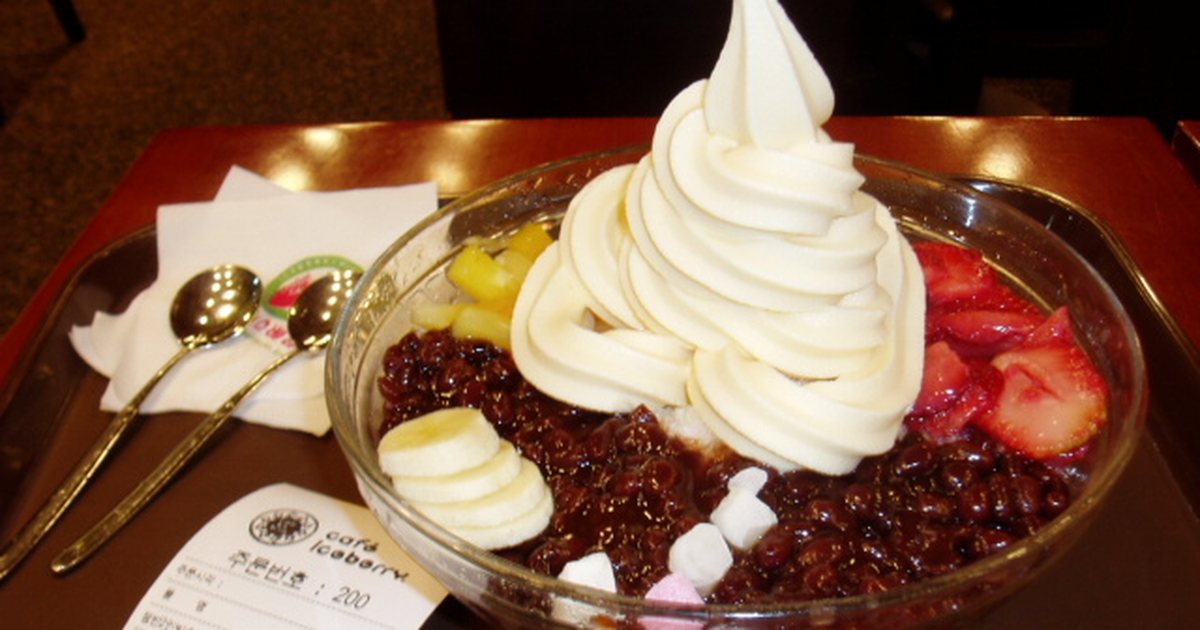
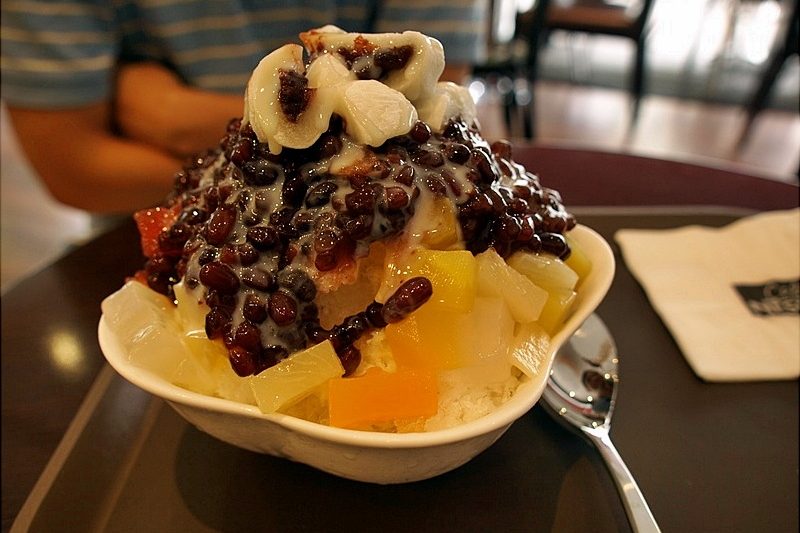
Bingsu is a mound of shaved ice piled into a wide bowl and loaded with toppings. The modern version you’ll find in Korean cafes uses frozen milk (sometimes sweetened) shaved so finely it’s called nunkkot bingsu (눈꽃빙수, “snowflake bingsu”). The texture lands somewhere between fresh snow and soft-serve, closer to a cloud than to a snow cone.
The classic is patbingsu, built on pat (팥), sweet stewed red beans. A typical bowl adds small cubes of tteok, a drizzle of condensed milk and sometimes a dusting of misutgaru (미숫가루, a roasted multi-grain powder that tastes a bit like toasted cereal).
Which bingsu should you order first?
- Injeolmi bingsu: covered in roasted soybean powder and rice cake. Nutty and only mildly sweet, which makes it the best introduction if you don’t like very sugary desserts. Sulbing, a Korean dessert-cafe chain, made this style famous.
- Patbingsu: the traditional choice. Try it if you like red bean in Japanese or Chinese sweets.
- Mango or strawberry bingsu: fruit-heavy and seasonal. Luxury hotels in Seoul serve a mango bingsu that sells out every summer. Prices change each year, so check the hotel’s official dining page.
How Koreans eat bingsu
Everyone shares one bowl, each with their own spoon. Before digging in, most people mix the toppings into the ice so every spoonful gets beans, ice and milk together. Bowls are big, so two people usually split one and three may add a second. Eat fast: milk ice melts much quicker than you’d think in a warm cafe.
Winter street sweets: hotteok, bungeoppang, gyeranppang and hoppang
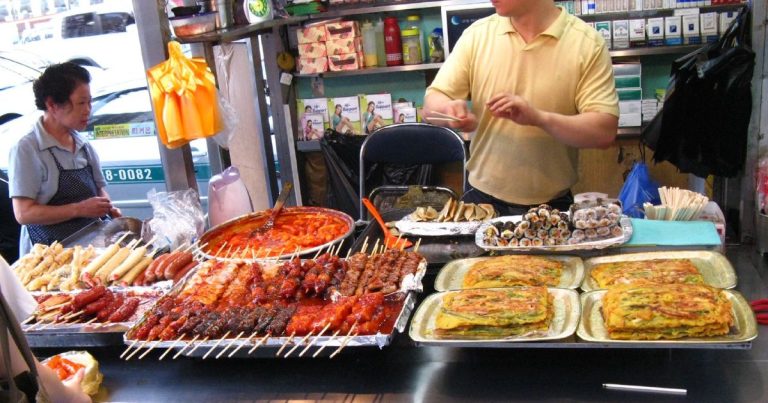
When the temperature drops in Korea, street carts start selling warm sweets near subway exits, schools and market entrances. Most are cheap enough to pay for with small bills, so carry cash. Some vendors take cards or bank transfers, but many don’t (our guide to how to pay in Korea as a foreigner explains how to handle it).
Hotteok (호떡)
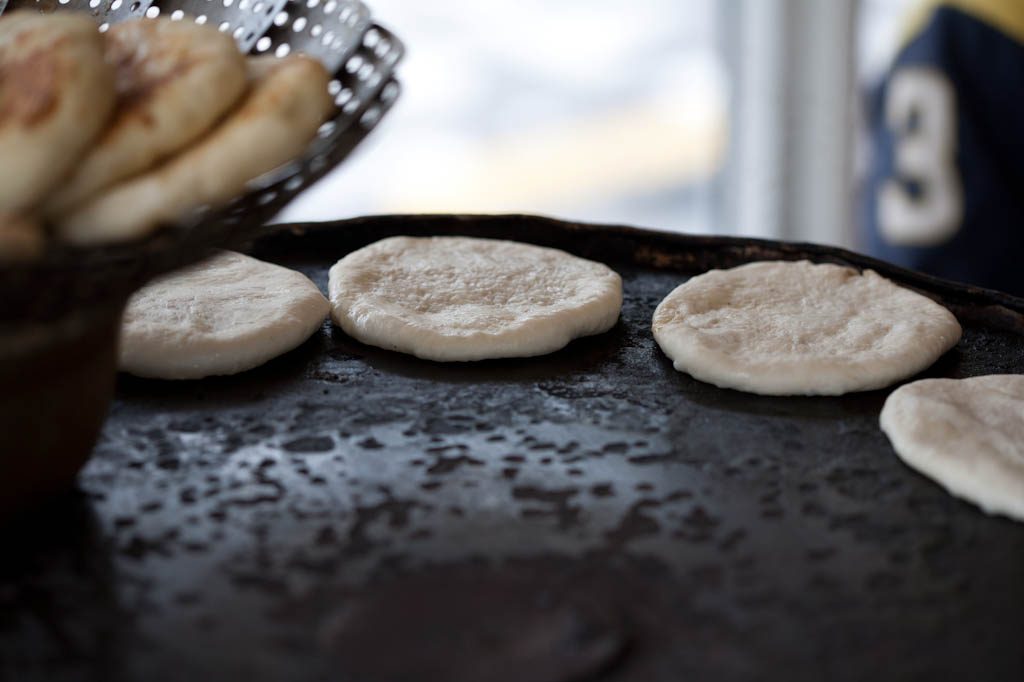
Hotteok is a ball of yeasted dough stuffed with brown sugar, cinnamon and chopped nuts, then pressed flat on an oiled griddle. The sugar melts into a molten syrup inside a crisp, chewy shell. It’s widely traced to Chinese merchants who settled in Korea in the late 19th century, and the name keeps that history: ho (호) was an old word for foreigners from the north.
Busan has its own version, ssiat hotteok (씨앗호떡, “seed hotteok”), which is split open after frying and stuffed with sunflower and pumpkin seeds. Stalls near BIFF Square in Nampo-dong are the best-known place to try it.
Bungeoppang (붕어빵)
Bungeoppang means “carp bread”: a crisp, fish-shaped cake cooked in an iron mold and filled with red bean paste or, more and more often, custard (shu-cream, 슈크림). It’s a cousin of Japanese taiyaki, which came to Korea during the colonial period. Koreans really do argue about whether you should eat it head first or tail first. There’s no right answer, but the tail is crunchier.
A bigger, thicker variant called ingeoppang (잉어빵, “carp bread” using a different carp word) has a thinner, crisper batter and more filling. Most visitors can’t tell them apart, and either one is worth buying.
Gyeranppang (계란빵)
Gyeranppang is a small oval loaf of sweet, slightly salty batter baked with a whole egg cracked on top. It eats like breakfast and dessert at once, which is why office workers buy it on the way to the subway in winter.
Hoppang (호빵)
Hoppang is a soft steamed bun, the Korean take on Chinese baozi. The sweet version holds red bean paste, and savory ones come with vegetable, pizza or curry fillings. You’ll rarely see it at a stall. Look for the glass steamer cabinet on the counter of convenience stores like GS25 and CU from late autumn. Supermarkets sell boxes you can microwave at home.
Hodu-gwaja (호두과자)
These walnut-shaped mini cakes are a specialty of Cheonan, south of Seoul, and a classic road-trip snack at highway rest stops and train stations. Each one holds red bean paste and a piece of walnut. They aren’t seasonal, so they’re your best bet for a warm street-style sweet in summer.
Traditional Korean desserts: yakgwa, tteok and hangwa
Before refined sugar was common, Korean sweets relied on honey, jocheong (조청, a thick rice syrup), grains, nuts and dried fruit. These desserts are called hangwa (한과, traditional confections) and tteok (떡, rice cakes). They show up at holidays, at jesa (제사, ancestral memorial rites), at weddings and as gifts. These are the four to look for.
Yakgwa (약과)
Yakgwa is a dense cookie of wheat flour, sesame oil and honey, deep-fried and then soaked in syrup, often with ginger. Yak (약) means medicine, because honey was once valued as medicinal. The result is chewy, sticky and very sweet, with a flaky layered texture in good versions. In recent years young Koreans have rediscovered it as part of the halmaenial trend (할매니얼, from halmae, “grandma”, plus “millennial”), and bakeries now put yakgwa on cookies, cakes and even bingsu.
Injeolmi (인절미)
Injeolmi is glutinous rice that has been steamed and pounded until stretchy, cut into small blocks and rolled in konggaru (콩가루, roasted soybean powder). It’s soft, chewy and nutty rather than sugary. If you’ve eaten Japanese mochi, you’ll recognize the texture right away.
Songpyeon (송편)
Songpyeon are half-moon rice cakes filled with sesame seeds and honey, sweetened beans or chestnut, then steamed on a bed of pine needles. Families make them together for Chuseok, the autumn harvest holiday. Rice cakes play the same role at the Lunar New Year, when the dish is savory tteokguk, a rice cake soup (see our Seollal guide).
Yakbap (약밥)
Yakbap is sticky rice steamed with brown sugar or honey, sesame oil, a little soy sauce, jujubes (Korean red dates), chestnuts and pine nuts. It’s dark brown and glossy, and the mix of sweet and savory surprises most first-timers. Supermarkets and tteok shops sell individually wrapped squares.
Sikhye and sujeonggwa: the dessert drinks
Korean meals often end with a cold, sweet drink instead of a plated dessert. Sikhye (식혜) is a rice punch made by fermenting cooked rice with malted barley, and you’ll see grains of rice floating in it. Sujeonggwa (수정과) is a cinnamon and ginger punch, often served with a dried persimmon or pine nuts. Sikhye comes with the territory in a jjimjilbang (Korean bathhouse), and both come in cans at convenience stores.
Dalgona (달고나): the honeycomb candy from Squid Game
Dalgona is melted sugar mixed with a pinch of baking soda, which foams it into a light, brittle honeycomb. Vendors pour it into a flat disc and stamp a shape into it: a star, circle, triangle or umbrella. The schoolyard game, also called ppopgi (뽑기), was to carve out the shape with a needle without breaking it. Get it right and you won a free candy.
The candy was a staple of Korean childhoods in the 1970s and 1980s and went global in 2021, when Netflix’s Squid Game turned the shape-cutting challenge into one of its deadliest games. You’ll now find dalgona stalls on tourist streets like Insadong and Myeongdong, and DIY kits online. It’s mostly about the game and the nostalgia. The flavor is simply burnt sugar.
Don’t confuse it with dalgona coffee, the whipped instant-coffee drink that went viral during the 2020 lockdowns. It got the name because its foam tastes a little like the candy.
Korean cafe culture: where the modern desserts live
Seoul has an enormous number of independent cafes, and many of them are really dessert destinations that also serve coffee. Groups of friends often go out for a meal and then go “2-cha” (2차, second round) to a cafe for cake and drinks, the way some people abroad head to a bar.
Modern Korean desserts to look for
- Croffles: croissant dough pressed in a waffle iron, a cafe staple since the early 2020s.
- Ttungcarons (뚱카롱, “fat macarons”): macarons stuffed with a filling thicker than the shells.
- Lettering cakes: small minimalist cakes with a hand-piped message, made to order for birthdays.
- Rice-cake cafe desserts: injeolmi toast, yakgwa cookies and tteok in modern shapes.
How Korean dessert cafes work
Many cafes now take orders at a self-service kiosk, and most kiosks have an English option. A common house rule is one drink per person. Sharing a single latte among three people while you camp at a table is considered rude. Cafes in Seongsu-dong and Ikseon-dong (a neighborhood of converted hanok, traditional Korean houses) lean hard into design, so expect queues on weekends. Our guide to where to shop in Seoul covers both areas if you want to combine dessert with shopping.
Traditional vs modern: how Korean sweets differ from Western ones
If your first bite of tteok or patbingsu feels underwhelming, it’s probably because you were expecting American levels of sugar. These are the differences worth knowing before you order.
- Texture comes first. Koreans prize jjolgit (쫄깃, chewy and springy). Rice cakes, the dough of hotteok and the edges of bungeoppang all aim for it.
- Beans and grains do the work of chocolate. Red bean, roasted soybean, black sesame and misutgaru supply the deep, toasty flavors.
- “Not too sweet” is a compliment. You’ll hear Koreans praise a dessert by saying an dalaseo joa (안 달아서 좋아, “it’s good because it’s not sweet”).
- Seasons matter. Iced desserts in summer, steamed and griddled ones in winter, and specific rice cakes for specific holidays.
Yakgwa and hotteok are the exceptions, since both are properly sweet. If you have a strong sweet tooth, start with those. If you prefer subtle flavors, start with injeolmi bingsu or plain injeolmi.
Where to try Korean desserts in Seoul and abroad
In Seoul
- Traditional markets like Gwangjang Market and Namdaemun Market have hotteok stalls and rice cake vendors in one place.
- Nagwon-dong rice cake street, near Jongno 3-ga Station, has a cluster of long-running tteok shops. Go in the morning, when the rice cakes are freshest.
- Insadong has traditional teahouses that serve sujeonggwa, yakgwa and other hangwa with tea, plus dalgona and hotteok on the street outside.
- Myeongdong street-food stalls set up in the evening and sell most of the winter sweets in a single walk.
- Convenience stores sell hoppang in winter, canned sikhye, and the ice-cream versions of classics, like Binggrae’s Samanco, a fish-shaped ice-cream sandwich modeled on bungeoppang.
Opening days and hours change, especially for markets and small shops, so check each venue’s official page or a map app before you go.
Outside Korea
In the US, Canada, the UK and Australia, the easiest starting point is a Korean supermarket such as H Mart. The freezer aisle usually has frozen tteok, bungeoppang-style snacks and hoppang. Korean bakery chains Paris Baguette and Tous les Jours have overseas branches that carry some Korean-style cakes and bingsu, depending on the store. Boxed hotteok mix (Beksul, a CJ brand, is common) comes with a filling packet and is the shortcut version of the recipe below.
How to make hotteok (호떡) at home
- 1 1/2 cups (about 190 g) all-purpose flour
- 2 tbsp glutinous (sweet) rice flour, optional, for extra chew
- 1 tsp instant yeast
- 1 tbsp white sugar
- 1/2 tsp salt
- 2/3 cup lukewarm milk or water
- 1 tbsp neutral oil, plus about 3 tbsp for frying
- 1/2 cup packed dark brown sugar (filling)
- 1 tsp ground cinnamon (filling)
- 3 tbsp finely chopped walnuts, peanuts or mixed seeds (filling)
- In a bowl, mix the flours, yeast, white sugar and salt. Add the lukewarm milk and 1 tbsp oil and stir into a soft, sticky dough. Knead it in the bowl with an oiled hand for 1 to 2 minutes.
- Cover the bowl and leave it somewhere warm for about 1 hour, until the dough has roughly doubled.
- Meanwhile, mix the brown sugar, cinnamon and chopped nuts in a small bowl.
- Oil your hands, punch the dough down and divide it into 6 pieces. Flatten one piece in your palm, add a heaped tablespoon of filling, and pinch the edges together to seal. Set it seam side down. Repeat.
- Heat 1 tbsp oil in a skillet over medium-low heat. Add 2 or 3 balls seam side down and cook for about 1 minute, until the bottom is golden.
- Flip each one and press it flat to about 1 cm thick with an oiled spatula or the bottom of a cup. Cook 2 to 3 minutes per side, until both sides are deep golden and the sugar inside has melted.
- Let the hotteok rest for 2 minutes before eating. The filling is molten.
Substitutions if you can’t find Korean ingredients
- Glutinous rice flour: sold as “sweet rice flour” (Mochiko is a widely available brand in the US). Skip it entirely and your hotteok will be a little less chewy but still good.
- Dark brown sugar: muscovado works well. Light brown sugar works but tastes milder.
- Nuts: pecans, sunflower seeds or pumpkin seeds all work. Pumpkin and sunflower seeds get you close to Busan’s ssiat hotteok.
- Nut-free: leave the nuts out and add a pinch more cinnamon. The filling will be runnier, so seal the dough carefully.
Common mistakes: the pan is too hot (the outside burns before the sugar melts), there’s too much filling (it leaks and scorches), and the dough is too dry. Hotteok dough should feel stickier than bread dough.
FAQ
What is the most popular Korean dessert?
Bingsu is the dessert most visitors seek out, and cafes serve it all year. In winter, hotteok and bungeoppang from street carts are what Koreans actually buy most often on the go. For holidays and gifts, rice cakes and yakgwa are the traditional choice.
What is the difference between bingsu and shaved ice?
American shaved ice is usually water ice soaked in flavored syrup. Modern Korean bingsu is shaved from frozen milk into fine, fluffy flakes, then topped with red beans, fruit, rice cake or powders instead of syrup. It’s creamier and less sweet.
Are Korean desserts very sweet?
Most are less sweet than American desserts, especially tteok, injeolmi and patbingsu. Yakgwa and hotteok are the sweet exceptions. Koreans often praise a dessert by saying it isn’t too sweet.
Is tteok the same as mochi?
They’re close relatives. Both are made from rice and many types share the same chewy texture, but tteok is a broader category that includes steamed, pounded and savory rice cakes, like the cylinder-shaped garaetteok used in soup and tteokbokki.
Do Korean desserts contain common allergens?
Often, yes. Hotteok and many hangwa contain nuts or seeds, bingsu usually contains milk, and bakery items contain wheat and eggs. If you have an allergy, ask the vendor or check the package label, and learn the Korean words for your allergens before you travel.
When is bungeoppang season in Korea?
Bungeoppang carts usually appear when the weather turns cold in late autumn and disappear in spring. Timing depends on each vendor and the weather, so there’s no fixed date. Frozen versions are sold year-round in supermarkets.
What to try next: a Korean dessert plan for your trip or your kitchen
Visiting in summer? Make injeolmi bingsu your first stop, then a traditional teahouse in Insadong for sujeonggwa and yakgwa. In winter, walk a market like Gwangjang with cash in your pocket and work through hotteok, bungeoppang and gyeranppang in one afternoon.
At home, make the hotteok recipe above this weekend, then look in the freezer aisle at your nearest Korean supermarket for frozen tteok and hoppang. If you’re timing a trip around food, Chuseok is the time for songpyeon and the Lunar New Year brings rice cakes of every kind. Check the holiday dates for your travel year before you book, since both follow the lunar calendar.
Related reading

Sources k-korea.blog
Prices, opening hours and availability change. Check the official page before you buy or travel.